
Key takeaways
- A marketing funnel should be structured around customer decisions and revenue milestones, not a generic awareness-to-purchase diagram.
- Every stage needs one clear commercial job, an appropriate message and a measurable next action.
- Acquisition, conversion and retention must operate as one system. Optimising only the top of funnel can create expensive growth with weak margins.
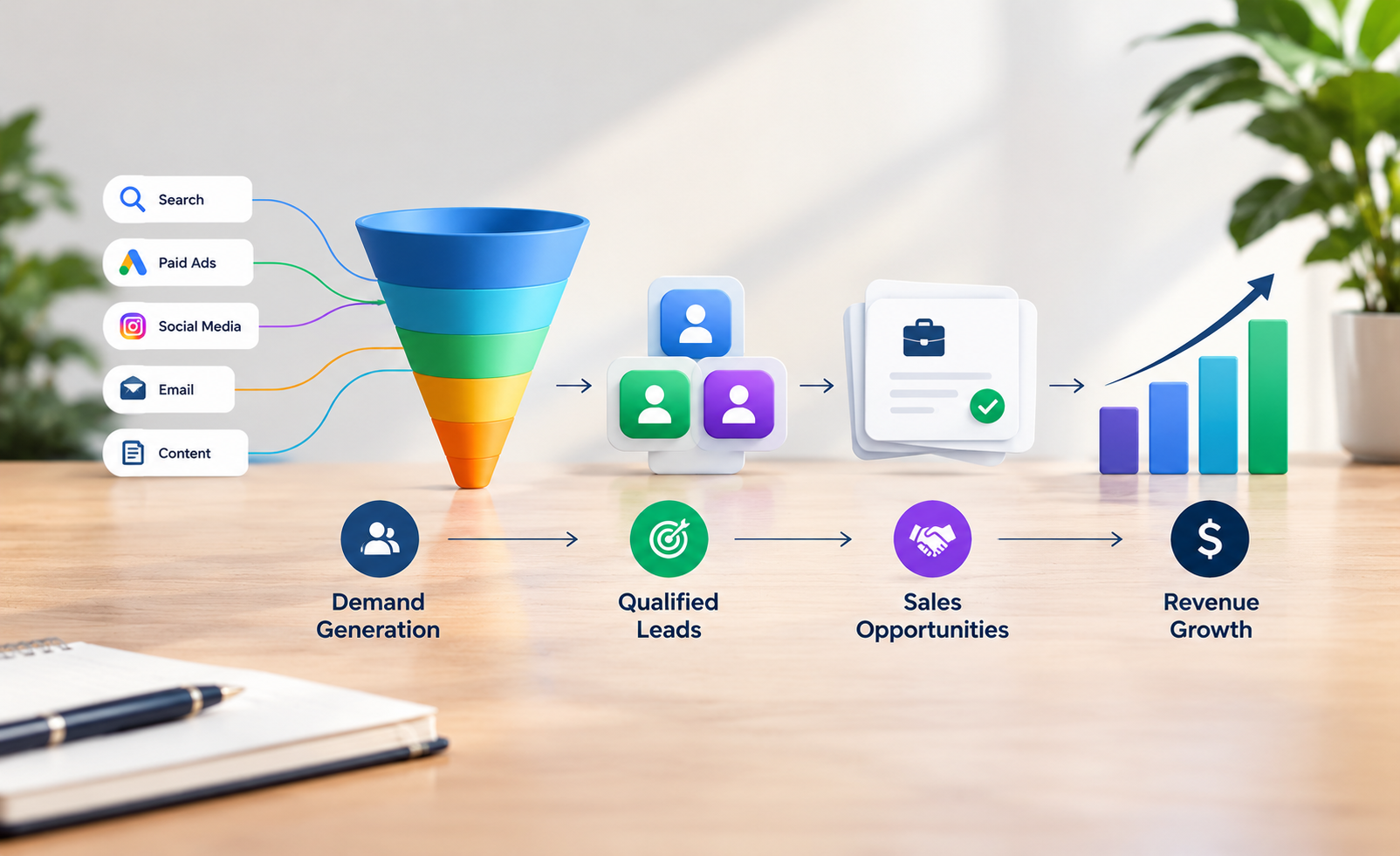
Most funnel underperformance is not a channel problem. It is a structural problem: paid media is asked to convert cold audiences, product pages are doing the work of sales teams, or CRM is treated as an afterthought. Knowing how to structure marketing funnels means designing a connected system that moves prospective customers from uncertainty to a confident commercial decision.
For Australian businesses, the right structure depends on buying cycle, average order value, purchase frequency and the level of consideration involved. A $49 skincare purchase, a $2,000 home-services quote and a $100,000 B2B software contract should not follow the same path. The common principle is simple: each stage must reduce a specific barrier to revenue.
Start with the economics, not the channels
Before mapping ads, emails or landing pages, define what a viable customer is worth. Your funnel has to support the relationship between customer acquisition cost, gross margin, conversion rate and lifetime value. Without these guardrails, teams can report strong lead volume or cheap clicks while the business loses money on every acquired customer.
Set the primary revenue outcome first. For eCommerce, that may be a first purchase at an acceptable contribution margin, followed by a second order within 90 days. For lead generation, it may be a qualified opportunity that reaches proposal stage, not a form completion. B2B businesses should also account for sales acceptance rates, deal velocity and close rates.
Give each funnel stage a commercial job
A useful funnel is not defined by labels alone. It is defined by the customer’s decision and the evidence required to proceed.
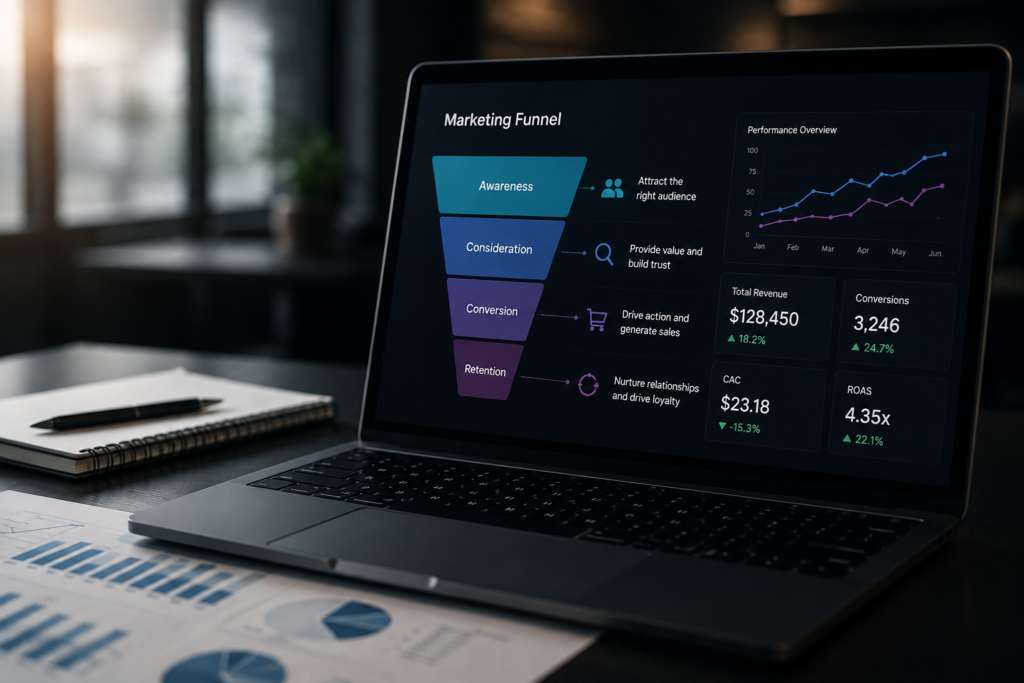
| Funnel stage | Customer decision | Business job | Useful primary measure |
|---|---|---|---|
| Demand creation | Is this problem worth solving? | Create relevance and category understanding | Qualified reach, engaged visits, branded search growth |
| Demand capture | Which option best fits my need? | Turn active intent into a meaningful visit or enquiry | Landing page engagement, cost per qualified lead |
| Conversion | Can I trust this business to deliver? | Remove friction and make the next step easy | Purchase rate, lead-to-opportunity rate |
| Retention | Was this the right choice? | Create repeat revenue and advocacy | Repeat purchase rate, churn, customer lifetime value |
The labels can change, but the logic should not. If a metric does not show whether the business job is being completed, it belongs in a secondary dashboard rather than at the centre of decision-making.
Map intent before creating campaigns
Channel planning often starts with available budget: a share for Google Ads, a share for Meta, perhaps some SEO and email. That approach creates activity, but not necessarily a funnel. Start instead with the questions buyers ask at different levels of intent.
At low intent, customers may be recognising a problem or looking for inspiration. Content, video, social proof and broader audience targeting can build familiarity here. At high intent, they are comparing providers, searching for pricing, reading reviews or checking delivery terms. Search, shopping campaigns, comparison pages, case studies and sales enablement are usually more valuable at this point.
Build distinct paths for different buyers
One business can need more than one funnel. A returning customer searching for a specific product should not receive the same message as a first-time visitor learning about the category. Likewise, an owner researching a major capital purchase needs different proof than a practitioner seeking a quick operational fix.
Segment paths by behaviour and commercial value, not by broad demographics alone. A practical split might include first-time visitors, high-intent product viewers, cart abandoners, existing customers and lapsed customers. Each group has a different reason for hesitating, which means each needs a different message.
This is where many retargeting programmes fail. Repeating the same ad to every visitor is not funnel design. A person who viewed a product page may need delivery reassurance or a product comparison. Someone who abandoned a quote request may need proof of outcomes, clearer pricing context or a faster way to speak with an expert.
Design the conversion path around friction
The conversion stage is where strategy meets user experience. Once a customer is ready to act, every unnecessary field, vague claim and missing detail creates avoidable leakage. Baymard Institute’s aggregated 2024 benchmark put average online cart abandonment at 70.19 per cent. Not every abandoned cart is recoverable, but the figure shows why checkout and product-page decisions deserve commercial attention.
For eCommerce, prioritise product availability, delivery cost and timing, returns, payment options, reviews and clear product information. For lead generation, prioritise the relevance of the offer, a credible value exchange, form length, response expectations and what happens immediately after submission.
A strong conversion path answers four questions quickly: what am I getting, why should I believe you, what will it cost or require, and what happens next? If the page cannot answer these questions without forcing users to hunt, paid traffic will become increasingly expensive.
Do not assume fewer steps always wins. Reducing a B2B enquiry form from ten fields to three may lift submission volume but lower lead quality. The right trade-off depends on sales capacity, deal value and the cost of qualifying poor-fit leads. Test for qualified revenue, not just conversion rate.
Connect measurement to the customer journey
Funnels become manageable when teams can see where progression stops. That requires a measurement plan built around meaningful events. Track the actions that signal movement: product view, pricing-page view, lead submission, sales-qualified lead, checkout start, purchase, repeat purchase and cancellation where relevant.
Separate diagnostic metrics from success metrics
Success metrics show whether the funnel is creating profitable growth. These include revenue, qualified pipeline, customer acquisition cost, contribution margin and lifetime value. Diagnostic metrics help explain why performance moved. They include click-through rate, landing-page engagement, form completion and add-to-cart rate.
Both matter, but they should not carry equal weight. A campaign with a lower click-through rate can still be commercially superior if it attracts higher-value customers. Conversely, an impressive cost per lead means little when sales rejects most enquiries.
Attribution should also reflect reality. Last-click reporting is useful for operational decisions, but it systematically overvalues channels closest to conversion. Review platform data alongside CRM outcomes, blended acquisition cost, cohort retention and trends in branded search. The aim is not perfect attribution, which rarely exists, but better investment decisions.
Run the funnel as an operating system
A funnel is not a one-off diagram delivered in a strategy workshop. It needs a regular operating rhythm. Review performance weekly for urgent issues, monthly for channel and conversion decisions, and quarterly for deeper shifts in customer behaviour, economics and positioning.
Use this four-part review to keep work focused:
- Identify the largest revenue constraint, rather than optimising the loudest metric.
- Form a testable hypothesis about the customer barrier causing it.
- Change one meaningful variable, such as offer, proof point, audience, landing page or follow-up sequence.
- Measure the impact on qualified progression and revenue before scaling the change.
For example, if high-intent search traffic converts poorly, do not immediately increase bids. Check search-query relevance, landing-page message match, price visibility, mobile speed, product availability and sales follow-up. The bottleneck may sit well beyond the ad account.
How to structure marketing funnels for scale
The most effective marketing funnels become more precise as the business grows. Early-stage brands may need a simple path from demand capture to conversion, because resources are limited and intent already exists. Mature brands often need a broader demand-creation layer, stronger lifecycle marketing and more advanced segmentation to protect efficiency as paid acquisition costs rise.
Keep the system simple enough to manage, but rigorous enough to expose weak links. If every channel, page and automation has a defined role in progressing a customer towards profitable revenue, marketing stops being a collection of tactics. It becomes a measurable growth engine built to move revenue.