
A product page can attract thousands of qualified visits and still underperform because shoppers cannot find the right variant, hesitate at checkout or simply lose confidence. The best ecommerce conversion tools make those points of friction visible, then give teams a practical way to remove them. They are not a substitute for a clear offer, competitive pricing or reliable fulfilment. They are the operating system for improving what happens between the first click and completed revenue.
For Australian retailers, the right stack is rarely the largest one. It is the combination that produces trustworthy insight, supports controlled experimentation and connects directly to commercial decisions.
Key takeaways
- Start with measurement and behavioural evidence before buying testing or personalisation software.
- Choose tools around a specific conversion problem: discovery, confidence, checkout friction or customer recovery.
- Treat A/B testing as a decision system, not a button for changing colours and headlines.
- Protect site speed, consent compliance and data quality. A bloated stack can reduce the conversion rate it was meant to improve.
What makes a conversion tool worth the investment?
A useful conversion tool should answer one of three questions: where are shoppers dropping out, why are they dropping out, and which change will improve the outcome? If it cannot influence a decision, it is reporting software rather than a conversion lever.
Evaluate each platform against four practical criteria: implementation effort, data quality, impact on page performance and whether your team will act on the findings. Enterprise platforms can be justified for high-traffic retailers with complex catalogues. For a growing Shopify store, a lighter tool that is properly configured will usually move revenue faster.
Baymard Institute’s ongoing checkout research consistently shows that avoidable checkout design issues remain widespread. That is the commercial case for prioritising fundamentals before sophisticated personalisation. Fixing form friction, delivery uncertainty and mobile usability can outperform a costly recommendation engine.
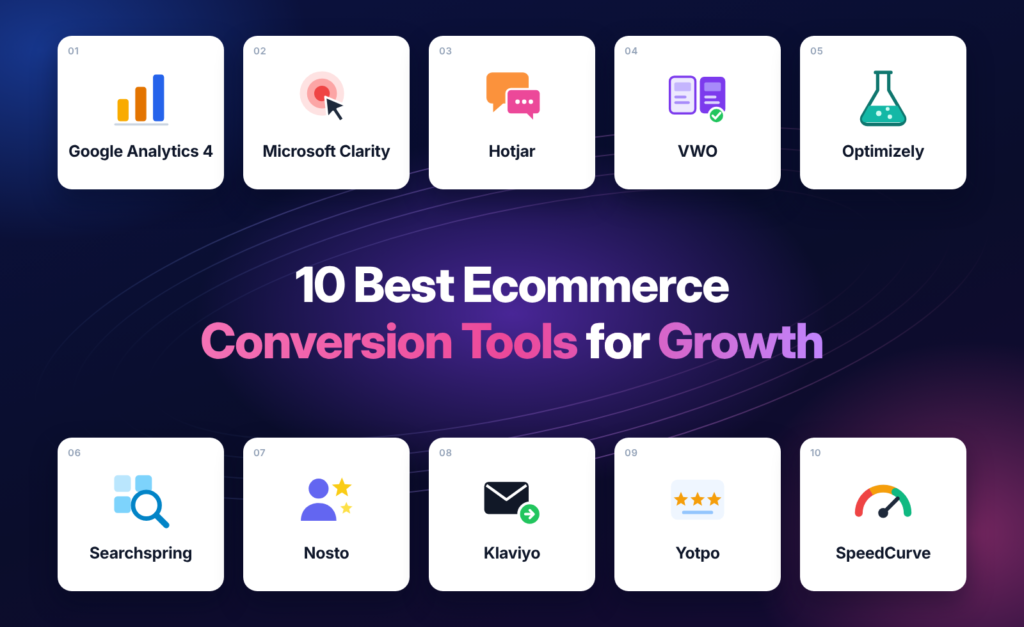
The 10 best ecommerce conversion tools
1. Google Analytics 4 for conversion measurement
GA4 is the measurement foundation. It helps retailers map the path from acquisition channel to product view, add to cart, checkout and purchase. Set up ecommerce events properly, reconcile revenue with the platform where practical, and segment results by device, channel, new versus returning customer and product category.
Its limitation is diagnostic depth. GA4 will show that mobile checkout abandonment is high, but it will not show precisely where a shopper got stuck. Pair it with behavioural analysis rather than expecting it to answer every question.
2. Microsoft Clarity for friction discovery
Microsoft Clarity provides session recordings, heatmaps and rage-click indicators at no licence cost. It is particularly useful for spotting broken interactions, confusing navigation and mobile layouts that require too much scrolling.
Use recordings as qualitative evidence, not proof. Ten frustrated sessions can identify a hypothesis, but they cannot tell you how much revenue a fix will generate. Confirm the pattern against GA4 volumes and then test the change.
3. Hotjar for targeted customer feedback
Hotjar combines behavioural observation with on-page surveys and feedback widgets. This makes it valuable when the question is not merely what customers did, but why. A short exit survey on a high-traffic category page can expose issues such as limited size availability, unclear delivery timing or price objections.
The trade-off is that surveys can interrupt the experience and self-selected responses are biased. Keep questions specific and deploy them only where a genuine decision needs evidence.
4. VWO for structured A/B testing
VWO is a strong option for teams that need experimentation, behavioural analysis and testing governance in one environment. Its value is not the ability to test endlessly. It is the discipline of setting a primary metric, defining guardrail metrics and documenting what the result means.
For example, a retailer might test simplified product-page delivery messaging against the current layout. The primary metric could be add-to-cart rate, while average order value and checkout completion act as guardrails. A result that lifts adds to cart but reduces purchase completion is not a win.
5. Optimizely for mature experimentation programmes
Optimizely is designed for larger organisations running frequent, controlled experiments across web and digital products. It suits teams with meaningful traffic, technical support and a backlog of high-value hypotheses.
It is not the sensible first purchase for every retailer. Without enough conversion volume, results take too long to become reliable. In that scenario, invest in analytics, user research and obvious usability fixes first.
6. Searchspring for product discovery
On-site search visitors often carry stronger purchase intent than browsers, which makes search quality a conversion issue rather than a navigation detail. Searchspring helps retailers improve search relevance, merchandising rules, autocomplete and filtering.
This matters most for large catalogues, fashion, beauty, parts and multi-brand stores. Monitor zero-result searches, search exits and refinement behaviour. Those reports often reveal demand gaps and language customers use that your product data does not yet reflect.
7. Nosto for merchandising and personalisation
Nosto supports product recommendations, segmentation and personalised merchandising. It can help when a catalogue is broad enough that customers need guidance towards complementary, higher-margin or more relevant products.
Personalisation works best when it earns its place. A ‘recently viewed’ module may be useful; irrelevant recommendations beneath every product can add clutter and slow the page. Measure incremental revenue against a control group, not just clicks on the widget.
8. Klaviyo for browse and cart recovery
Klaviyo turns customer behaviour into timely email and SMS automation. Browse abandonment, cart recovery, replenishment reminders and post-purchase flows can recover demand that would otherwise disappear.
The conversion opportunity depends on permission, message relevance and timing. Australian retailers also need to manage consent carefully and ensure communications comply with the Spam Act 2003. A sequence that is too aggressive may lift short-term sales while increasing unsubscribes and damaging lifetime value.
9. Yotpo for reviews and customer confidence
Reviews, ratings and customer photos reduce uncertainty, especially for products where fit, quality or real-world performance matter. Yotpo gives retailers tools to collect and display social proof across product pages and lifecycle communications.
Authenticity matters more than a perfect score. Displaying useful reviews, including reasonable critical feedback, can build more confidence than suppressing anything below five stars. Focus on review coverage for best-selling and high-consideration products before chasing volume everywhere.
10. SpeedCurve for performance monitoring
Site speed is a conversion variable, especially on mobile networks. SpeedCurve tracks real-user performance and helps teams see how third-party scripts, images and releases affect the experience over time.
This is the tool that keeps the rest of the stack honest. Heatmaps, chat widgets, pop-ups and recommendation modules can each be defensible in isolation. Together, they can create a slow, distracting storefront. Use performance budgets and remove scripts that do not demonstrate commercial value.
How to choose the right ecommerce conversion stack
Build around the constraint that is limiting revenue now. If reporting is unreliable, begin with GA4. If mobile users add products but do not purchase, use Clarity or Hotjar to identify friction and prioritise checkout fixes. If product discovery is weak across a large catalogue, invest in search and merchandising. If the store has stable traffic and a capable team, introduce structured testing.
A practical sequence is measurement, diagnosis, prioritisation, experimentation and monitoring. This avoids the common mistake of adding personalisation before the site can reliably measure whether it helped.
Use a simple prioritisation formula for your backlog:
Estimated annual revenue impact = affected sessions × expected conversion-rate lift × average order value
It is an estimate, not a forecast. Its job is to force commercial thinking. A checkout fix affecting 100,000 sessions may deserve attention ahead of a clever homepage test with limited reach.
Make tools part of a conversion system
The most effective ecommerce teams do not collect tools. They run a repeatable cadence: inspect data, review qualitative evidence, form a hypothesis, launch a controlled change and decide what happens next. Record both wins and losses. A failed test that disproves a costly assumption still improves decision-making.
For a wider strategy, conversion rate optimisation should connect to acquisition quality, landing-page intent, product economics and customer retention. Traffic that never had purchase intent cannot be repaired by another pop-up. Likewise, a conversion lift that creates low-value, high-return orders is not measurable success.
The right tool is the one that helps your team make the next revenue decision with greater confidence – then proves whether that decision worked.