



What a content marketing strategy actually does
Content marketing is the deliberate use of useful information to create demand, capture existing demand and move prospects towards a commercial action. That action may be a quote request, trial, consultation, product purchase, email subscription or return visit.
A strategy is not a list of article topics. It is a decision system that answers four questions: which customers matter most, what information they need before buying, where they look for it, and how content will contribute to revenue.
For a Melbourne manufacturer, that might mean technical specification pages and project case studies that reduce procurement risk. For an eCommerce skincare brand, it may mean ingredient explainers, routine builders and comparison content that raises conversion rate and repeat purchase. The format changes. The job does not.
| Strategy component | Commercial question | Practical output |
|---|---|---|
| Audience and demand research | What are profitable customers trying to solve? | Search themes, customer interviews, sales-call insights |
| Positioning | Why should they trust this business over alternatives? | Point of view, proof points, expert commentary |
| Content architecture | Which assets answer each stage of the decision? | Pillar pages, guides, comparisons, case studies |
| Distribution | How will the right people find and revisit it? | Organic search, email, paid amplification, sales enablement |
| Measurement | Did it create commercial progress? | Lead quality, assisted revenue, conversion and retention data |
Start with demand, not keywords
Keyword research remains useful, but it is only one input. Search volume tells you that a phrase is searched. It does not tell you whether the query belongs to a high-value customer, whether the searcher is ready to buy, or whether your business can credibly answer it.
Build a demand map by combining search data with first-party evidence. Review sales calls, support tickets, on-site search, CRM notes, reviews and objections that appear late in the buying process. These are often more valuable than broad informational keywords because they reveal friction that prevents revenue.
For example, a B2B software provider may see substantial traffic from “what is workflow automation”. That can be worthwhile awareness content. Yet “workflow automation software for construction companies” may have lower volume and much stronger commercial intent. The second topic should usually receive more subject-matter expertise, conversion design and distribution budget.
Segment topics by decision stage
A simple three-stage model prevents teams from over-investing in top-of-funnel traffic.
Awareness content helps buyers understand a problem or category. Consideration content compares approaches, explains costs, addresses implementation and clarifies trade-offs. Decision content provides product comparisons, case studies, technical details, pricing guidance, migration plans and proof.
Most brands have too much awareness content because it is easy to commission and appears impressive in traffic reports. The gap is often consideration and decision content, where customer anxiety is highest and generic advice is least useful.
Build for Australian context, not a generic English-speaking market
A strong content marketing strategy in Australia reflects the realities buyers face locally. Prices should be in Australian dollars where appropriate. Claims must account for Australian consumer law, industry rules and delivery conditions. Examples should reflect how Australians actually buy, whether that means state-based service availability, regional logistics, GST, local climate conditions or procurement cycles.
Language matters too. A page written for a US audience can sound subtly wrong even when the product is relevant. “Mobile”, “organise”, “pricing”, “quote”, “tradie” and “super” may be the natural terms for a given category. Local relevance is not decorative. It signals that a business understands its customer’s operating environment.
This does not mean every article needs an Australian flag in the opening sentence. It means local evidence appears where it changes the decision. A national insurer should explain state differences where they affect cover. An eCommerce retailer should be clear about shipping zones and returns. A professional services firm should address the regulatory context clients must navigate.
Create an asset system, not a content treadmill
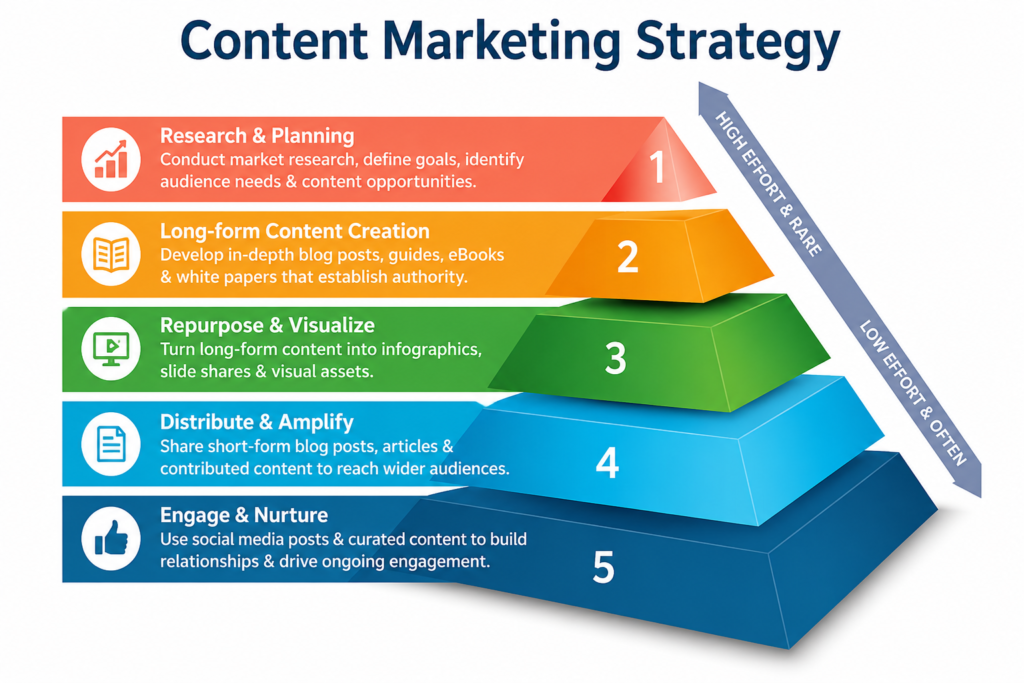
Publishing frequently is only efficient when each asset has a defined role. The better model is to build a small number of high-value pillar assets, then create supporting pieces that answer narrower questions and guide readers towards the next action.
A pillar page might address “how to choose payroll software in Australia”. Supporting assets could examine implementation costs, common migration mistakes, security requirements, payroll compliance questions and comparisons between approaches. Each piece should stand on its own, while reinforcing the central topic.
Prioritise formats that reduce buyer uncertainty. Original research, calculators, templates, decision checklists, expert interviews and case studies can outperform another surface-level explainer because they give prospects something they cannot get from ten interchangeable search results.
AI tools can speed up research synthesis, briefing, content repurposing and quality assurance. They are less reliable as an unsupervised publishing engine. If a competitor can generate the same article in minutes, it is unlikely to become a durable source of trust. The defensible material comes from first-party data, real customer patterns, informed judgement and clear points of view.
A practical prioritisation score
Score prospective content on four factors from one to five: commercial intent, audience fit, ability to win, and reuse potential. Then subtract production complexity where specialist input, legal review or data collection makes the asset expensive.
This does not turn editorial planning into a mathematical certainty. It does create a disciplined way to compare a broad, low-intent trend article with a detailed guide that sales teams can use in live opportunities for the next two years.
Design the conversion path before publishing
Every content asset should have a sensible next step. That does not mean placing an aggressive enquiry form after every paragraph. It means matching the call to action to the reader’s readiness level.
A first-time visitor reading a category explainer may respond to a checklist, benchmark or email series. A buyer reviewing implementation risks may be ready for a consultation, audit or tailored quote. For eCommerce, the next step could be a product finder, sample bundle or relevant collection page.
The page itself must make the business easy to evaluate. Include authorship where expertise matters, dated research where freshness matters, transparent assumptions in calculators and specific proof in case studies. “We helped a client grow” is weak evidence. A clear explanation of the starting point, intervention, timeframe and result is more credible, even when the outcome is not spectacular.
Measure content against business performance
Traffic and rankings are diagnostic metrics, not the finish line. A page can rank first and still fail if it attracts the wrong audience or gives visitors no reason to progress. Conversely, a modest-traffic case study may influence a meaningful pipeline opportunity.
Use CRM data wherever possible. Tag lead sources, record the pages viewed before conversion and ask sales teams which assets prospects mention. Attribution will never be perfect, particularly for longer B2B buying cycles. The aim is not false precision. It is a more honest view of which content creates qualified attention and helps deals progress.
Review the programme quarterly. Update pages that are losing rankings or no longer reflect the market. Consolidate overlapping articles that compete for the same intent. Expand assets that attract qualified visitors but lack a strong next step. Stop producing formats that generate activity without evidence of commercial value.