
Key takeaways
- AI visibility is the likelihood that a brand is mentioned, cited or recommended in AI-generated answers when buyers research a category.
- Rankings still matter, but AI systems select evidence, entities and sources rather than simply returning a list of webpages.
- Brands that publish clear first-party expertise, maintain accurate entity data and measure citations can build a compounding advantage.
A buyer asking an AI assistant for the best project management platform for a 40-person construction business may never see page two of Google. They may receive four suggested options, a comparison, and a short explanation of which one suits their needs. AI visibility for brands determines whether your business is part of that answer, absent from it, or described inaccurately.
This is not a reason to abandon SEO. It is a reason to update what search visibility means. Traditional organic search has rewarded pages that rank for a query. Generative search rewards sources that an AI system can understand, trust and use to construct an answer. The commercial consequence is straightforward: if your category is researched in AI interfaces, visibility needs to be managed before the buyer reaches a branded search or your website.
What AI visibility actually means
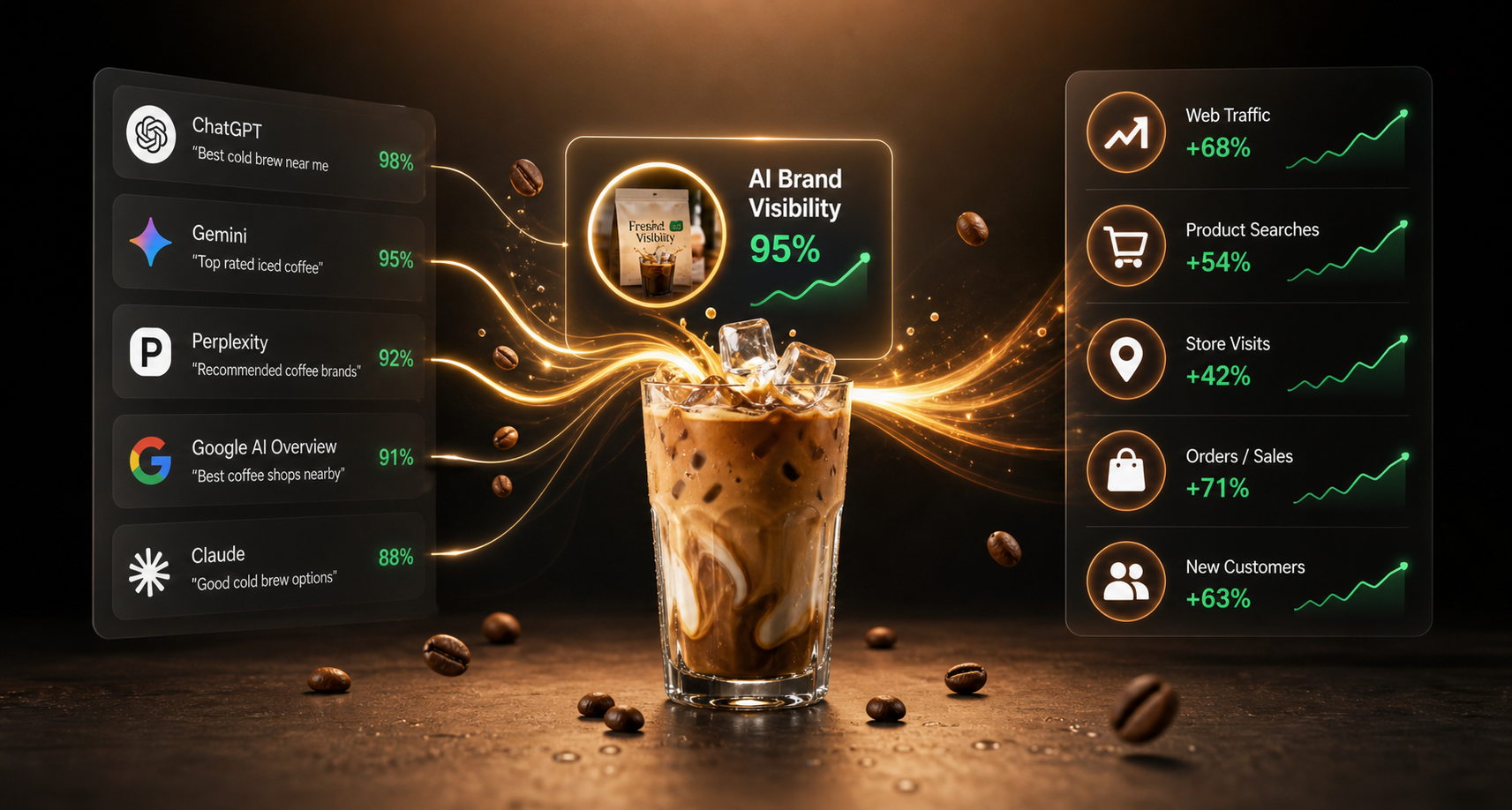
AI visibility is a brand’s presence within answers generated by systems such as Google AI Overviews, ChatGPT, Perplexity, Microsoft Copilot and the AI features increasingly embedded in shopping and productivity tools. It includes direct brand mentions, citations to owned content, inclusion in product comparisons, and accurate descriptions of what the business does.
It is not the same as traffic. A brand can be regularly mentioned in an AI answer without receiving a click. That can still build consideration, but it makes measurement harder and weakens the old assumption that search success is visible only in sessions and rankings.
| Visibility outcome | What it signals | Commercial value |
|---|---|---|
| Brand mention | The system recognises the brand as relevant | Early awareness and category association |
| Citation of owned content | Your page supplied supporting evidence | Authority, referral traffic and lead potential |
| Product recommendation | The brand meets a stated use case | High-intent consideration |
| Accurate comparison | The system understands differentiators and limitations | Better-qualified demand |
| Omission or misinformation | Source signals are weak, incomplete or contradictory | Lost demand and reputational risk |
The distinction matters because AI answers are usually assembled from multiple sources. A strong product page alone may not be enough. The model may use review platforms, publisher coverage, documentation, retailer listings, forums, social conversations and third-party research to decide what it says. Your website remains the source you control, but it is one part of a wider evidence base.
Why AI search changes the visibility equation
AI systems are designed to answer a task, not just match a phrase. A searcher may ask: “Which accounting software is best for an Australian eCommerce business with Shopify and payroll needs?” That single prompt contains industry, geography, platform compatibility, business size and functional requirements. The answer needs synthesis.
That creates an opportunity for specialist brands. A business with specific, well-evidenced relevance can outperform a larger competitor that has broad awareness but vague category information. It also creates risk. Generic copy, thin comparison pages and unsubstantiated claims give systems little useful material to cite.
The impact on click behaviour is already material. A 2025 Pew Research Centre analysis of Google searches found users clicked a traditional result on 8% of visits where an AI summary appeared, compared with 15% where it did not. The study reflects observed browsing behaviour rather than every search category, but the direction is commercially clear: being visible in the answer itself is becoming more valuable.
Google’s AI Overviews, meanwhile, are not shown consistently across all queries. High-stakes, complex, product-led and informational searches can behave differently, and results change by location and device. Australian brands should avoid treating overseas screenshots or a single prompt test as market evidence. Monitor the prompts your actual buyers use in Australia.
How to build AI visibility for brands
Start with decision-stage questions, not vanity keywords
The best AI visibility strategy begins with the questions that move revenue. Map the prompts buyers ask before selecting a supplier, product or platform. Include category discovery, alternatives, implementation concerns, pricing logic, integrations, compliance, suitability and proof.
For a B2B software provider, “best CRM” is too broad to guide action. “Which CRM integrates with Xero and suits a five-person Australian sales team?” is closer to a decision. For an eCommerce brand, useful prompts might cover ingredient comparisons, sizing, delivery expectations, product care and whether a product suits a particular use case.
Group these prompts by intent and business value. Then identify where your brand is mentioned, which competitors appear, what sources are cited and what claims recur. This creates a practical visibility baseline rather than a vague ambition to ‘rank in AI’.
Publish evidence that can be extracted and checked
AI systems need clear source material. That means pages should answer specific questions directly, explain terminology, show eligibility criteria and distinguish facts from marketing claims. Write the way a capable buyer evaluates a decision, not the way a brochure fills space.
Original evidence carries disproportionate weight. Publish product specifications, methodology, pricing assumptions, expert commentary, customer outcomes with appropriate context, research findings and implementation guidance. If a claim is conditional, say so. “Reduces set-up time by 30% for businesses using our standard integration” is more credible and useful than “saves time”.
Keep core facts consistent across the site. Product names, service descriptions, founding details, locations, spokespersons and category language should not change from page to page. Contradictions make it harder for both search engines and users to establish what the business is.
Strengthen the entity, not only the page
An entity is the identifiable thing a search engine or AI system understands: your company, product, founder, location or service. Strong entities have consistent names, defined relationships and corroborating references across trusted sources.
For brands, this means maintaining accurate business profiles, merchant information, social accounts, media mentions and industry listings. Use structured data on relevant pages to communicate products, organisations, articles, reviews and FAQs where the markup accurately reflects visible content. Structured data does not guarantee an AI citation, but it reduces ambiguity.
Do not manufacture authority through low-quality guest posts, copied listicles or review manipulation. AI systems can surface those sources, but poor evidence is a fragile foundation. The goal is corroboration from credible places where your brand genuinely belongs.
Make comparison content genuinely useful
AI assistants are frequently used as comparison engines. This is where many brands make a strategic mistake: they avoid naming alternatives and leave the comparison to publishers, forums and competitors.
Build honest comparison pages when there is real search demand and a defensible perspective. Explain where each option fits, including situations where your offering is not the right choice. State the criteria: price model, integrations, delivery speed, materials, support, scalability or compliance. A balanced comparison improves buyer trust and gives AI systems a clearer basis for matching your brand to the right use case.
The trade-off is obvious. Some readers will choose another option. But hiding limitations does not remove them from AI answers. It simply gives up control of the evidence used to describe them.
A measurement framework that reaches beyond rankings
Track AI visibility at the query level, then connect it to business outcomes. Manual testing is useful for discovery but not sufficient: answers vary by user history, model, location and time. Use a controlled prompt set, document the date and market, and repeat testing regularly. Combine that with search console data, referral data, branded search trends, assisted conversions and sales-call insights.
| Metric | What to measure | Why it matters |
|---|---|---|
| Mention rate | Share of priority prompts that name the brand | Measures presence before the click |
| Citation rate | Share of prompts citing an owned page | Shows whether your content is being used as evidence |
| Sentiment and accuracy | Whether descriptions and claims are correct | Protects positioning and trust |
| Competitor share | Brands repeatedly recommended alongside yours | Reveals the real consideration set |
| Downstream demand | Branded searches, referrals, leads and assisted revenue | Connects visibility to measurable success |
Avoid attributing every lift in branded search to AI. Campaigns, PR, seasonality, retail distribution and paid media can all influence demand. The most useful view is directional: did visibility improve across priority prompts, and did that improvement coincide with stronger qualified demand?
Where brands should be cautious
AI answers can be wrong, stale or overly confident. Regulated categories such as health, finance, law and insurance require tighter review of factual content and claims. So do brands with changing prices, availability or product specifications. Make key information easy to update, timestamp research where relevant, and avoid publishing claims that require ongoing manual correction unless you have a governance process.
There is also a resource question. Not every brand needs dozens of AI-focused pages. If customers buy through retail, marketplaces or distributors, product data quality and third-party listings may matter more than a large editorial programme. If the sales cycle is complex, expert guides and implementation content may have greater leverage. Strategy should follow the buying journey, not the hype cycle.
The brands that win will not chase every new AI interface. They will build a body of credible, structured and commercially useful information that makes them easy to understand and hard to ignore. That work improves search, conversion and sales enablement at the same time – which is exactly where visibility starts to move revenue.