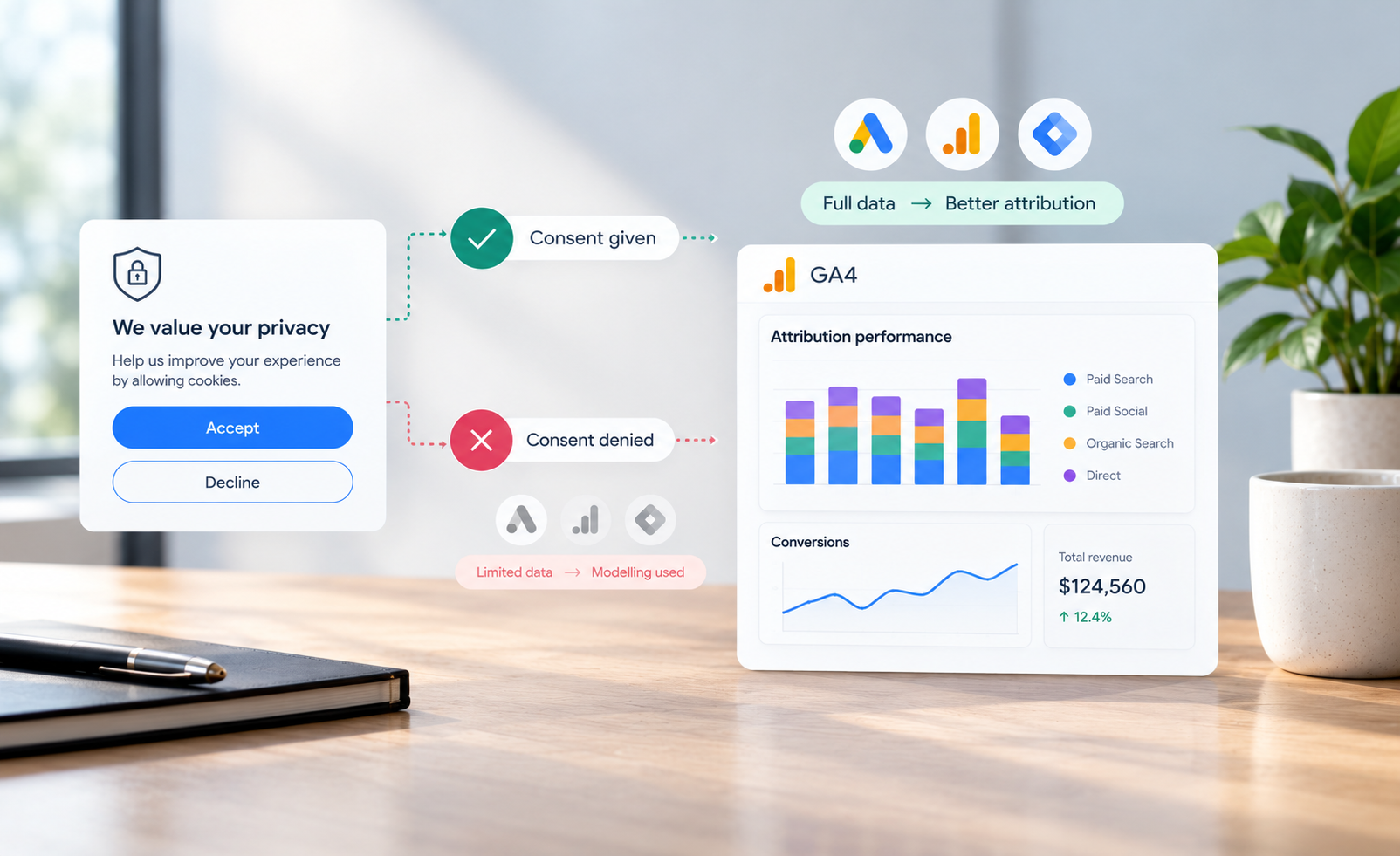

A visitor declines analytics cookies, then buys three days later after returning through a branded search. Without the right measurement setup, that conversion can disappear from your reports entirely. So, how does consent mode work? It gives Google tags instructions on what they can and cannot do based on a person’s consent choices, while allowing limited, privacy-preserving measurement signals to support modelling where consent is denied.
For Australian businesses running Google Ads, GA4 or Floodlight, Consent Mode is not a compliance badge. It is measurement infrastructure. Configured well, it helps protect the integrity of reporting in a consent-led environment. Configured poorly, it can create false confidence, fragmented attribution and decisions built on incomplete data.
Key takeaways
Consent Mode changes Google tag behaviour according to consent status. It does not replace a compliant consent management platform, a privacy policy or legal advice. Its commercial value lies in reducing measurement blind spots, particularly for businesses that rely on paid media optimisation and conversion reporting.
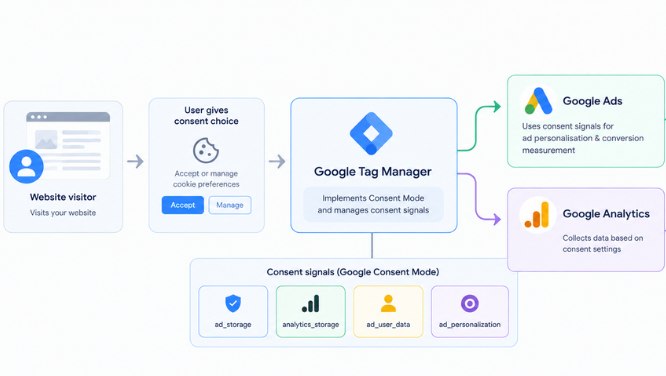
Google’s current framework, commonly called Consent Mode v2, uses four consent signals: `ad_storage`, `analytics_storage`, `ad_user_data` and `ad_personalization`. The first two govern storage and measurement behaviour. The latter two govern whether consented data can be used for advertising purposes such as user data sharing and personalised advertising.
How does consent mode work in practice?
Consent Mode sits between your consent banner and Google’s tracking tags. A consent management platform, or CMP, presents the visitor with a meaningful choice. It then passes their selection to Google Tag Manager, the Google tag, or another tag implementation as a set of consent states.
Before that decision is known, tags should receive a default state. For a consent-first implementation, this will generally be denied for any storage or advertising purpose that requires consent. Once the visitor accepts, rejects or adjusts their preferences, the consent state updates and tags respond accordingly.
If analytics consent is granted, GA4 can set and read analytics cookies as configured. If advertising storage and the relevant advertising signals are granted, Google Ads tags can support remarketing and conversion measurement as usual. When consent is denied, Google tags limit their behaviour and, in advanced implementations, can send cookieless pings containing a small amount of contextual information rather than storing identifiers.
Those pings are not a back door around consent. They are designed to communicate consent state and limited event context without writing or reading advertising or analytics cookies. Google may use aggregated data and machine learning to model some unobserved conversions and behavioural data in eligible reporting products.
The practical distinction matters: a modelled conversion is an estimate, not an identified person. It can improve directional decision-making at scale, but it should not replace first-party customer data or clean transaction records.
The four consent signals that matter
`analytics_storage` controls whether analytics-related storage, such as GA cookies, can be used. `ad_storage` controls storage related to advertising, including remarketing and conversion measurement cookies.
Consent Mode v2 added two signals that are especially relevant to businesses with users in the European Economic Area. `ad_user_data` controls whether personal data can be sent to Google for advertising purposes. In contrast, `ad_personalization` controls whether data can support personalised advertising. For example, A visitor might allow measurement but decline personalised ads. Your setup needs to preserve that distinction rather than treating consent as a single all-or-nothing switch.
Google introduced the additional v2 requirements to support its EU user consent policy. Australian businesses are not automatically exempt simply because they operate locally. If your website attracts, sells to or advertises to people in the EEA, assess your setup against the requirements that apply to those users. The Office of the Australian Information Commissioner’s guidance remains relevant for Australian privacy obligations, but it is separate from Google’s platform requirements and from overseas laws.
Basic versus advanced implementation
Google offers two implementation approaches. The right choice depends on your risk appetite, traffic volume, measurement maturity and legal guidance.
With Basic Consent Mode, Google tags remain blocked until the visitor grants consent. This is simpler to explain and may be more conservative from a privacy perspective. However, when a person declines consent, Google receives no tag data from that session. Reporting will have a larger measurement gap, and conversion modelling has less information to work with.
With Advanced Consent Mode, Google tags load with a denied default and send cookieless pings when consent is denied. If consent is granted, they then operate according to the approved settings. This creates a stronger foundation for Google’s modelling, particularly where a meaningful share of users decline cookies.
Advanced does not mean better by default. It requires more careful configuration, a clear understanding of what fires before consent, and sign-off from the people responsible for privacy and governance. The operational mistake is choosing advanced mode purely to recover reporting, then failing to validate whether the tag behaviour matches the consent experience promised to users.
What Consent Mode can and cannot fix
Consent Mode can improve the quality of Google measurement where consent choices reduce observable data. It can support conversion modelling in Google Ads, behavioural modelling in GA4 where eligibility thresholds are met, and more accurate bidding inputs than a fully blocked implementation may provide.
It cannot repair poor conversion architecture. If purchase events double-fire, leads are not deduplicated, consent updates occur after tags have already fired, or revenue values are missing, Consent Mode will not solve the underlying problem. Server-side tracking can address a different part of the measurement setup by changing where data collection and processing happen. Modelling can amplify a sound measurement design, but it cannot turn unreliable inputs into trustworthy reporting.
It also does not make a website compliant on its own. A banner that nudges visitors towards acceptance, provides no genuine rejection option, or categorises advertising cookies as essential is a consent design problem. Consent Mode merely acts on the signals it receives.
A practical implementation framework
Start by mapping every Google tag and its purpose. Most businesses discover that GA4, Google Ads conversion tags, remarketing, Floodlight, enhanced conversions and third-party pixels have been implemented by different teams over time. You cannot configure meaningful consent controls until you know what is collecting data.
Then define a consent taxonomy that aligns with your CMP. Keep the language user-facing and distinguish essential functions, analytics and advertising where relevant. Map those categories to Google’s four consent signals, with a denied default applied before tags run.
Next, implement through Google Tag Manager or your site’s tag framework. Google Tag Manager’s Consent Overview can help you identify tags not configured to respect consent. Review both built-in consent checks and any additional consent requirements set at tag level. This is where many implementations fail: the Google tag is configured, but a separate advertising pixel is still firing without restriction.
Finally, test the full journey. Use Tag Assistant, browser developer tools and your CMP’s audit records to check what happens when users accept all, reject all, accept analytics only, and change their preferences later. Test on mobile and desktop. Confirm that the default consent command loads before any relevant Google configuration command, because sequencing determines whether data is collected appropriately.
How to judge whether it is working
Do not assess Consent Mode by asking whether GA4 traffic increased. Look for consistency across systems. The more strategic mistake is over-relying on platform-reported marketing attribution. Compare consent rates, tag-firing behaviour, observed conversions, modelled conversions and backend sales over time. Segment by channel, device and geography, because consent behaviour can vary substantially between audiences.
A useful management view separates three numbers: directly observed conversions, modelled conversions and total reported conversions. This prevents teams from treating all reported revenue as equally certain. It also makes changes in consent rate visible when campaign performance appears to shift.
For eCommerce brands, match Google’s reported transactions against the platform or order management system, then investigate material variance. For lead generation, protect lead quality by passing qualified outcomes and offline sales back into advertising platforms where consent and privacy settings allow. The closer optimisation gets to real commercial outcomes, the less reliant you are on a single browser event.
Google’s Consent Mode documentation and GA4 modelling guidance make clear that modelling eligibility and results depend on product-specific thresholds and data quality. No universal uplift figure worth planning a budget around. Treat vendor estimates as inputs to test, not revenue you have already earned.
Common mistakes that weaken measurement
The most common failure is setting consent only after the page has loaded. Another is using a CMP that updates cookie preferences but does not pass those choices into Google tags. Businesses also regularly confuse `ad_storage` with the newer `ad_user_data` and `ad_personalization` signals, leaving their v2 configuration incomplete.
The more strategic mistake is over-relying on platform-reported attribution. Consent Mode can make Google reporting more useful, but CRM outcomes, profit, incrementality testing and channel-level trends should still inform executive decisions.
A useful management view separates three numbers: directly observed conversions, modelled conversions and total reported conversions. Marketing dashboards can make this distinction easier to monitor across channels and reporting periods.
A consent-led measurement strategy asks a harder, more useful question than whether every user can be tracked: what evidence is strong enough to make the next investment decision with confidence? Consent Mode is one part of that answer, provided its implementation is technically sound, transparent to users and measured against real commercial outcomes.