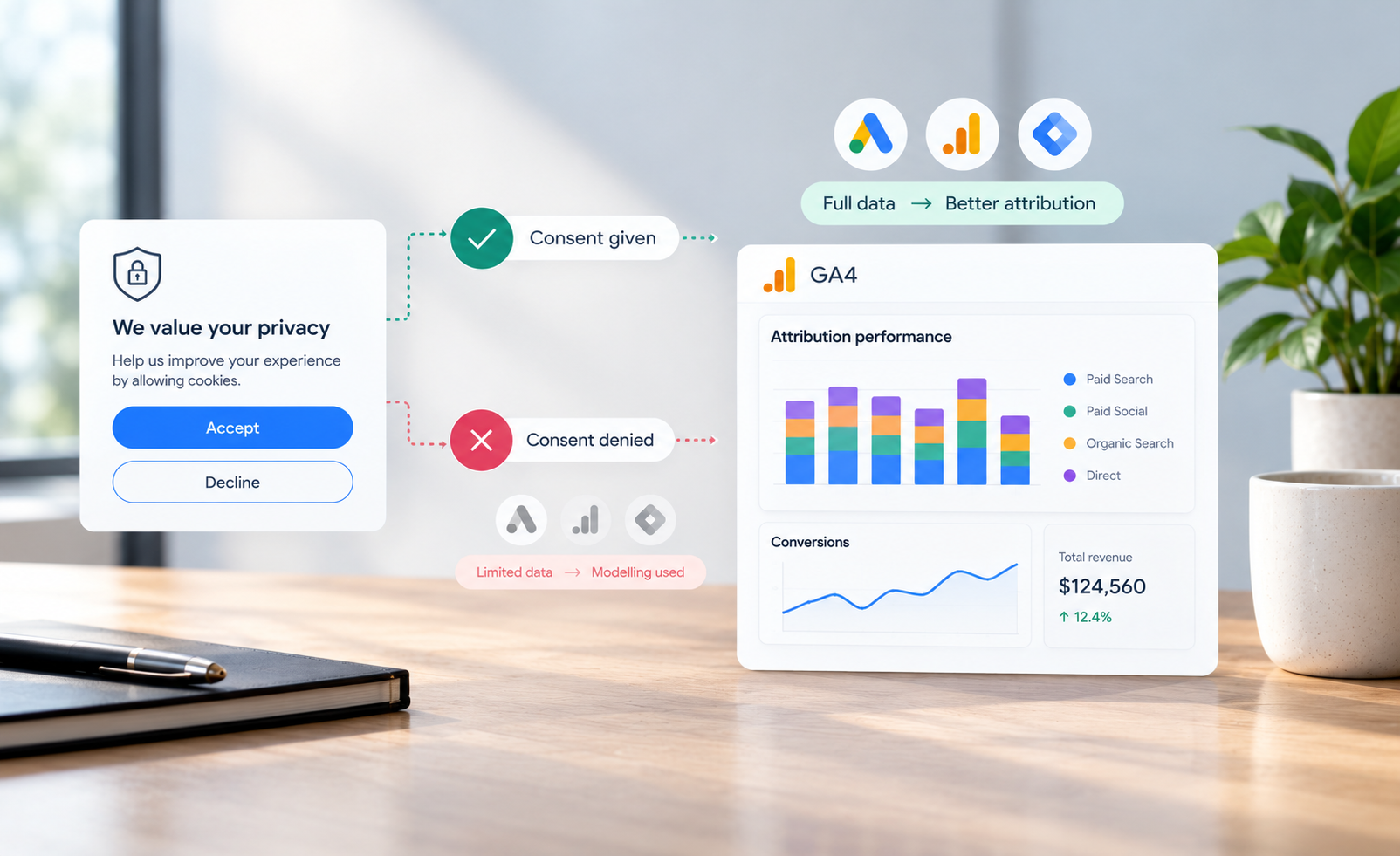

A customer clicks a paid search ad, declines analytics cookies, then buys three days later. Your revenue has not disappeared. But the evidence connecting that sale to the ad may have changed. So, does consent mode affect attribution? Yes – not by rewriting your attribution model, but by changing the data available for that model to work with.
For Australian businesses running Google Ads and GA4, that distinction matters. Consent Mode can reduce the volume of directly observed user-level journeys while allowing Google to model some measurement outcomes where the implementation and data eligibility support it. Read the numbers without understanding that trade-off and you can under-credit acquisition channels, overreact to apparent performance changes, or make budget decisions on incomplete evidence.
Key takeaways
- Consent Mode affects attribution indirectly by changing which ad and analytics signals can be stored and used.
- When consent is denied, GA4 and Google Ads may receive limited, cookieless signals rather than the identifiers used to join a full user journey.
- Modelling can fill part of the measurement gap, but it is an estimate, not a user-level record of every conversion.
- A clean consent implementation, stable tagging and a sensible reporting baseline matter more than chasing one perfect attribution number.
What Consent Mode actually changes
Google Consent Mode is a mechanism for adjusting Google tag behaviour according to a visitor’s consent choices. Its relevant settings include `analytics_storage` and `ad_storage`, plus newer consent signals such as `ad_user_data` and `ad_personalization`.
When a person grants consent, tags can operate with the storage and identifiers permitted by that choice. When they decline, Google tags can be configured to limit storage. Depending on the implementation, they may still send anonymised or cookieless pings that describe basic conversion or page activity without placing or reading the usual advertising and analytics cookies.
That creates a material measurement difference. Standard digital attribution relies heavily on identifiers: browser cookies, click IDs, device signals and authenticated user data. Fewer permitted identifiers mean fewer journeys can be observed from first click through to purchase.
Consent Mode has two broad implementation approaches. Basic Consent Mode blocks Google tags until consent is granted. Advanced Consent Mode allows tags to send consent-aware, cookieless pings when consent is denied. Neither is inherently the right choice for every business. The decision should reflect privacy obligations, your consent platform’s capabilities, legal advice and the measurement trade-off you are prepared to accept.
Consent Mode is not a replacement for a compliant consent strategy. It is a Google measurement setting, not a legal opinion on the Privacy Act, the Australian Privacy Principles, or the rules that apply to your specific data practices.
Does Consent Mode affect attribution in GA4?
Yes, particularly in the gap between observed attribution and reported attribution.
GA4 can use different reporting identities, including device-based and blended approaches that incorporate observed and modelled data where available. With a higher consent-denial rate, the portion of conversion paths that GA4 can observe directly may decline. A user who refuses analytics storage may not appear as the same returning user across sessions, devices or days.
In practical terms, this can make paths look shorter, direct traffic look stronger, and upper-funnel channels look weaker than they are. For example, a shopper may discover a retailer through a non-brand search campaign on mobile, return via an email on desktop and purchase. If identifiers cannot be retained or joined, the final visit may be more likely to be recorded without the complete preceding path.
GA4’s behavioural modelling is designed to estimate some missing behavioural data for eligible properties. Google applies thresholds and eligibility requirements, so it should not be treated as universally available or instantly reliable after a tag change. Google’s own documentation makes clear that modelling is based on observed data patterns, which means quality, volume and implementation consistency matter.
The key point is simple: consent affects the evidence GA4 receives. Attribution reports are then built from that evidence, plus any modelling that is available. The attribution rule itself – such as data-driven attribution or a selected paid and organic model – is only one part of the outcome.
Attribution model versus measurement coverage
These are often confused. An attribution model decides how credit is allocated across known touchpoints. Measurement coverage determines how many touchpoints and conversions are known in the first place.
Changing from last click to data-driven attribution may redistribute credit across your recorded journey data. Implementing Consent Mode may alter the amount and type of journey data recorded. They can both change channel results, but they solve different problems.
A business that sees paid social conversions fall after a consent banner update should not immediately conclude that paid social became less effective. First, establish whether consent acceptance changed, whether tags now fire differently, whether UTM parameters remain intact, and whether the reporting identity or attribution settings also changed.
The effect on Google Ads attribution
Google Ads has its own conversion measurement and modelling systems. Consent Mode can affect the signals available for conversion tracking, remarketing and bidding. Where advanced Consent Mode is implemented correctly, and the account meets Google’s requirements, Google Ads may use conversion modelling to estimate conversions that could not be directly observed because users declined consent.
That can produce more complete campaign-level measurement than a hard stop on all tags. It does not mean every unconsented conversion is recovered, nor does it make the estimate interchangeable with a confirmed order record in your eCommerce platform.
This distinction is commercially useful. Your finance system should remain the source of truth for total revenue and orders. Google Ads should be used to understand the likely incremental contribution and efficiency of ad spend. GA4 should be used to analyse behaviour, channel interactions and conversion patterns. Forcing all three systems to match exactly is usually a wasted exercise because they use different scopes, identities, windows and rules.
Where attribution can go wrong
The biggest risk is not Consent Mode itself. It is interpreting a changed number as a changed customer behaviour when the tracking setup has changed underneath it.
Common failure points include a consent banner that loads after tags fire, consent defaults that are incorrectly configured, duplicate tags managed through both the site code and Google Tag Manager, and conversion tags that fire before an order is confirmed. Another common issue is deploying advanced Consent Mode without validating the consent state sent with each relevant event.
For Australian retailers, a checkout can also cross multiple domains or payment providers. If cross-domain measurement is not configured correctly, the payment return may be treated as a new session or referral. Consent settings can compound that breakage, but they are not necessarily the original cause.
A practical framework for interpreting post-consent results
Before comparing performance before and after Consent Mode, document the exact deployment date, the consent banner change date, the GA4 reporting identity, Google Ads conversion actions, attribution windows and any concurrent campaign or website changes. Attribution is sensitive to all of them.
Then compare three layers of evidence. Start with business outcomes: total orders, qualified leads, revenue, margin and new-customer rate. Next, review platform-reported conversions and cost efficiency. Finally, assess diagnostic indicators such as consent rate, tag firing, event volume, conversion lag and channel mix.
If platform conversions decline while total revenue and order volume remain stable, investigate measurement coverage before cutting spend. If both platform-reported conversions and revenue decline, the issue may be genuine demand, site performance, offer competitiveness or media execution rather than consent configuration.
Use controlled tests where possible. Geo experiments, holdout audiences, campaign on-off tests and matched-market comparisons will not eliminate uncertainty, but they are stronger evidence of incremental impact than an attribution report alone. This is especially valuable for channels with weaker last-click visibility, including video, paid social and prospecting activity.
What good governance looks like
Treat consent changes like any other material analytics release. Create a measurement plan, test consent states in a staging environment, retain screenshots or tag-debugging records, and annotate the release in reporting. Monitor the first weeks closely, but avoid judging performance on a few days of post-release data.
Also separate privacy decisions from reporting preferences. The right implementation is the one that respects the user’s choice and gives the business a transparent view of what is observed, what is modelled and what remains unknown. Trying to preserve every tracking signal at any cost is a poor long-term strategy for trust and risk management.
For teams built to move revenue, the objective is not perfect attribution. It is decision-grade measurement: enough reliable evidence to allocate budget, identify waste, and test the channels most likely to create incremental growth.
Consent Mode changes the confidence interval around your attribution, not the reality of whether customers were influenced. Build reporting that acknowledges the gap, validate it against commercial outcomes, and let disciplined experimentation carry the weight that dashboards cannot.