
A full pipeline is not proof of a healthy acquisition strategy. If sales spends its week chasing poor-fit enquiries, the issue is rarely lead volume. It is channel selection, intent and measurement. The best channels for lead generation are the ones that put your offer in front of commercially relevant buyers, create enough demand to sustain growth and produce data your team can act on.
For Australian businesses, there is no universal ranking. A Melbourne eCommerce brand, a national B2B software company and a professional services firm may all use paid media, search and email, but their channel mix should look materially different. The right choice depends on buying cycle length, deal value, category maturity, audience behaviour and the economics of turning a lead into revenue.
Start With the Economics, Not the Channel
The common mistake is choosing channels based on popularity. A competitor is active on LinkedIn, so the team launches LinkedIn ads. Search campaigns are generating leads, so budget keeps flowing into search. Neither decision proves commercial value.
Before allocating budget, establish three numbers: your target customer acquisition cost, your lead-to-opportunity rate and your opportunity-to-sale rate. Together, they show how much a lead is actually worth.
A simple working formula is:
Allowable cost per lead = target customer acquisition cost × lead-to-sale rate
If your business can acquire a customer for $2,000 and one in 20 qualified leads becomes a customer, an initial allowable cost per qualified lead is $100. That is not a fixed rule. Gross margin, repeat purchase behaviour, sales capacity and cash flow all matter. But it stops teams celebrating cheap leads that never convert.
Channel performance should be evaluated against qualified pipeline and revenue wherever possible, not platform-reported conversions alone. Ad platforms can report a form fill. They cannot reliably tell you whether that person had budget, urgency or decision-making authority.
The Best Channels for Lead Generation by Buyer Intent
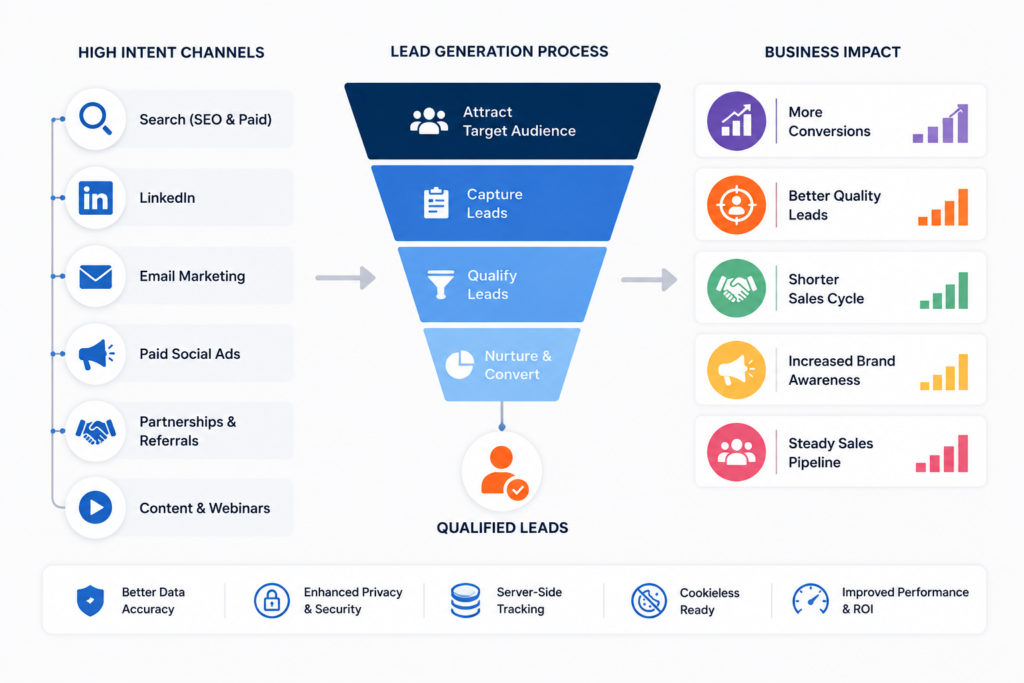
The most effective acquisition mix usually combines high-intent capture with demand creation. Capture channels harvest existing demand. Creation channels make more of the right people aware of a problem, a category or a credible solution. Relying on one alone makes growth fragile.
| Channel | Best use case | Strength | Watch-out |
|---|---|---|---|
| Organic search | Buyers actively researching solutions | Compounding visibility and high intent | Takes time and needs technical discipline |
| Paid search | Urgent, measurable demand | Fast route to ready-to-act prospects | Costs rise in competitive categories |
| B2B targeting and account-based activity | Strong professional targeting | Lead forms can reduce quality | |
| Paid social | eCommerce, local services and demand creation | Scalable creative testing | Weak targeting or creative creates waste |
| Nurture, retention and reactivation | Low marginal cost and strong ownership | Requires consent, data quality and relevance | |
| Partnerships | Trust-led and niche B2B acquisition | Access to credible audiences | Slower to build and harder to standardise |
Search: The strongest channel for declared demand
Search remains a foundational lead-generation channel because it reaches people who have already signalled a need. A prospect searching “commercial solar installer Melbourne”, “cyber security consultant Australia” or “best warehouse management software” is doing more than browsing. They are progressing through a decision.
Organic search works best when content maps to distinct intent. Service pages should answer commercial questions clearly. Comparison pages should help buyers assess options. Educational content should solve the research questions that appear before a buyer knows exactly what to purchase. Technical SEO matters because slow pages, poor mobile experience and unclear site structure undermine otherwise strong content.
Paid search adds control and speed. It is particularly effective where leads have high value, demand already exists and your team can respond quickly. The trade-off is competition. If every advertiser bids on the same short list of transactional terms, cost per click can climb faster than conversion rate. Use search terms reports, negative keywords and landing pages tailored to the query. Sending every click to a generic homepage is an expensive shortcut.
Search is not the best answer when buyers do not yet recognise the problem or lack a clear category to search for. In those cases, it captures only the small portion of demand already in market.
LinkedIn: high potential for complex B2B sales
LinkedIn is often one of the best channels for lead generation in B2B, especially when targeting job function, seniority, industry and company size matters. It is useful for reaching a defined buying committee, distributing a strong point of view and supporting account-based marketing activity.
Its weakness is that a lead form removes friction. That can be useful for newsletter subscriptions, event registrations and mid-funnel content, but it can also produce contacts with limited buying intent. For high-consideration services, test both native forms and website conversion paths. A form may improve volume while a landing page may provide better qualification.
The creative needs a commercial premise. Generic claims such as “we help businesses grow” disappear into the feed. Better work identifies a recognisable problem, frames the financial or operational consequence, and gives the reader a reason to reconsider their current approach. A CFO may respond to margin leakage. A marketing manager may respond to inefficient attribution. Different buyer, different message.
Paid social: creative is the targeting layer
Meta, TikTok and other paid social platforms are rarely intent channels in the same way as search. Their value lies in creating consideration, testing messages quickly and reaching audiences before they begin a formal buying journey.
For eCommerce, paid social can drive both prospecting and repeat purchase when product economics support it. For services and B2B, it is often more effective as a demand-creation and remarketing channel than as a standalone source of sales-qualified leads.
The platform will optimise towards the event you give it. Optimise for cheap leads, and it will find people likely to complete forms. Optimise for qualified opportunities, where data integration allows, and it has a better commercial signal. This is why CRM feedback is not a reporting extra. It is a media-buying advantage.
Email: the channel you own
Email is less glamorous than paid acquisition and often more profitable. It turns existing attention into a managed audience: leads who are not ready yet, past customers, webinar registrants, abandoned enquiries and high-intent site visitors who have consented to hear from you.
Its effectiveness depends on segmentation and timing. A founder who downloaded a pricing guide should not receive the same sequence as an existing customer. Useful nurture programs acknowledge where the person is in the decision process, answer likely objections and offer the next sensible step.
For longer sales cycles, email also protects lead quality. Not every prospect needs an immediate sales call. A thoughtful nurture sequence can qualify interest over time, while sales focuses on people showing stronger buying signals.
Partnerships, referrals and industry authority
Some of the highest-quality leads never originate in an ad account. Referral partners, associations, technology partners, events and respected industry voices can transfer trust faster than cold outreach.
These channels are especially valuable in specialised categories where buyers face meaningful risk. A referred accounting firm, logistics provider or enterprise technology partner begins with more credibility than an unknown advertiser. The trade-off is scale and predictability. Partnerships require relationship management, shared incentives and clear rules for lead ownership.
Treat partner activity as a channel with its own operating model. Define the ideal referral, response-time expectations, reporting process and commercial value to both parties. Casual partnerships tend to produce casual results.
Build a Lead Generation Mix That Can Learn
A sensible starting mix is one capture channel, one creation channel and one nurture channel. For example, a B2B firm might pair paid search with LinkedIn thought-leadership campaigns and email nurture. An eCommerce operator might combine Google Shopping, Meta prospecting and lifecycle email.
Then set a clear test horizon. New channels should not be judged after a handful of conversions, but they should not receive unlimited patience either. Assess early signals such as qualified conversion rate, cost per sales conversation, pipeline contribution and time to conversion. Mature channels can be held to stricter efficiency targets. Emerging channels should be judged partly on what they teach you about audience, offer and creative.
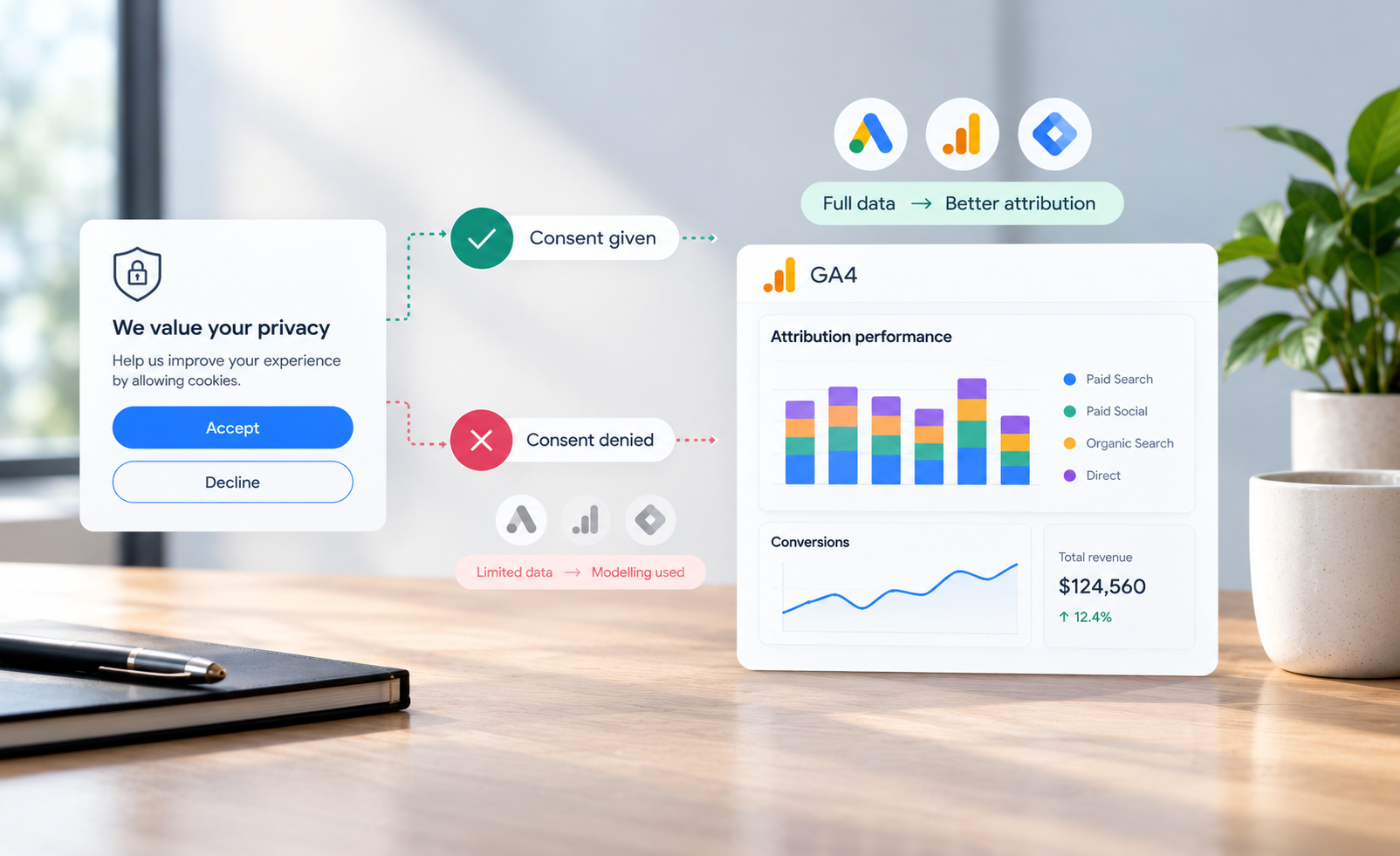
Attribution needs practical discipline. Use consistent campaign naming, capture source in your CRM, track lead status and ask sales why leads were rejected. A prospect may first encounter a video, later search your brand, and finally convert through paid search. Giving all credit to the final click will overvalue capture and underfund demand creation.
Quality Controls That Protect Your Budget
Channel choice cannot compensate for a weak conversion system. Every campaign needs a clear offer, a landing page aligned with the message and a follow-up process that matches buyer urgency. If response time is slow, qualification is inconsistent or sales notes are missing, marketing will optimise against incomplete evidence.
Review lead quality with sales at least monthly. Look beyond a binary qualified or unqualified label. Identify patterns in industry, company size, role, location, requested service, budget and sales outcome. This is where channel strategy becomes measurable success rather than a collection of dashboards.
The strongest lead-generation program is not built around whichever platform is having a good quarter. It is built around a clear understanding of how customers buy, what a profitable conversion costs and where your business can earn attention before competitors do. Start there, keep the feedback loop tight, and let revenue decide which channels deserve more of your budget.