
Magento 2 is the current generation of the Magento eCommerce platform. Adobe has owned it since 2018. It replaced Magento 1, which reached end of life on 30 June 2020.
Magento 2 comes in two editions. Magento Open Source is free to licence and self-hosted. Adobe Commerce is the paid edition. It adds B2B features, Page Builder, advanced merchandising and an optional Adobe-managed cloud. Both editions run on the same 2.4.x codebase.
When clients say “Magento 2 upgrade”, they usually mean one of three things. A point-release update within 2.4.x. A rebuild onto the current release. Or a move from Magento 1 to Magento 2. Each has a very different cost, so we ask which one first.
Which Magento 2 Versions Are Supported in 2026?
Your current version is the first thing that sets your upgrade cost. Adobe publishes a software lifecycle policy with a support end date for every 2.4.x release. Once a release passes that date it receives no security patches. That also puts your PCI DSS compliance at risk with your payment provider.
Check your version in the admin footer or run bin/magento –version. Then compare it with the table below. Every row further down means more compatibility work and a higher quote.
| Magento 2 release | General availability | Support ends | Status in 2026 |
|---|---|---|---|
| 2.4.9 | 12 May 2026 | 31 May 2029 | Current release |
| 2.4.8 | 8 April 2025 | 31 May 2028 | Supported |
| 2.4.7 | 9 April 2024 | 31 May 2027 (extended support for Adobe Commerce to 31 May 2028) | Supported. Plan the upgrade now |
| 2.4.6 and older | 14 March 2023 and earlier | 2.4.6 ended 11 August 2026; 2.4.5 ended 12 August 2025; 2.4.4 ended 12 April 2025 | Out of standard support. Open Source stores receive no further patches. Adobe Commerce holders get extended or security-only fixes to the dates in the note below |
Source: Adobe Commerce lifecycle policy, updated 19 August 2026
Standard support is three years from release for both editions. Adobe Commerce licence holders also get extended support (2.4.6 to 31 August 2027, 2.4.7 to 31 May 2028) and a one-time security-only period (2.4.4 and 2.4.5 to 31 May 2027, 2.4.6 to 31 May 2028). Magento Open Source gets neither. Adobe Commerce on Cloud stores on unsupported versions face enforced upgrades from 1 June 2027.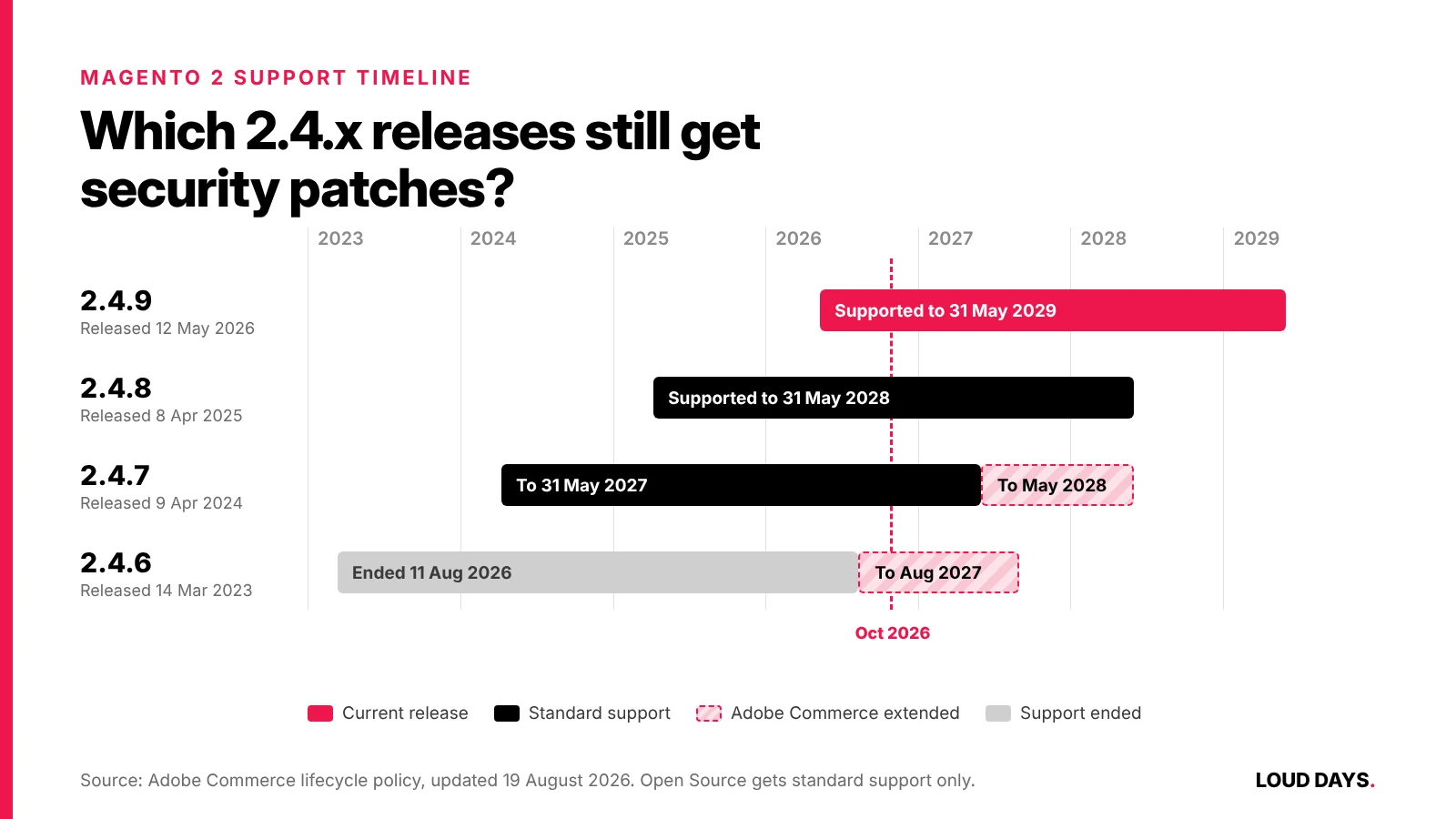
If your release is 2.4.6 or older, the upgrade is a security requirement, not a discretionary project. On Open Source, the 11 August 2026 date for 2.4.6 was a hard stop. We move those stores to the front of our schedule. In cost terms, one release behind is a point-release job. Two or more behind, or a lapse past the end of support, usually turns into a rebuild quote.
Before we quote, we score a store against eight drivers. You can do the same with the table below.
| Cost driver | Low cost when | High cost when | Effect on budget |
|---|---|---|---|
| Current version gap | One point release behind | Two or more releases behind, or on 2.3.x | Each skipped release adds compatibility work |
| Third-party extensions | Under 10, all maintained | 25 or more, some abandoned | Each extension needs a compatible version or a replacement |
| Custom modules | Few, documented, Adobe coding standards | Many, undocumented, core overrides | Largest source of surprise hours |
| Theme | Recent Luma-based or Hyva theme | Heavily customised Luma or a Magento 1-era design | A Hyva move rebuilds every template |
| Integrations (ERP, PIM, 3PL, payments) | Vendor-supported connectors | Custom middleware, undocumented ERP sync | Every data flow must be re-tested |
| Catalogue size and data quality | Clean catalogue, few attributes | Large SKU count, messy attributes, duplicates | Slows migration and QA |
| Hosting and stack | PHP, database and OpenSearch already supported | PHP or search engine upgrade needed too | Adds infrastructure work before code work |
| Testing scope | One store view, few payment methods | Multi-store, multi-currency, B2B roles, many shipping rules | QA hours scale with combinations |
Two drivers cause the most blown budgets in our experience: undocumented custom modules and abandoned extensions. Count both before you ask anyone for a price.
The Real Cost Breakdown by Upgrade Type
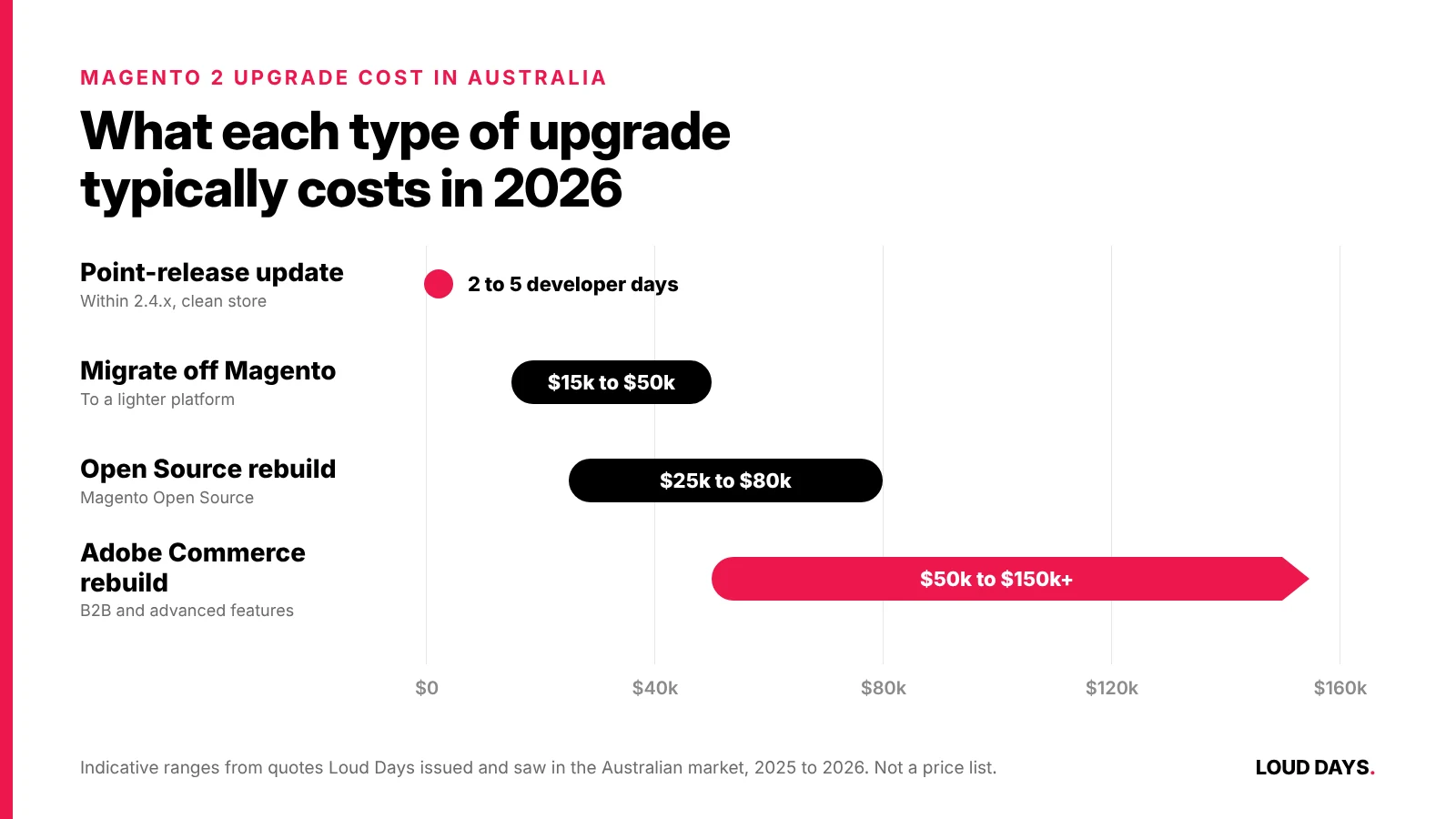
Point-release upgrades (moving between 2.4.x versions) are the cheapest scenario. On a store close to vanilla Magento with few custom modules, expect two to five developer days. That covers the Composer update, a PHP version change, extension compatibility checks, a theme regression pass and staging QA. Stores with many extensions or an old theme take longer. Each extension needs a compatible release and each template override needs testing.
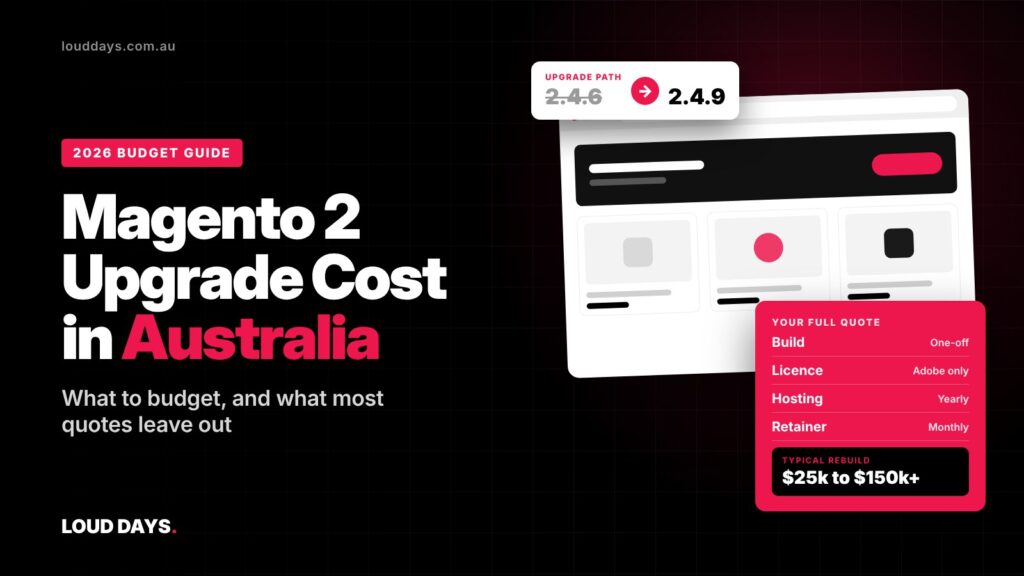
Full rebuilds onto a modern Magento 2 or Adobe Commerce build are a different project. This is not a patch. Themes and extensions usually need full replacement or custom redevelopment rather than a straight port. For a Magento Open Source build, Australian businesses are generally looking at $25,000 to $80,000. Stepping up to Adobe Commerce, the build climbs to $50,000 to $150,000 or more. The extra comes from B2B tooling, advanced merchandising and the integration complexity that usually arrives with that tier.
These ranges reflect quotes Loud Days has issued and seen in the Australian market in 2025 and 2026. They are not a published price list.
The frontend is often the largest single line in a rebuild. Most new Magento 2 builds now use the Hyva theme instead of the default Luma theme. Hyva loads faster and carries a smaller codebase. Moving to Hyva means every extension with a frontend component needs a Hyva-compatible version, and every custom template must be rewritten. Budget for it separately. Ask your agency to list which of your extensions already support Hyva. Hyva maintains a public compatibility list for third-party extensions.
Migrating off Magento entirely to a lighter platform typically runs $15,000 to $50,000. Some businesses discover the enterprise tier outgrew their needs. Once you count what you stop paying for, leaving can cost less than upgrading in place.
If your store is still on Magento 1, the cost logic is different. Our Magento 1 to Magento 2 migration checklist covers both paths.
Timelines follow the same pattern. A genuine rebuild takes 10 to 24 weeks, not the few days a point release might take. If someone quotes a full rebuild in two weeks, ask what they have left out.
Not sure if your store meets these requirements?
Get a free Magento 2 compatibility audit from Loud Days before you budget a single dollar.
Before budgeting a dollar, confirm your environment meets the target release’s requirements. Mismatches here are the most common source of surprise costs mid-project. We check five things: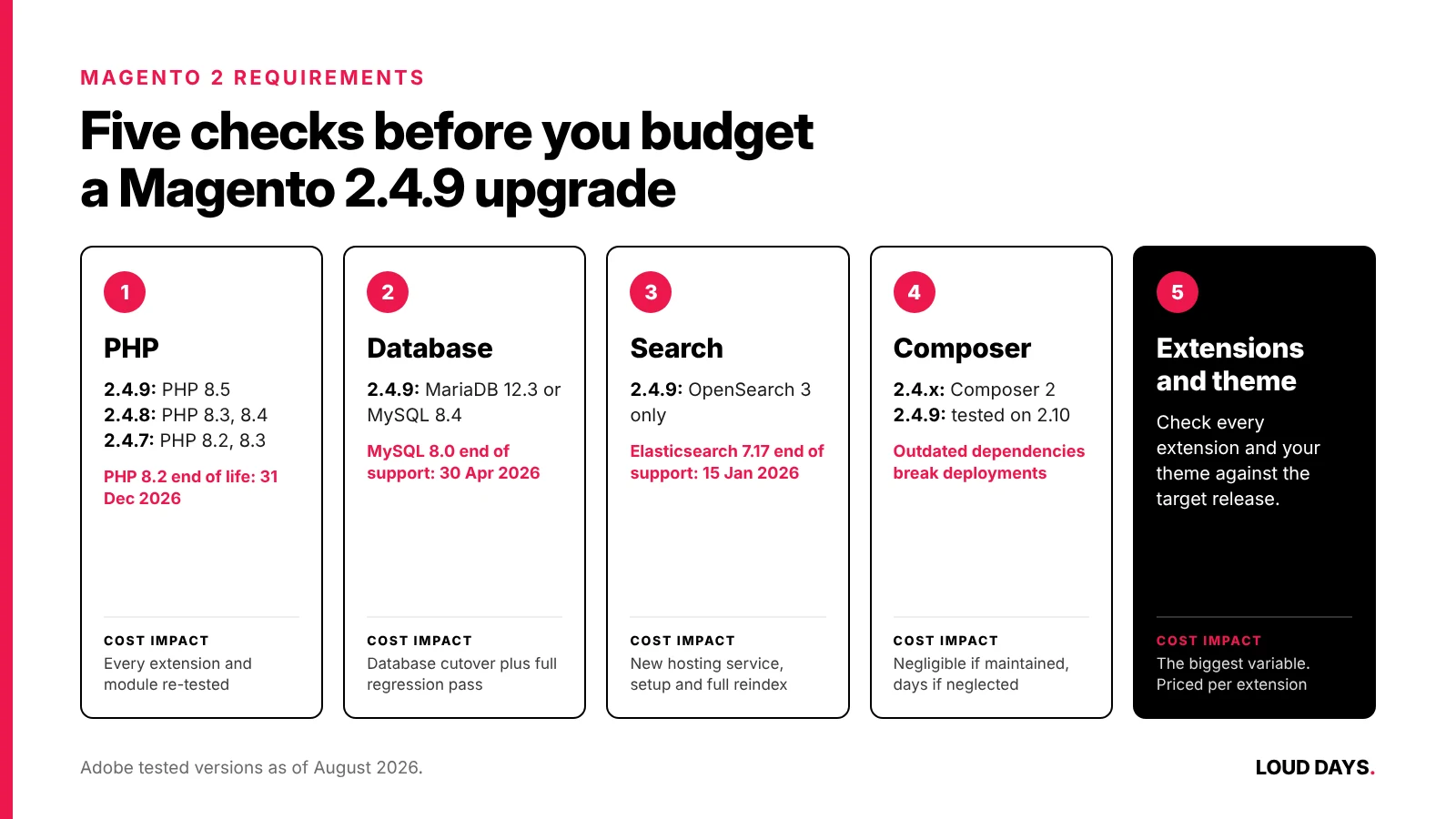
- PHP version. Each 2.4.x release supports a narrow PHP range. Running an unsupported PHP version is the most common blocker. As of August 2026, Adobe tests 2.4.9 on PHP 8.5, 2.4.8 on PHP 8.3 and 8.4, and 2.4.7 on PHP 8.2 and 8.3. PHP 8.1 reached end of life on 31 December 2025. PHP 8.2 reaches it on 31 December 2026. Both dates put PCI compliance at risk for stores on 2.4.6 and older.
Cost impact: a PHP jump means every extension and custom module is re-tested, which adds developer days before the upgrade proper starts. - Database. MySQL 8.0 reached end of support on 30 April 2026. Adobe now advises on-premises stores on 2.4.4 to 2.4.7 to move to MariaDB. 2.4.9 is tested with MariaDB 12.3 and MySQL 8.4.
Cost impact: a MariaDB migration adds a database cutover and a full regression pass to the quote. - Search engine. Elasticsearch 7.17 reached end of support on 15 January 2026. Adobe tests 2.4.9 with OpenSearch 3 only. If your store still runs Elasticsearch, plan the move to OpenSearch as part of the upgrade.
Cost impact: a new search service on your hosting bill, plus configuration and a full reindex. - Composer. Magento 2.4.x requires Composer 2, and 2.4.9 is tested with Composer 2.10. Outdated dependencies cause failed deployments more often than code does.
Cost impact: negligible on a maintained store, days of untangling on a neglected one. - Extensions and theme. Check every third-party extension and your theme individually against the target release. Never assume they carry over.
Cost impact: the single biggest variable. We price this per extension, not per site.
A technical audit against these requirements should inform your budget, not the other way around.
The Hidden Costs Most Budgets Miss
The build price is the number everyone focuses on. It is also the number that most understates total cost. Four categories get left off initial budgets again and again:
- Licensing. Adobe does not publish Adobe Commerce pricing. Licences are commonly reported to start in the low tens of thousands of US dollars per year and scale with gross merchandise value. Get a written quote from Adobe or an Adobe partner before you budget. Magento Open Source carries no licence fee. That is one of the biggest reasons some businesses choose to migrate down rather than up.
- Hosting. Magento-capable hosting is not cheap hosting. Depending on scale, budget $2,000 to $40,000 or more per year. That range covers the plans our Australian clients run, from a single managed VPS to a multi-node cluster.
- Ongoing retainer and maintenance. Security patches, extension compatibility checks and performance monitoring do not stop at launch. This is a monthly cost, not a one-off.
- Data and redirect mapping. Often treated as an afterthought. It is one of the most consequential line items on the whole project.
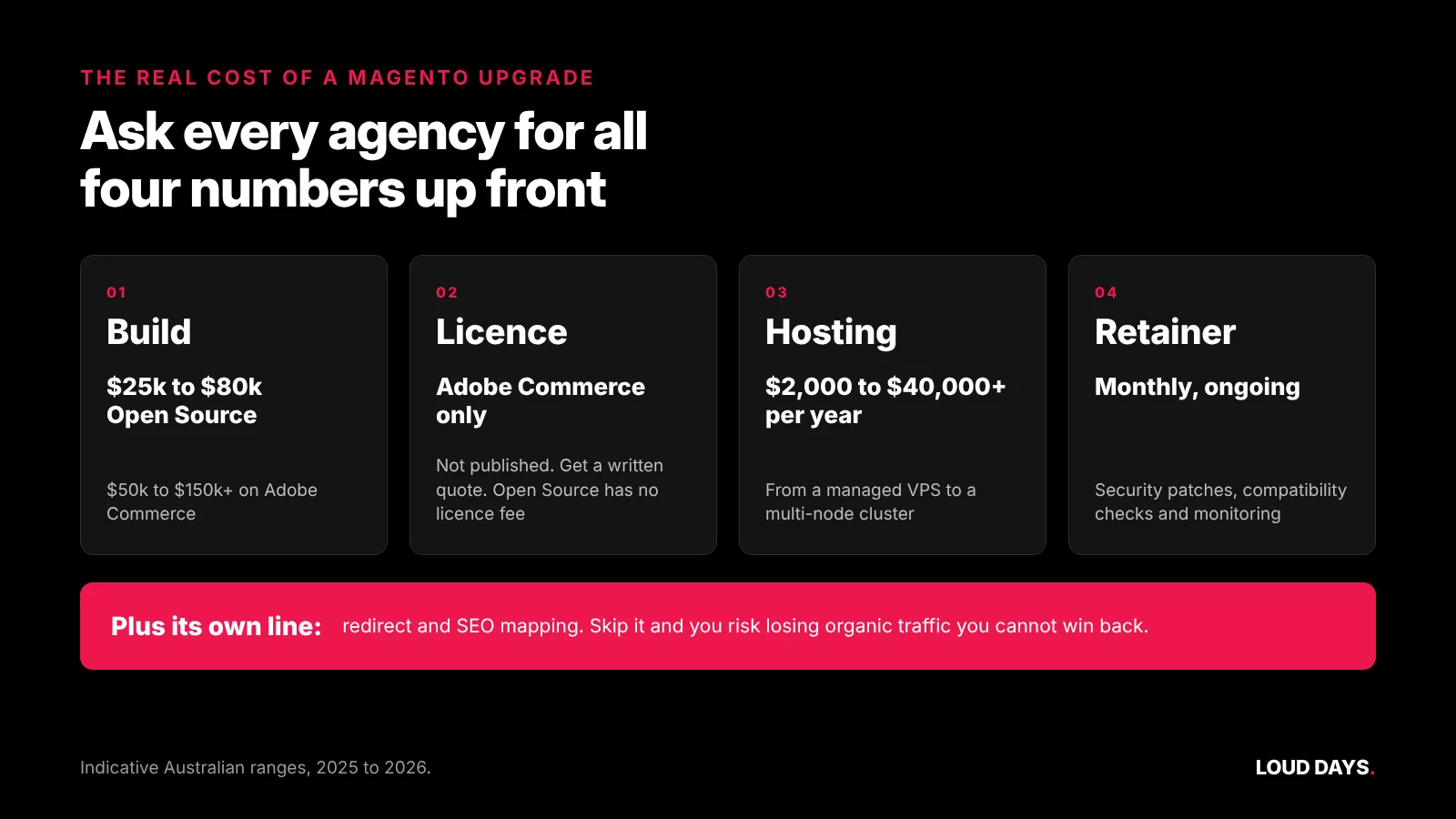
A quote that shows only the build price shows you a fraction of what the platform will cost in its first year.
Common Pitfalls to Avoid When Upgrading to Magento 2
Treating the upgrade as a version bump
To many owners, “upgrade” sounds like running a few commands. A real upgrade means reviewing the whole codebase, testing every third-party component and often rewriting customised pages. It is not changing a version number.
Rushing the data and redirect mapping phase
This is the pitfall with the most expensive consequences. Businesses that skip redirect mapping routinely lose a large share of their organic traffic. That loss is hard to recover once Google has re-indexed the broken URLs. Unlike almost anything else in the project, you cannot fix it after the fact.
Skipping the “do we even need this tier?” question
Not every business on Adobe Commerce today needs to be. If your catalogue and operations do not require multi-store B2B tooling or advanced merchandising, migrating down to Open Source can be the cheaper move. Ask the same question before any rebuild. For B2B stores weighing whether Adobe Commerce is still the right tier, see our comparison of Magento and Shopify Plus for Australian B2B.
No staging environment
Testing changes against a live store is how minor bugs turn into checkout outages during a sale period. A proper staging environment is not optional at any serious scale.
Picking the developer on hourly rate alone
Ambiguous scope costs $150 to $250 per hour regardless of who you hire. Messy legacy data and undocumented ERP connections are where the time goes. A cheaper hourly rate on a poorly scoped project usually means more billed hours, not a lower total.
How to Keep a 2026 Magento Upgrade on Budget
- Get an honest audit before you get a quote. The audit should tell you whether to upgrade in place, migrate to Open Source or leave Magento. Decide the platform question before pricing the project. A Magento agency that scopes upgrades regularly can run this in a few days. See what Loud Days covers in a Magento upgrade audit.
- Ask for all four numbers up front. Build, licence (if applicable), hosting and ongoing retainer. Any proposal that quotes only the build is incomplete.
- Budget redirect and SEO mapping as its own line item. Not a footnote. It is the single most preventable expensive mistake in a Magento migration.
- Supply a clean catalogue and integration documentation before development starts. Every hour a developer spends untangling ambiguous data or an undocumented ERP connection is billed at premium rates. Cleaner inputs, tighter invoice.
- Weigh migrating against upgrading. If you spend real money every year keeping legacy architecture patched, that recurring cost may already rival a one-time move to a modern build.
The businesses that finish a Magento upgrade on budget are not the ones who found the cheapest quote. They scoped the real cost categories before signing anything.
Ready to budget your Magento 2 upgrade properly?
We scope build, licence, hosting and retainer before you request a single quote.