
What Google Ads costs per month in Australia (by business type)
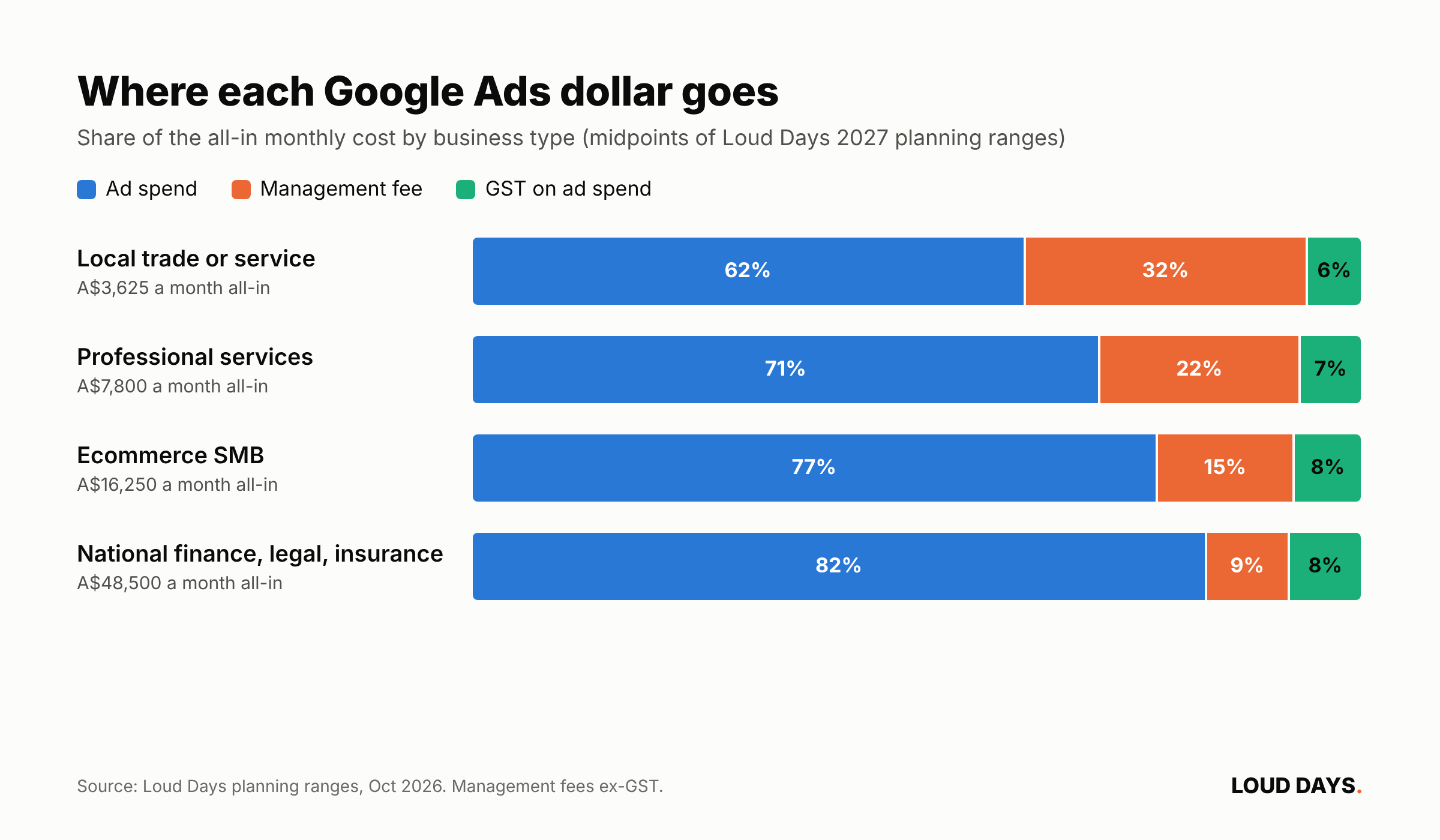
A local service business can run a useful campaign on A2,500toA5,000 a month all-in. An ecommerce brand or a national lead generation business usually needs five figures. Here’s how the total stacks up once you add management and GST. These are our planning ranges for 2027, based on what we quote and what Australian agencies publish.| Business type | Ad spend per month | Management fee | GST on ad spend | All-in per month |
|---|---|---|---|---|
| Local trade or service, one metro (plumber, electrician, removalist) | A$1,500 to A$3,000 | A$800 to A$1,500 | A$150 to A$300 | A$2,450 to A$4,800 |
| Professional services (accountant, clinic, physio, conveyancer) | A$3,000 to A$8,000 | A$1,000 to A$2,500 | A$300 to A$800 | A$4,300 to A$11,300 |
| Ecommerce SMB (Shopping and Performance Max) | A$5,000 to A$20,000 | A$1,500 to A$3,500 | A$500 to A$2,000 | A$7,000 to A$25,500 |
| National lead gen in finance, legal or insurance | A$20,000 to A$60,000+ | A$3,000 to A$6,000+ | A$2,000 to A$6,000 | A$25,000 to A$72,000+ |
 Your own number depends on 2 things more than anything else: what a click costs in your category, and how many of those clicks turn into enquiries or sales. The rest of this guide shows you how to work out both.
Google Ads cost per click by industry (2026 data for 2027 planning)
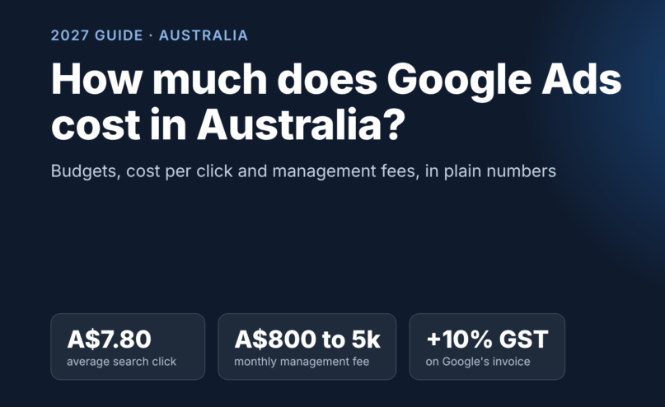
The average Google Ads cost per click is about A$7.80 across all industries in 2026, but the spread is huge: from about A$2.35 for arts and entertainment to A$14.21 for legal services.
That average comes from the 2026 LocaliQ/WordStream benchmark report, the dataset most agencies quote. It’s built mostly from US accounts, so I’ve converted it at A$1.44 per US dollar (late October 2026 rate) and paired it with Australian keyword data below.
| Industry | Avg CPC (US$) | Avg CPC (A$) |
|---|---|---|
| Attorneys and legal services | 9.87 | 14.21 |
| Home and home improvement | 8.33 | 12.00 |
| Dentists and dental services | 8.00 | 11.52 |
| Personal services | 7.17 | 10.32 |
| Health and fitness | 6.17 | 8.88 |
| Business services | 5.87 | 8.45 |
| Industrial and commercial | 5.87 | 8.45 |
| Education and instruction | 4.81 | 6.93 |
| Apparel, fashion and jewellery | 4.44 | 6.39 |
| Finance and insurance | 3.39 | 4.88 |
| Real estate | 3.22 | 4.64 |
| Automotive (for sale) | 2.27 | 3.27 |
| Restaurants and food | 2.05 | 2.95 |
| Arts and entertainment | 1.63 | 2.35 |
| All industries | 5.42 | 7.80 |
Source: LocaliQ/WordStream Google Ads Benchmarks 2026. AUD conversion by Loud Days at 1 USD = 1.44 AUD.
Prices moved a lot in a year. Legal clicks rose about 15%, and personal services and health and fitness each jumped about 23%, while education fell about 23% (Focus Digital summary of the 2026 data).
What Australian keywords actually cost
That finance and insurance figure of A$4.88 looks cheap. It is, until you check Australian search terms. “Car insurance” averages about A$20 a click here.
So we analysed 15 common Australian searches using Ahrefs’ Australian keyword database. Here’s what each click costs on average.
| Search term | AU searches per month | Avg CPC (A$) |
|---|---|---|
| car insurance | 122,000 | 20.16 |
| business loans | 2,200 | 20.16 |
| family lawyer melbourne | 800 | 14.40 |
| emergency plumber | 6,000 | 12.96 |
| mortgage broker | 15,000 | 10.08 |
| conveyancing melbourne | 1,100 | 10.08 |
| removalists melbourne | 4,300 | 8.64 |
| it support | 3,100 | 8.64 |
| pest control | 11,000 | 6.48 |
| electrician near me | 17,000 | 5.76 |
| crm software | 2,500 | 5.04 |
| dentist near me | 31,000 | 4.32 |
| solar panels | 18,000 | 3.60 |
| gym near me | 32,000 | 1.73 |
| running shoes | 24,000 | 0.22 |
Source: Loud Days analysis of Ahrefs Keywords Explorer data (Australia), 27 October 2026. CPCs converted from US$ at A$1.44.
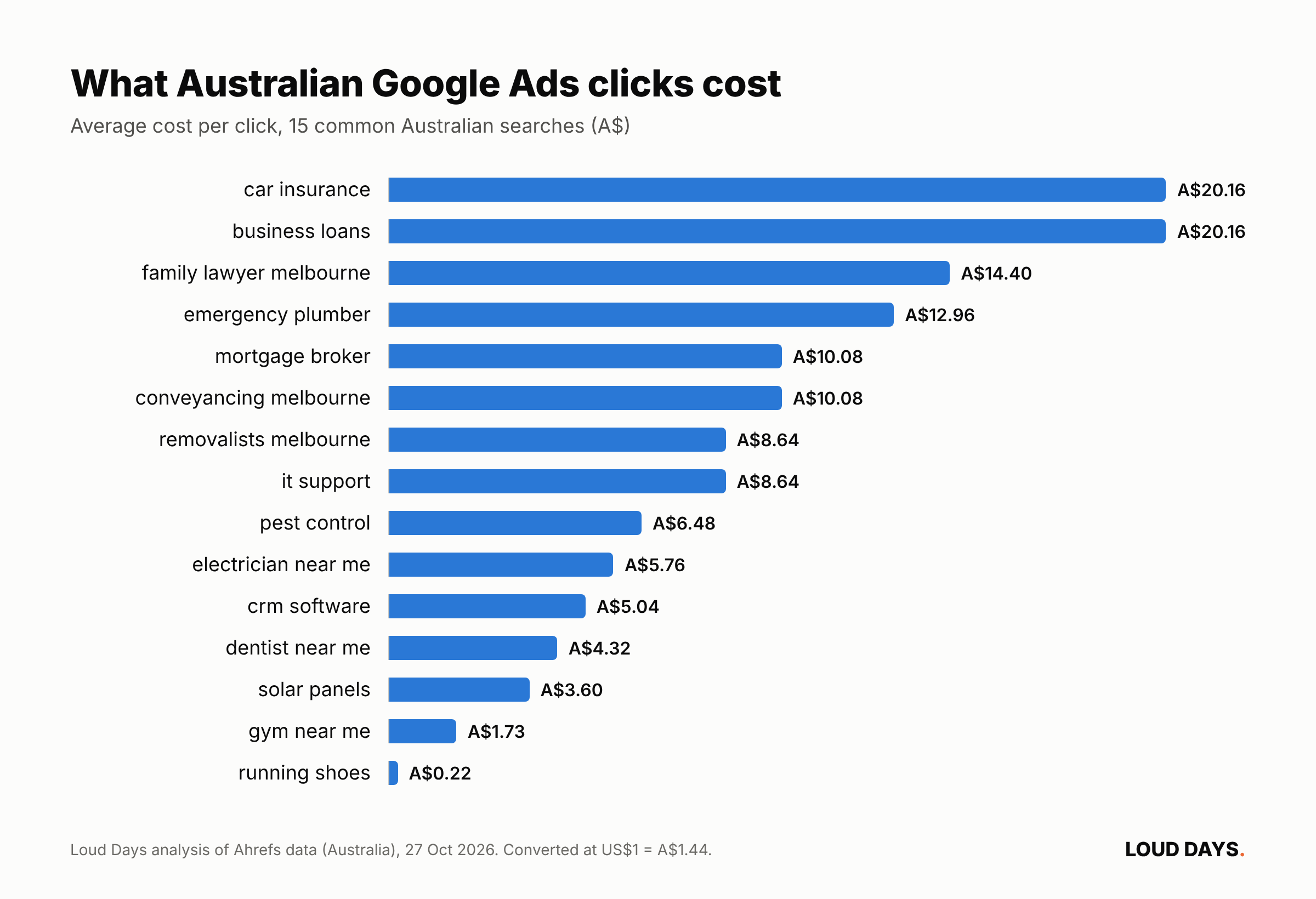
Read this table as a floor. Tool CPCs average out every hour, device and match type. In the accounts we manage, the “service + suburb” searches that actually convert in Sydney and Melbourne usually cost more than the head-term average (my view, based on what we see in auction data).
Want numbers for your own keywords? Google’s free Keyword Planner shows a low and high “top of page bid” range for each term. Use the high end for budgeting.
How much should you spend on Google Ads?
Spend enough to buy the number of leads or sales you need at a cost per lead your margins can carry. Work backwards from that target, and your Google Ads budget sets itself.
Here’s the 30-second Google Ads cost calculator we use in first meetings:
Cost per lead = cost per click ÷ conversion rate
Monthly budget = leads you need × cost per lead
Daily budget = monthly budget ÷ 30.4
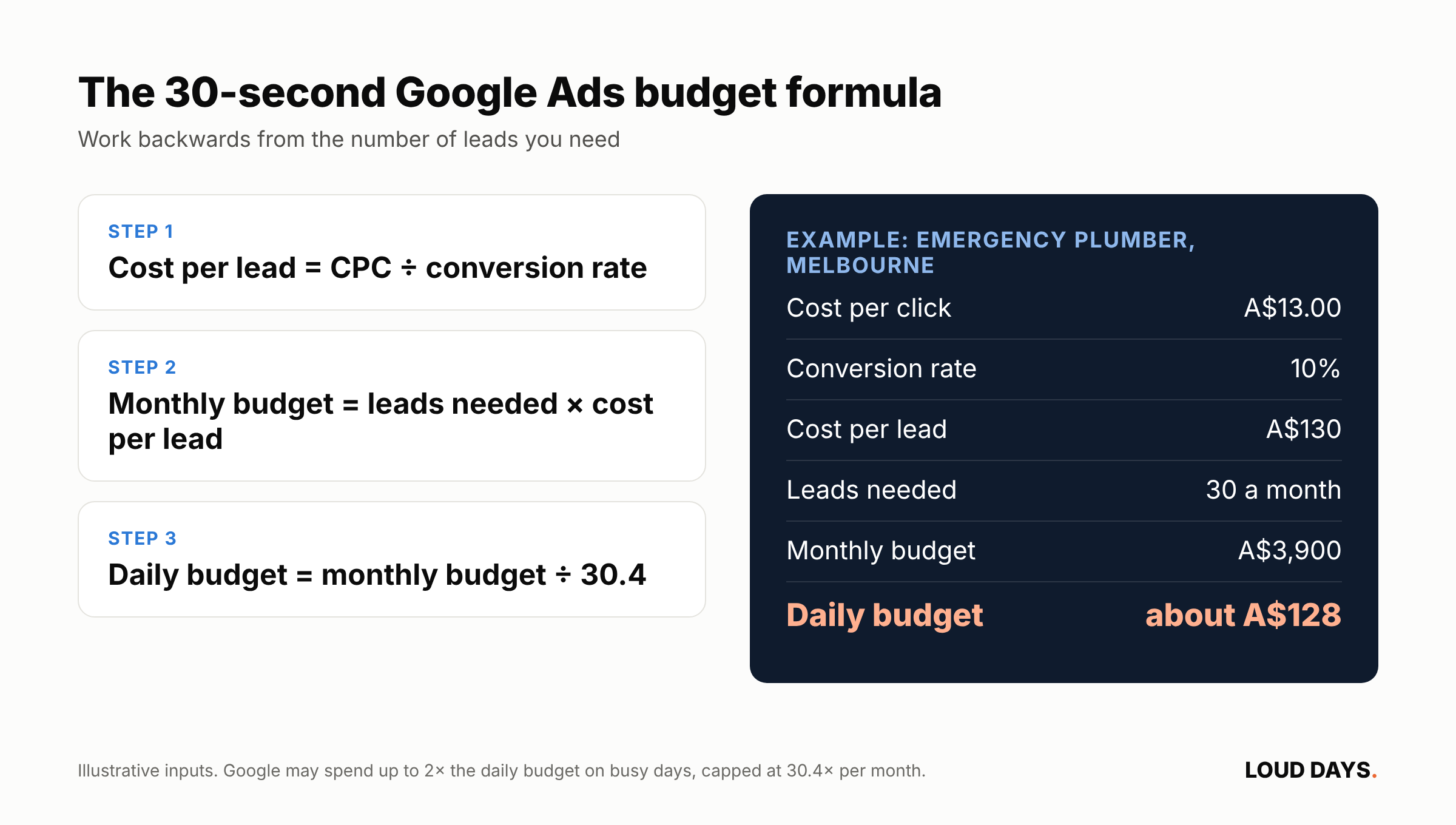
Say you’re an emergency plumber in Melbourne. Clicks cost about A$13 and your landing page turns 1 in 10 clicks into a call or form. Each lead costs A$130. You want 30 leads a month, so you budget A$3,900 or about A$128 a day.
| Example | CPC (A$) | Conv. rate | Cost per result (A$) | Target | Monthly budget (A$) | Daily budget (A$) |
|---|---|---|---|---|---|---|
| Emergency plumber, Melbourne | 13.00 | 10% | 130 | 30 leads | 3,900 | 128 |
| Accounting firm, Brisbane | 6.00 | 6% | 100 | 25 leads | 2,500 | 82 |
| Online activewear store | 1.20 | 2% | 60 | 200 sales | 12,000 | 395 |
Notice what moves the budget most. Lift the plumber’s conversion rate from 10% to 15% and the same 30 leads cost A$2,600 instead of A$3,900. That’s why we look at the landing page before we touch bids.
Is A$10 or A$20 a day enough for Google Ads?
A$10 a day gives you about A$304 a month. At A$5.76 a click (“electrician near me”), that buys roughly 52 clicks and maybe 5 enquiries. At A$14.40 (“family lawyer melbourne”), it buys about 21 clicks.
A$20 a day (about A$608 a month) doubles that: roughly 105 cheap clicks or 42 expensive ones. It can work for a local business with low click prices and a tight service area.
A$1 a day is a test, nothing more. It buys about 5 clicks a month.
Our own rule: we generally start client media budgets at A$2,000 a month. Below that, Smart Bidding rarely gets enough conversions to learn, and one expensive day skews the whole month.
Google Ads management fees in Australia
Australian agencies charge A$800 to A$5,000 a month to manage Google Ads, or 10% to 20% of ad spend. Most small and mid-sized accounts pay A$1,000 to A$3,000.
We reviewed the fees Australian agencies publish in October 2026. They ran from about A$400 a month at the very low end to A$5,000+, often with a 3-month minimum term. The model behind the fee matters as much as the number.
| Pricing model | Typical Australian range | Suits | Watch out for |
|---|---|---|---|
| Flat monthly retainer | A$800 to A$5,000 | Most SMBs; you know the cost upfront | Vague scope. Ask what’s in and what’s billed extra |
| Percentage of ad spend | 10% to 20% of spend, usually with a minimum fee | Larger accounts with rising spend | The agency’s income rises with your spend, whether or not your revenue does |
| Tiered by spend band | Fee steps up at set spend levels | Seasonal businesses | Big jumps at the edge of each band |
| Setup or onboarding fee | Quoted per account | New builds and messy inherited accounts | Ask for it itemised: audit, tracking, build |
| Performance-based (per lead or revenue share) | Rare in Australia | Businesses with clean, CRM-tracked sales | Arguments over lead quality; agencies chasing cheap leads |
| Consulting or one-off audit | Quoted per project | In-house teams that want a second opinion | Your team still does the work |
What a management fee should cover
A good fee buys a person who checks your account most working days, and the boring work that keeps cost per lead down:
- Keyword, competitor and search intent research before launch
- Conversion tracking set up and tested, including GA4 events and offline conversions where it makes sense
- Ad copy testing, sitelinks and other assets
- Search terms reviewed and negative keywords added every week (at minimum)
- Bid strategy and target setting tied to your margins
- Shopping feed fixes for ecommerce
- Landing page recommendations
- Reporting on cost per lead, ROAS and revenue
If a quote leaves out tracking or search term work, it’s cheaper for a reason.
Agency, freelancer or in-house?
A freelancer can suit a single-campaign local account. An in-house hire makes sense once spend is large enough to keep a specialist busy full-time. An agency sits in between and brings a team that sees dozens of accounts at once. We’ve written up the agency vs in-house trade-offs in more detail.
Red flags in a Google Ads quote
- The agency owns the ad account. Leave, and you lose years of history and conversion data. You should always own it.
- Undisclosed media mark-up. Your ad spend should go straight to Google on your card or invoice.
- Long lock-in contracts with no performance review point.
- Reports full of impressions and clicks but no cost per lead or revenue.
At Loud Days, we price Google Ads management on scope, account size and what you need, so there’s no fixed package. Your media budget goes directly to Google, and you keep full ownership of the account. For a longer checklist, read how to choose a Google Ads agency in Melbourne.
Hidden costs that blow out Google Ads budgets
Click spend makes up roughly 60% to 85% of the real monthly cost of Google Ads, based on the planning ranges above. The rest hides in tax, tracking and tools.
| Hidden cost | When it bites | How to keep it in check |
|---|---|---|
| 10% GST | Every Google invoice | Plan cash flow on spend + 10% |
| Overseas surcharges | Ads served in the UK (2% fee) or Austria (5%), plus regulatory fees in France, Italy, Spain and Turkey | Check location targeting. Google adds GST on top of these fees (Google Ads Help) |
| Overdelivery | Busy days spend up to 2× your daily budget | Set the daily budget from your monthly figure ÷ 30.4 and avoid mid-month changes |
| Conversion tracking | Missing or broken tracking teaches Smart Bidding to buy the wrong clicks | One-off GA4, consent mode and server-side setup |
| Landing pages | Ads pointed at a homepage convert poorly | A dedicated page per service or product category |
| Call tracking and tools | Phone-led businesses can’t see which keywords make the phone ring | A small monthly subscription, worth it for trades and clinics |
| Creative | Performance Max and Demand Gen need images and video | Budget for a shoot, or start with Google’s built-in asset tools |
| Wasted spend | Broad match with no negatives, and auto-applied recommendations | Weekly search term reviews; switch auto-apply off |
Tracking is the one I’d never skimp on. If you’re unsure where yours stands, start with our GA4 event tracking guide, then read how consent mode works and how to implement server-side tracking.
Google filters most invalid clicks automatically and credits them back. For most small businesses, a separate click-fraud tool is optional.
What will change Google Ads costs in 2027
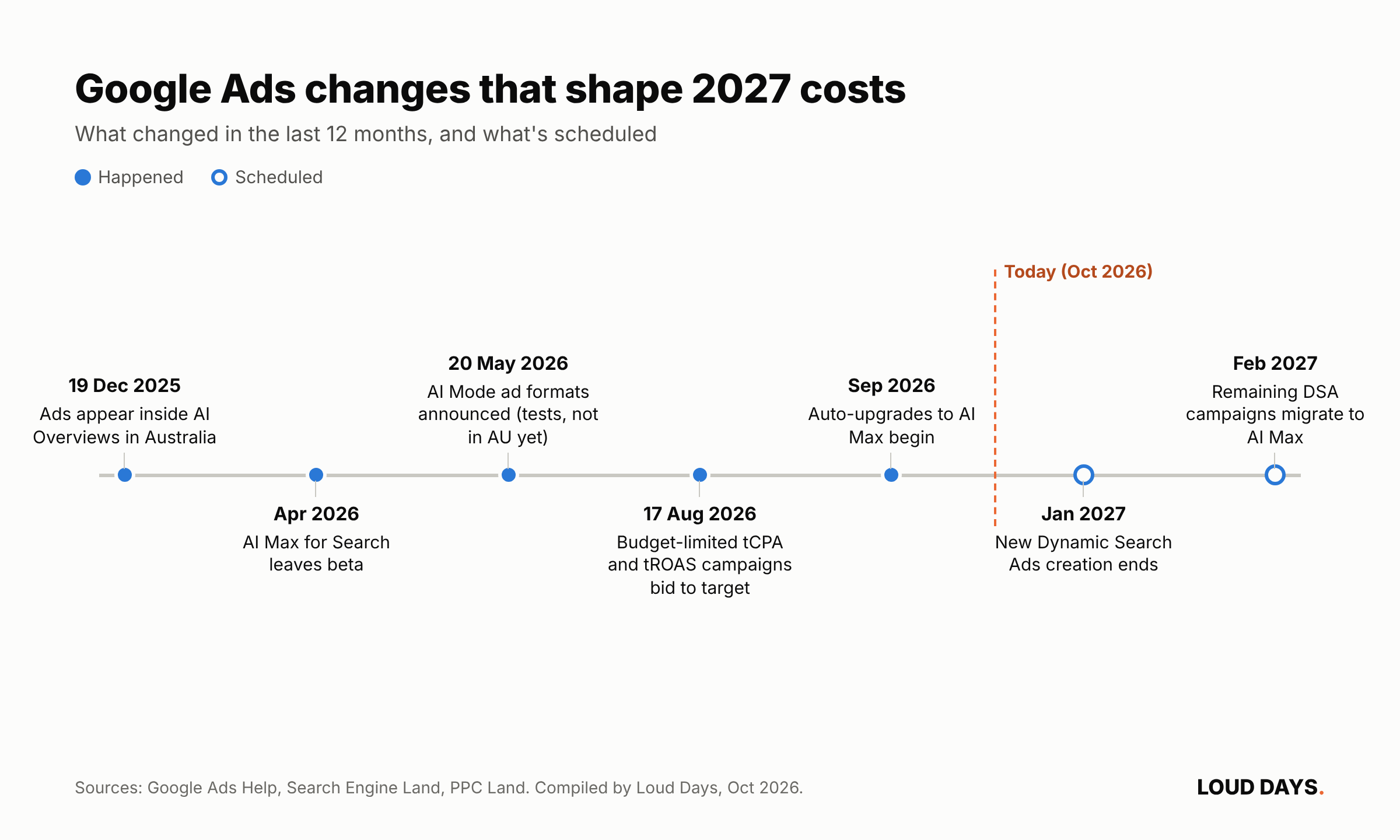
For 2027, plan on paying more per result if your account runs on autopilot. 4 platform changes from the last 12 months explain why.
1. Budget-limited campaigns now bid up to your target
From 17 August 2026, campaigns marked “Limited by budget” that use Target CPA or Target ROAS started delivering toward the target you entered. Google’s own example: a campaign with a $10 target CPA that was converting at $5 will drift toward $10 (PPC Land).
It covers Search, Shopping, Performance Max, Demand Gen and Travel. Google left everyone’s targets and budgets as they were and now treats each target as the number to hit.
What to do: compare each target with what the campaign actually achieved before 17 August. Then set a target your margins can live with, and stop leaving old numbers in place.
2. AI Max takes over Search, and Dynamic Search Ads retire
AI Max for Search left beta in April 2026. From September 2026, Google began upgrading campaigns that used automatically created assets or the campaign-level broad match setting.
Dynamic Search Ads get the same treatment soon. New DSA creation ends in January 2027, and Google starts migrating the rest in February 2027 (Search Engine Land).
AI Max matches your ads to searches beyond your keyword list. That can find new buyers. It can also spend money on searches you’d never have chosen. Brand exclusions, URL exclusions and a weekly look at search terms keep it honest. Our post on broad match vs exact match covers where each one earns its keep.
3. Your ads can now appear inside AI Overviews in Australia
Google expanded ads inside AI Overviews to Australia (English searches) on 19 December 2025 (PPC Land). Ads come from existing Search, Shopping and Performance Max campaigns.
There’s no separate report for these placements yet, and eligibility leans on broad match or keywordless targeting with Smart Bidding. More inventory means more auctions to win, so watch cost per lead closely. Our take on zero-click search trends explains what this does to organic traffic too.
4. AI Mode ads are coming, but they aren’t here yet
At Google Marketing Live on 20 May 2026, Google showed 4 new ad formats for AI Mode, including conversational ads and a lead-gen agent inside the ad. As of October 2026 they’re tests, with no confirmed Australian launch. Eligibility will run through AI Max and Performance Max.
How I’d set a 2027 Google Ads budget
- Rebuild the budget from target cost per lead, using current click prices.
- Assume click prices rise in your category; most rose in 2026.
Review every Target CPA and Target ROAS against real margins each quarter. - Move any DSA campaigns to AI Max yourself in January, in your settings.
- Read the search terms report every week.
For the wider picture, see our Google Ads trends roundup
Is Google Ads worth it for Australian businesses?
Google Ads is worth it when your cost per lead sits below what a lead is worth to you. You can check that before you spend a dollar.
Break-even cost per lead = average sale value × gross margin × close rate
Take an accounting firm where a new client brings A$2,400 in first-year fees at a 60% margin, and the firm wins 3 in 10 enquiries. It can pay up to A$432 per lead and still break even. At A$100 a lead (our earlier example), that’s a strong channel.
Now the plumber. An A$650 average job at 50% margin, with half of leads booked, gives a break-even of A$162.50. At A$130 per lead, the margin is thin, which is why a better landing page or repeat customers matter so much for trades.
For ecommerce, use ROAS. Break-even ROAS = 1 ÷ gross margin. At a 40% margin, you need a ROAS of 2.5 just to cover the ads. Our activewear example sat at 2.0, so it loses money on the first order unless customers come back. We go deeper in how to improve ROAS and how to reduce customer acquisition cost.
When Google Ads probably isn’t worth it (yet)
- Your budget is under A1,000 a month in a category where clicks cost A$15+
- You can’t track calls, forms or sales back to the ad
- Your landing page is slow or doesn’t match what people searched
- No one answers the phone during the hours your ads run
In those cases, fix the basics first or put the money into organic search. Our SEO vs Google Ads comparison walks through when each one wins.
How to lower your Google Ads cost without losing leads
The fastest way to cut cost per lead usually sits on your website. Here’s the order we work in on inherited accounts.
- Fix the landing page first. Match the headline to the search, cut form fields and load fast on mobile. Our CRO team starts here, and how to fix low website conversions lists the usual culprits.
- Read search terms every week. Add negatives for anything you’d never sell. This is where most budgets leak.
- Split brand and non-brand campaigns. Brand clicks are cheap and convert well. Mixed, they flatter results and hide expensive generic terms.
- Tighten location and schedule. Target the suburbs you actually service and the hours someone can answer the phone.
- Set targets you mean. Since the August 2026 change, a loose Target CPA costs real money.
- Clean up your Shopping feed. Better titles and product data win cheaper clicks. See our Google Shopping feed guide.
- Audit the account twice a year. Our paid search audit checklist and why your Google Ads aren’t converting cover what to check.