
Key takeaways
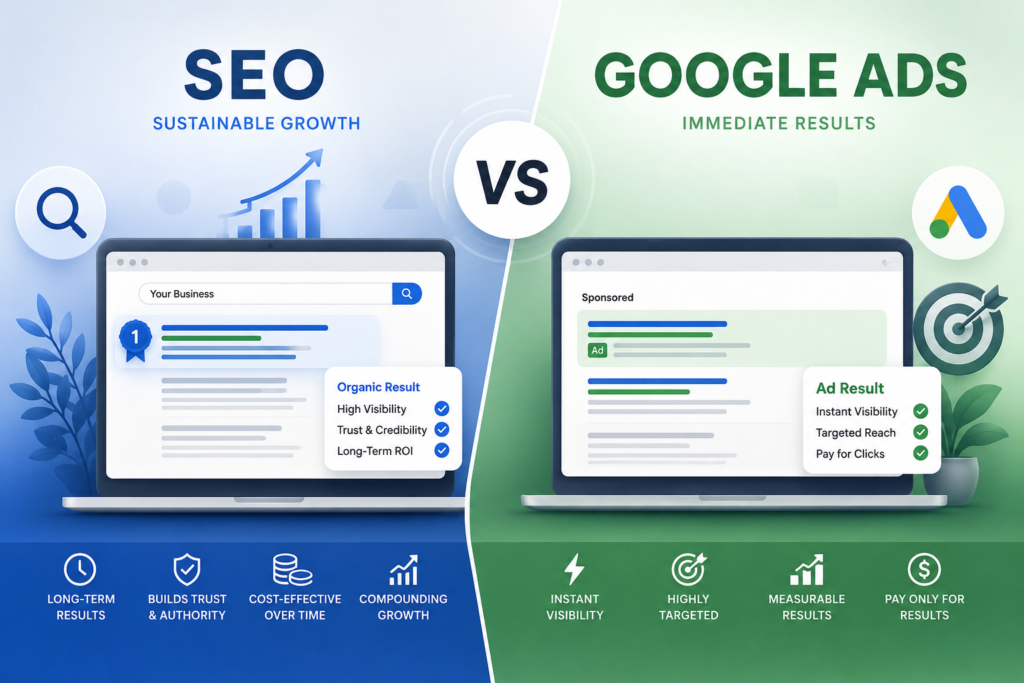
- SEO builds an owned acquisition asset, but it takes time to earn rankings, trust and qualified traffic.
- Google Ads delivers immediate visibility and tighter testing control, but traffic stops when spend stops.
- The strongest decision is rarely SEO or Google Ads. It is a channel mix matched to your margins, sales cycle, search demand and growth horizon.
- Use paid search to validate demand and capture urgent intent. Use SEO to reduce dependency on paid media and compound returns over time.
A business searching for SEO vs Google Ads is usually not choosing between two marketing tactics. It is deciding how to buy growth, how quickly revenue needs to move, and how much reliance it is willing to place on an auction it does not control. That distinction matters. Both channels can put your brand in front of high-intent customers, yet they create value in very different ways.
For Australian businesses, the right answer depends on commercial reality: average order value, gross margin, lead quality, buying cycle, brand awareness and the strength of competitors already occupying the search results.
SEO vs Google Ads: the commercial difference
Search engine optimisation (SEO) improves a website’s ability to appear in unpaid search results. It combines technical site health, useful content, authority signals and conversion-focused landing pages. The goal is not merely to rank. It is to earn profitable, relevant demand repeatedly without paying for every click.
Google Ads places paid listings in Google’s results through an auction. Advertisers bid on keywords, but position is not determined by bid alone. Google’s Ad Rank also considers ad and landing-page quality, expected impact from assets, and the context of the search. A better offer and more relevant experience can outperform a larger budget.
| Factor | SEO | Google Ads |
|---|---|---|
| Time to visibility | Usually months, especially in competitive categories | Often days once campaigns and tracking are ready |
| Cost model | Investment in strategy, content, technical work and authority | Pay per click, plus management and creative costs |
| Traffic durability | Can continue generating traffic after work is published | Stops as soon as budget is paused |
| Control | Less direct control over rankings and timing | High control over targeting, bids, messaging and budget |
| Best use | Building long-term demand capture and category authority | Capturing immediate demand, testing and promotions |
| Core risk | Investing without fixing technical, content or conversion gaps | Paying for unprofitable clicks or measuring the wrong outcome |
The table makes the trade-off clear. SEO is an asset-building program. Google Ads is a demand-capture and experimentation engine. Both need disciplined measurement to become commercially useful.
When Google Ads should lead
Google Ads should lead when speed matters. A new service launch, seasonal offer, stock clearance, event campaign or market-entry plan cannot wait six months for organic rankings to mature. Paid search also works well when a buyer signals urgency through a specific query, such as emergency repairs, legal advice, software demos or product availability.
It is also the faster way to learn what the market actually responds to. A campaign can test keyword themes, locations, offers, price points and landing-page messages in weeks. That information should influence SEO priorities. If a high-intent keyword produces qualified leads at an acceptable cost per acquisition, it is a stronger candidate for an SEO content and landing-page investment.
However, Google Ads is not a shortcut around strategy. Broad match keywords, weak negatives, generic ad copy and slow mobile landing pages can burn budget quickly. The click is only the beginning. If the sales team cannot follow up, the checkout leaks, or the CRM cannot identify qualified outcomes, an apparently efficient campaign can be deeply unprofitable.
A useful paid-search equation is:
Maximum cost per acquisition = gross profit per customer × acceptable acquisition percentage
For example, if a customer generates $1,000 in gross profit and the business can allocate 25 per cent of that to acquisition, the maximum sustainable CPA is $250. Work backwards from that number. Do not begin with an arbitrary monthly ad budget.
When SEO should lead
SEO should lead when your business has recurring search demand and a long enough horizon to build an advantage. This is especially true for eCommerce categories, B2B services, education-led purchases and local services with consistent demand across suburbs or regions.
The commercial case becomes stronger where paid click costs are high. If competitors are paying heavily for every click, a well-ranked organic result can improve blended acquisition economics over time. That does not make SEO free. Quality strategy, technical improvements, original content, digital PR and ongoing optimisation require investment. The difference is that effective work can keep producing after the initial cost is incurred.
An SEO agency also supports the research phase that Google Ads can struggle to cover profitably. Buyers may search broad questions before they are ready to enquire or buy. Helpful category pages, comparison content, calculators, guides and product education build familiarity before the final commercial search takes place.
But SEO is a poor fit for businesses that need revenue next week and have no existing search foundation. It is also a poor fit when there is little search demand, the offer is unclear, or the website fails to convert. Ranking more pages only amplifies a broken customer journey.
The hidden variable: search intent
The most expensive mistake is treating all search traffic as equal. A person searching for a product definition, a comparison, a price, a review or a local provider has different intent and different proximity to revenue.
Google Ads is typically strongest at the bottom of the funnel, where the query is specific and commercial. SEO can compete strongly there too, but it has a wider role across discovery, consideration and conversion. A buyer may first find your brand through an organic guide, return later via a branded Google Ad, then convert through a direct visit. Single-touch attribution rarely tells that story accurately.
Measure both channels against outcomes that matter: qualified leads, sales accepted by the team, gross profit, repeat purchase rate and customer lifetime value. Click-through rate and cost per click are diagnostic metrics, not business outcomes.
A practical allocation framework
Rather than splitting budget 50:50 by habit, use three questions.
First, how urgent is the revenue target? If the business needs measurable acquisition this quarter, fund Google Ads sufficiently to generate learnings and sales volume. Keep an SEO foundation running in parallel so every quarter does not begin at zero.
Second, is search demand proven? If not, use paid campaigns to test commercial intent before commissioning a large content program. If demand is proven and the same terms are repeatedly expensive, prioritise organic pages that can earn durable visibility.
Third, can the website convert? Before scaling either channel, check mobile speed, message match, forms, product detail, checkout friction and tracking. Marketing efficiency is often won or lost after the click.
A sensible starting point for an established business with immediate targets may be a paid-led mix, with 60 to 70 per cent of search investment in Google Ads and the balance in SEO foundations. A mature brand in a stable, high-search category may move progressively towards a more balanced mix as organic visibility grows. These are planning ranges, not universal rules. A high-margin lead generation business can sustain more paid spend than a low-margin retailer.
Build the channels to work together
The best search programs share data. Paid search query reports reveal the language customers use, objections they raise and locations where demand clusters. SEO data reveals topics, pages and non-branded queries that deserve paid protection or retargeting support. Landing-page tests from Ads can improve organic conversion rates, while strong SEO pages often become better paid destinations than generic campaign pages.
Use Google Ads to defend high-value branded searches, capture urgent commercial intent and test offers. Use SEO to earn non-branded visibility, answer buying questions and build a lower-dependency acquisition base. The objective is not channel purity. It is a measurable search system built to move revenue.
Benchmarks need context, not blind faith
Industry benchmarks can help identify problems, but they should not set your strategy. Google Ads click-through and conversion rates vary sharply by sector, device, location, auction pressure and whether a conversion is a form completion or a verified sale. Research published by platforms such as LocaliQ and WordStream consistently shows these differences across industries.
Your most useful benchmark is your own unit economics over time. Track impression share for valuable terms, organic share of non-branded traffic, paid CPA, blended customer acquisition cost, lead-to-sale rate and revenue per visitor. Review them together. A lower paid CPA is not a win if it produces lower-quality customers, and rising organic traffic is not a win if it does not create revenue.
Google’s search environment will keep changing, including richer result pages and AI-assisted answers. Businesses that invest in useful information, clear offers, credible brand signals and clean measurement will be better placed than those chasing a single ranking or a single cheap click. Start with the economics, test where the demand is, then build the search assets that make growth less rented and more durable.