
A paid social campaign can appear to miss half its purchases while Shopify, your CRM and bank account tell a very different story. That gap is why server-side tracking versus pixels has become a board-level measurement question, not a tag-management detail. The right answer is rarely to replace every pixel. It is to design a measurement system that preserves useful signal while respecting consent, privacy and data quality.
For Australian businesses spending across Google Ads, Meta, TikTok and programmatic media, the practical goal is clear: give platforms enough reliable conversion data to optimise towards revenue, without treating server-side tracking as a loophole around browser controls or customer consent.
Key takeaways
- Browser pixels remain valuable because they capture on-site behaviour in real time and support platform features such as remarketing.
- Server-side tracking can improve event reliability, control what data leaves your site and reduce losses caused by browser restrictions.
- Neither approach is automatically more accurate. Poor event definitions, duplicate transactions and mismatched identifiers can undermine both.
- The strongest setup is usually hybrid: browser events plus server events, deduplicated and governed by a clear consent model.
- Start with high-value events such as purchase, qualified lead and subscription, not every click on the site.
What pixels actually do
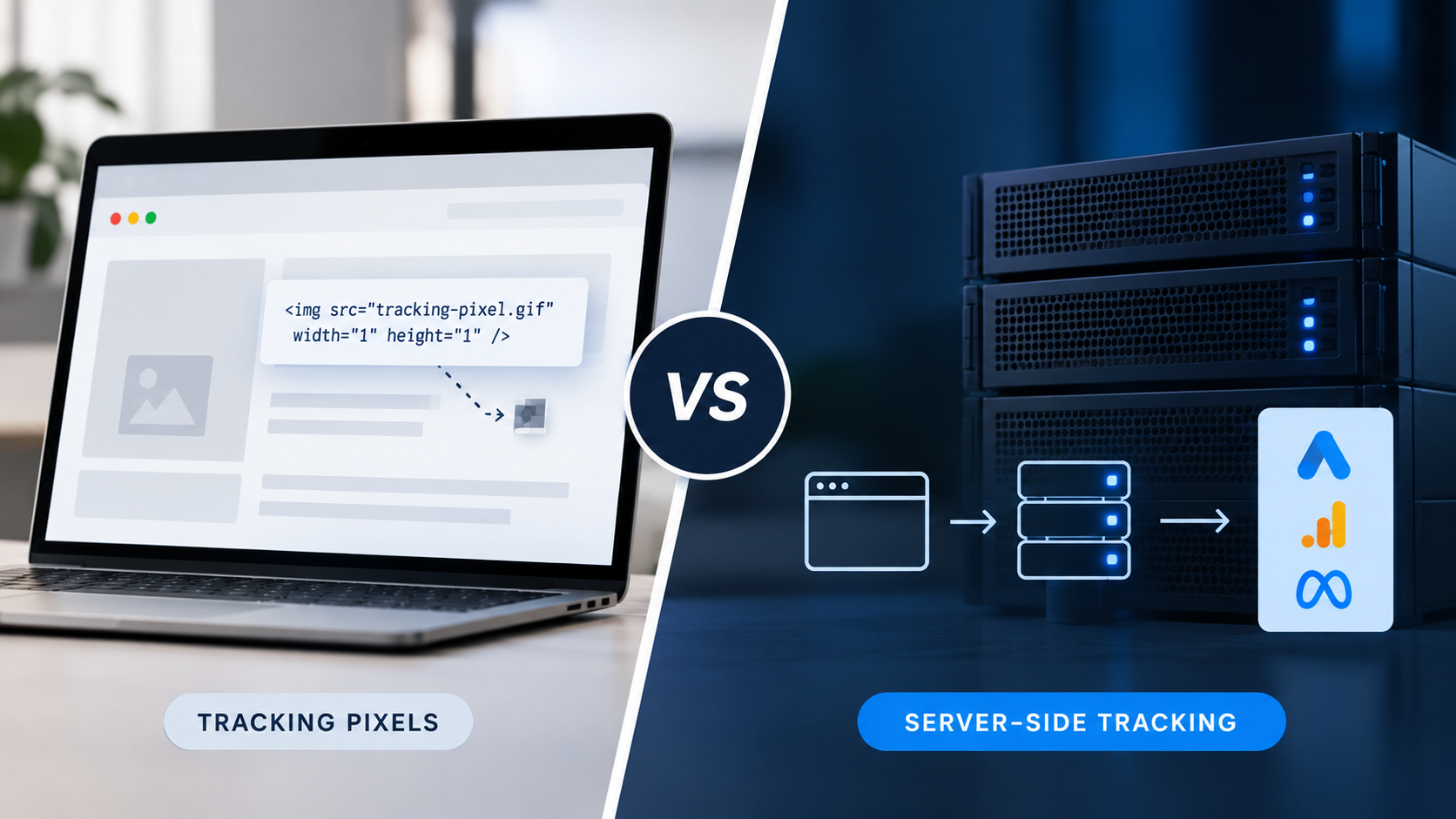
A pixel is a small piece of browser-side code. When someone loads a page or completes an action, the code sends an event directly from their browser to an advertising or analytics platform. A Meta Pixel might send a PageView, ViewContent, AddToCart and Purchase event; the Google tag might record a conversion and related campaign data.
Pixels are useful because the browser has immediate context: the page URL, referrer, device, campaign parameters and consent state. They are relatively quick to deploy and remain essential for many audience-building and on-site behavioural use cases.
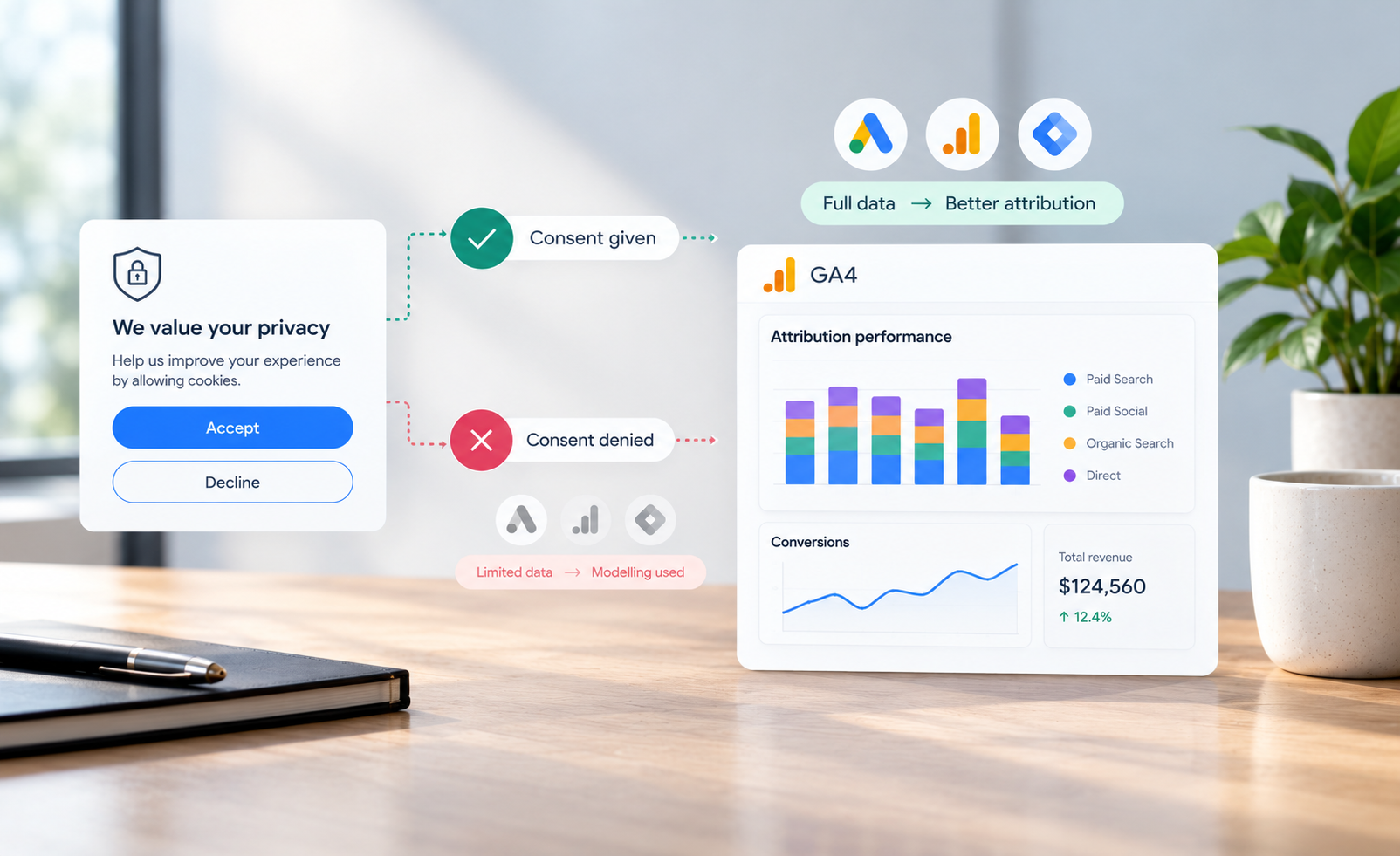
Their weakness is that the browser is not a controlled environment. Ad blockers, tracking prevention, cookie restrictions, network failures and consent choices can stop events from firing or reduce the identifiers attached to them. Safari’s Intelligent Tracking Prevention and similar browser changes have made that constraint familiar to any performance team comparing platform reporting with backend sales.
A pixel also only knows what the browser can see. If an order is later refunded, a lead is qualified by sales, or a phone enquiry becomes a customer, that value sits outside the browser unless it is deliberately sent back to the relevant platform.
How server-side tracking changes the data path
With server-side tracking, an event is sent from your server, ecommerce platform, CRM or a server-side tag-management environment to a destination such as Meta’s Conversions API or Google Ads enhanced conversions. Rather than relying entirely on a visitor’s browser to dispatch the event, your systems can confirm that a meaningful business action occurred and transmit a controlled record.
For a purchase, that record may include an order ID, transaction value, currency, product details, event time and privacy-safe matching information where consent permits it. For a lead-generation business, it may be a validated enquiry or an opportunity that reached an agreed sales stage.
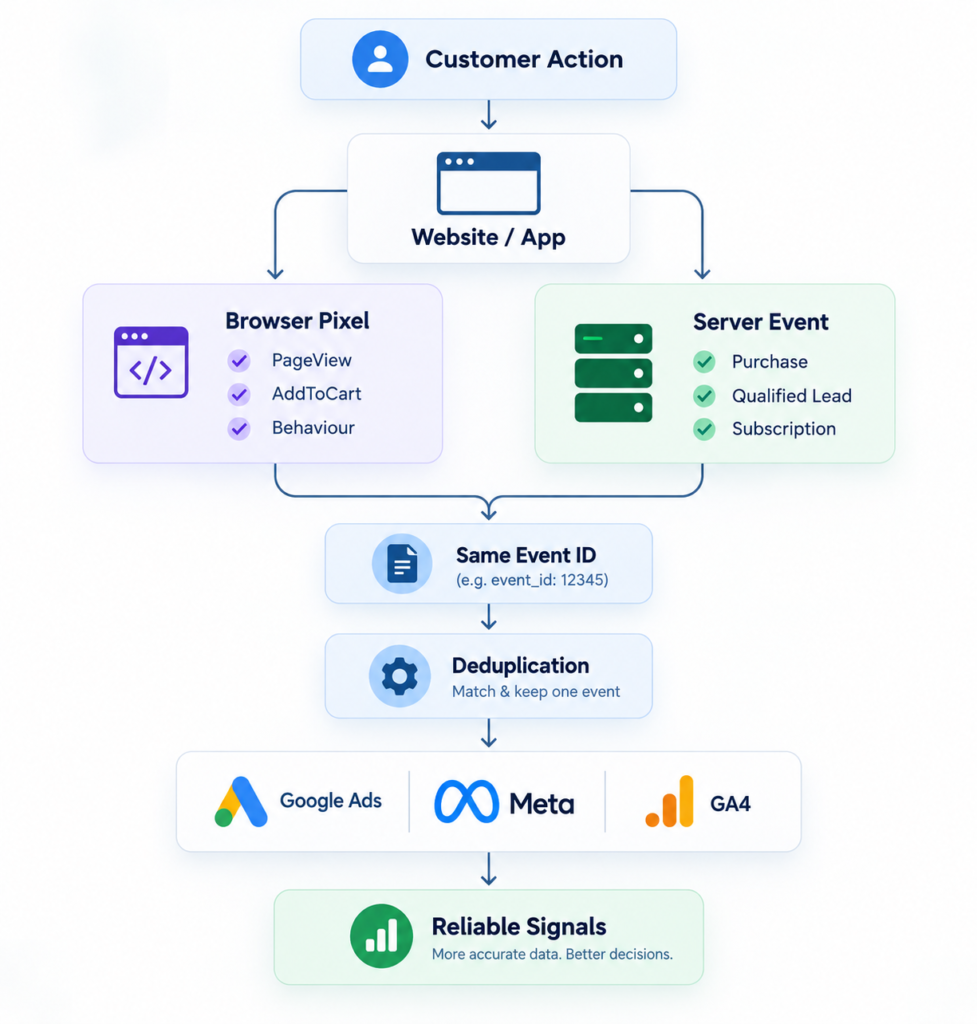
This makes consistent GA4 event tracking particularly important, because the events being measured need to reflect meaningful business actions rather than simply increasing the volume of reported interactions.
This improves resilience, but it does not make measurement magically complete. If the server event has no campaign context, weak matching data or an incorrect timestamp, the platform may struggle to attribute it. If the event fires before payment succeeds, it can overstate revenue. If the same purchase is sent by the browser and server without a shared event ID, you can count it twice.
The core difference at a glance
| Question | Browser pixel | Server-side tracking |
|---|---|---|
| Where does the event originate? | Customer’s browser | Your server, platform or controlled server container |
| Main strength | Fast behavioural context and audience signals | Greater control and resilience for confirmed business events |
| Main risk | Blocked or limited by browser, consent and network conditions | Poor implementation can create duplicates or detach events from campaign context |
| Best use | Page views, product views, add-to-cart activity, remarketing | Purchases, qualified leads, subscriptions, refunds and offline outcomes |
| Privacy implication | Data flows directly from browser to vendors | You decide what is sent, but consent obligations still apply |
Server-side tracking versus pixels is not a winner-takes-all decision
The common mistake is framing server-side tracking as a replacement for pixels. In most growth programmes, that creates a blind spot. Removing browser events can weaken audience building, reduce on-site context and make debugging harder. Keeping only browser pixels leaves revenue measurement exposed to an increasingly restrictive browser environment.
A hybrid architecture usually produces the most commercially useful result. The browser sends an event as the customer acts. The server confirms the event when your source of truth records it. Both events carry the same unique event ID so the receiving platform recognises them as one conversion, not two.
Think of the browser event as an early operational signal and the server event as the confirmation layer. This is especially effective for ecommerce purchases, subscription starts and leads that must pass fraud checks or qualification rules before they deserve optimisation value.
Meta and Google both provide documented approaches for pairing browser and server events. Their documentation should guide the technical build, but implementation choices should be driven by your measurement plan, not copied from a platform checklist.
Accuracy depends on the measurement design
Server-side tracking often improves observed conversion volume. That is not the same thing as proving every extra conversion was caused by advertising. Attribution remains a modelled estimate across channels, devices and time.
The more useful question is whether the setup produces a stable signal that helps bidding and budget decisions move revenue. Assess it against source-of-truth outcomes, not against a platform dashboard in isolation.
Use this practical hierarchy:
- Define the business outcome. A purchase is not always revenue if cancellations are material. A lead is not always value if most are unqualified.
- Choose the source of truth. For ecommerce, this may be the order management system. For B2B, it is often the CRM after defined qualification stages.
- Standardise event rules. Specify exactly when a conversion fires, what value it carries, how refunds are handled and which ID deduplicates it.
- Validate before scaling. Test transactions end to end, inspect duplicate rates and reconcile event counts against backend records.
- Optimise on the right depth of outcome. If possible, return qualified leads, revenue or margin signals rather than rewarding every form completion equally.
That final point matters. Better plumbing cannot compensate for a weak conversion definition. A campaign trained on low-quality leads can become very efficient at acquiring more low-quality leads.
Privacy and consent are design requirements
A first-party server endpoint does not remove privacy responsibilities. It simply changes the route data takes. Australian businesses still need to consider the Privacy Act 1988, the Australian Privacy Principles, their privacy policy, consent mechanisms and the contractual terms of each advertising platform. Businesses operating across jurisdictions may also face additional requirements.
The Office of the Australian Information Commissioner has made clear that organisations should be transparent about personal information handling. In practice, this means mapping what is collected, why it is sent, where it is sent and which consent state permits that processing. Obtain legal advice for your specific circumstances, particularly where sensitive information, health data, children or overseas disclosures are involved.
Do not send fields merely because an API accepts them. Minimise the data, hash identifiers where a platform requires it, honour consent choices and retain only what is necessary. Server-side tracking gives marketers more control. It also gives them more accountability.
A practical implementation framework
Begin with an event audit. List every event currently firing across analytics and media platforms, then identify which events are genuine commercial milestones. Most accounts benefit more from fixing Purchase, Lead, SubmitApplication and Subscribe than from adding another dozen micro-events.
If you are moving from a browser-only setup to a hybrid architecture, understanding how to implement server-side tracking can help you structure the event flow, consent rules and validation process correctly.
Next, create an event specification. It should document the event name, trigger, source system, value logic, currency, event ID, user identifiers, consent rule, destinations and owner. This prevents the familiar problem where development, paid media and analytics teams each hold a different definition of a conversion.
Then build the hybrid flow for one priority event. For example, an ecommerce brand may send AddToCart in the browser, then send Purchase from both browser and server using the same order-linked event ID. The server should fire only after the payment and order status meet your defined rule. Test this in platform diagnostics and against actual orders before expanding.
Finally, establish a monthly data-quality check. Compare backend orders, analytics transactions and platform-attributed conversions; review missing values, duplicate rates, refund treatment and any changes in consent rates. Measurement degrades quietly when checkout releases, app updates or CRM workflow changes occur.
When a pixel-only setup is still reasonable
Not every business needs a complex server-side build immediately. A small site with modest paid spend, a simple conversion path and reliable basic tracking may gain more from improving landing-page conversion rate, offer clarity or CRM follow-up first.
Server-side tracking earns its place when lost or unreliable conversion data is affecting bidding decisions, when transactions have meaningful value, when offline qualification matters, or when multiple platforms need consistent event logic. It should be treated as measurement infrastructure with an ongoing owner, not a one-off implementation project.
The best tracking setup is the one your team can explain, audit and trust when deciding where the next marketing dollar goes. Build for truthful signals, not inflated dashboards, and the technology will be far more likely to move revenue.