
Key takeaways
- A Google Ads conversion problem is rarely just an ad problem. It is usually a mismatch between search intent, the offer, the landing-page experience and measurement.
- Before changing bids or budgets, confirm that conversion tracking measures meaningful business outcomes accurately.
- High click-through rate with weak conversion rate typically signals an intent or landing-page issue. Low click-through rate usually points to keyword selection, ad relevance or positioning.
- Fix the largest commercial leak first. More traffic cannot compensate for an unclear offer, slow mobile experience or an enquiry process that goes nowhere.
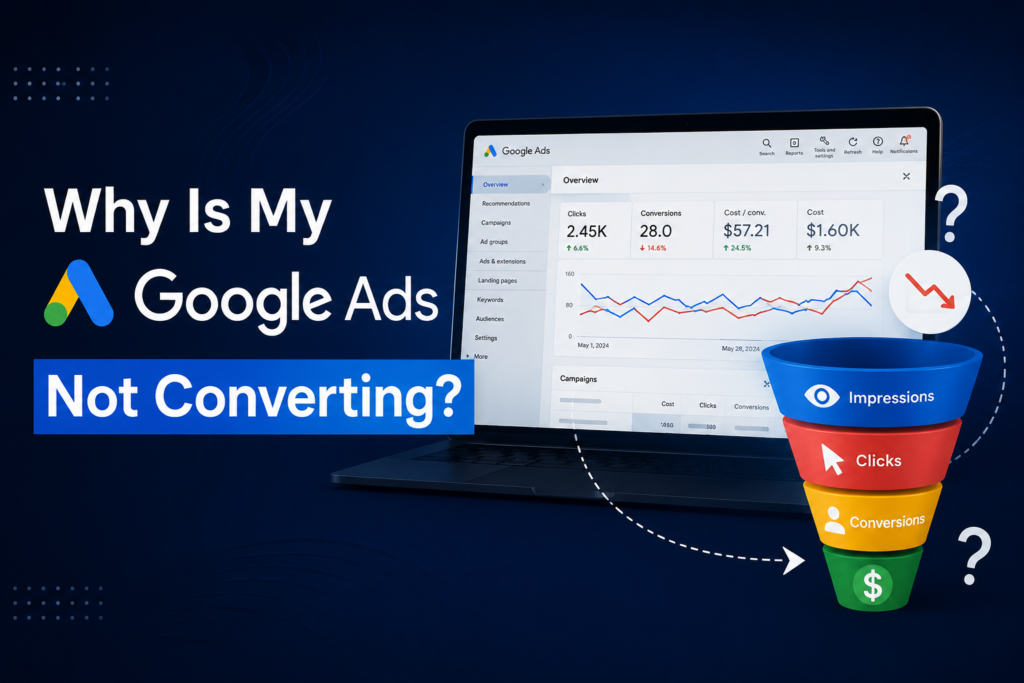
A campaign can look busy in Google Ads while doing very little for the business: impressions rise, clicks arrive and spend accumulates, yet revenue does not move. If you are asking, why is my Google Ads not converting, the answer is rarely a single setting. Paid search is a system. A break anywhere between the search query and the sale can make a campaign appear ineffective.
The commercial objective is not to generate clicks at the lowest possible cost. It is to acquire profitable customers with measurement you can trust. That distinction changes how you diagnose performance.
Start your campaign with the definition of a conversion
Google Ads can only optimise towards the actions you tell it matter. If a conversion is set as a page view, a button click or a three-second phone call, the platform may find more of those actions without finding more buyers.
For lead generation, primary conversions should usually include qualified form submissions, substantive phone calls and, where possible, confirmed appointments or opportunities imported from the CRM. For eCommerce, completed purchases and purchase value should be primary. Newsletter sign-ups, brochure downloads and add-to-cart events can still be useful diagnostic signals, but they should not automatically steer bidding.
This matters because automated bidding learns from conversion data. Feeding it weak signals trains it to buy more weak signals.
Audit tracking before judging campaign performance
Run a real test conversion on desktop and mobile. Check that the event fires once, records the correct value, attributes to the right Google Ads account and does not count duplicate thank-you-page reloads. Also check consent settings, cross-domain journeys, payment gateways and call tracking. These are common points of failure.
For lead businesses, the deeper issue is often offline quality. A campaign reporting 30 leads may have generated three sales-ready enquiries. Importing qualified leads and closed revenue back into Google Ads gives bidding a much stronger basis for decisions. It takes operational discipline, but it is built to move revenue rather than inflate dashboards.
Why is my Google Ads not converting? Follow the intent trail
A keyword can be relevant to your category and still be commercially wrong. Someone searching “marketing strategy template” has a different need from someone searching “digital marketing agency Melbourne“. Sending both users to the same service page and expecting identical conversion rates is poor demand capture.
Open the Search Terms report and review the actual language people used before clicking. Look for irrelevant themes, research-only queries, job seekers, DIY searches, competitor research and geographic mismatches. Add negative keywords where a query is clearly uncommercial. Do not over-prune merely because a query has not converted after one click. Use enough data to distinguish noise from a genuine pattern.
Match type also needs scrutiny. Broad match can work well alongside high-quality conversion data and smart bidding, but it can waste budget when tracking is shallow or the offer is vague. Exact and phrase match provide more control, particularly in low-volume, high-value B2B categories. The right mix depends on budget, market size and the quality of your feedback loop.
| Performance pattern | Most likely issue | First action |
|---|---|---|
| Impressions but few clicks | Ads do not match the search or competitors have a sharper proposition | Review search terms, ad relevance and offer differentiation |
| Clicks but no leads or sales | Poor intent, weak landing page or broken tracking | Validate tracking and compare search terms with landing-page message |
| Leads but poor sales quality | Conversion definition is too broad or qualification is weak | Track qualified leads and review enquiry pathways |
| Conversions at an unprofitable cost | Economics, bidding or conversion value is misaligned | Calculate allowable CPA and optimise to revenue or qualified pipeline |
Industry averages are only a directional reference. WordStream’s 2024 Google Ads benchmark research reported an average search conversion rate of 6.96% across industries, but a local emergency plumber, a high-consideration software provider and an Australian furniture retailer should not expect the same result. Your historical cost per acquisition, lead-to-sale rate, gross margin and customer lifetime value are more useful benchmarks.
Make the Google Ad earn the click
An ad should pre-qualify as well as attract attention. Generic copy such as “quality service” or “trusted experts” does little to establish why a buyer should click your result rather than the three surrounding it.
Use the headline and descriptions to make the offer concrete: product category, location or service area, price anchor where appropriate, turnaround time, proof point, eligibility requirement or outcome. If a prospect needs a minimum project budget, state it. You may lose low-value clicks, which is often a commercial win.
Asset coverage matters too. Add relevant sitelinks, callouts, structured snippets, price assets and image assets where eligible. These do not solve a weak strategy, but they can improve message depth and result-page visibility. Keep each asset connected to a decision a buyer needs to make, rather than filling space with generic claims.
The landing page is usually the conversion bottleneck
Paid traffic is impatient because it has alternatives one click away. A landing page should continue the exact conversation started by the keyword and ad. If the search is for “commercial solar installation Melbourne”, do not send visitors to a broad homepage that asks them to hunt through navigation.
The first visible screen on mobile should make four things clear: what you offer, who it is for, why it is credible and what happens next. A single, clear primary action is better than competing buttons that scatter attention.
Remove friction, but do not remove qualification
For a lead form, ask only for information needed to route and qualify the enquiry. Every extra field can reduce completion, though fewer fields may also increase lower-quality leads. There is no universal answer. Test form length against downstream sales quality, not form completions alone.
For eCommerce, conversion friction often sits in shipping costs revealed late, limited payment options, uncertain delivery windows, weak returns information or a mobile checkout that is harder than it needs to be. Review the full journey using real devices and real payment methods. Analytics can show a drop-off. It cannot tell you how frustrating the experience feels.
Page speed deserves attention, particularly on mobile networks. Compress heavy images, remove unnecessary scripts and minimise layout shifts. Speed is not a cosmetic technical metric. It affects buyer confidence and the number of people who remain long enough to assess the offer.
Check whether the numbers can work
A campaign may be converting but still failing commercially. Calculate your allowable cost per acquisition before choosing a target CPA or judging results.
For example, if a business earns $600 gross profit on a first purchase and retains $200 for acquisition after fulfilment and overheads, an initial CPA above $200 is not sustainable unless repeat purchase value justifies it. If only one in four qualified leads becomes a customer, a $200 allowable customer acquisition cost means the maximum qualified-lead cost is $50.
This calculation exposes strategy problems quickly. A $30 lead looks excellent until the sales team confirms that only one in 20 is viable. Equally, a $120 lead can be highly profitable when it reliably creates a $10,000 project. Optimise for the economic outcome, not the cheapest visible metric.
A practical 30-day repair sequence
Do not change keywords, ads, bids, audiences and landing pages all at once. You will create activity without learning what caused the result. Use a controlled sequence:
- In week one, validate tracking, conversion actions, values and CRM outcomes.
- In week two, analyse search terms, tighten negatives and separate materially different intent themes.
- In week three, rewrite ads around a clearer commercial proposition and align each major theme to an appropriate landing page.
- In week four, test one meaningful landing-page improvement, such as the offer, form structure, proof placement or mobile call to action.
Let changes gather sufficient data before declaring a winner. The required volume depends on traffic, conversion rate and sales cycle. A campaign with 20 clicks cannot support the same confidence as one with 2,000, so avoid overreacting to daily fluctuations.
When the issue is not Google Ads
Sometimes the account is doing its job and the market conditions are the real constraint. Demand may be seasonal, the price may be uncompetitive, the category may require more education than a search ad can provide, or the sales team may be responding too slowly. For high-consideration purchases, Google Ads often initiates research rather than producing an immediate transaction.
Review call recordings, form responses, lost-deal reasons and sales response times alongside campaign data. If enquiries consistently ask for something you do not offer, the campaign needs tighter targeting. If prospects like the offer but disappear after receiving a quote, the bottleneck sits beyond paid media.
Treat Google Ads as a measurable acquisition system, not a vending machine. The most profitable improvements usually come from sharper intent, stronger signals and fewer hand-offs between the click and the customer.