
A paid campaign can generate real sales while reporting makes it look average. That gap is increasingly common as browsers restrict cookies, ad platforms lose signal and customers move between devices. Knowing how to implement server-side tracking gives your business more control over the data it collects, validates and sends to marketing platforms – but it is not a shortcut around consent or poor measurement design.
Server-side tracking is a measurement infrastructure decision. Done well, it helps protect first-party data, improve event quality and give platforms cleaner signals for optimisation. Done badly, it duplicates conversions, inflates revenue and creates a privacy risk that lands with the business, not the technology vendor.
What server-side tracking actually changes
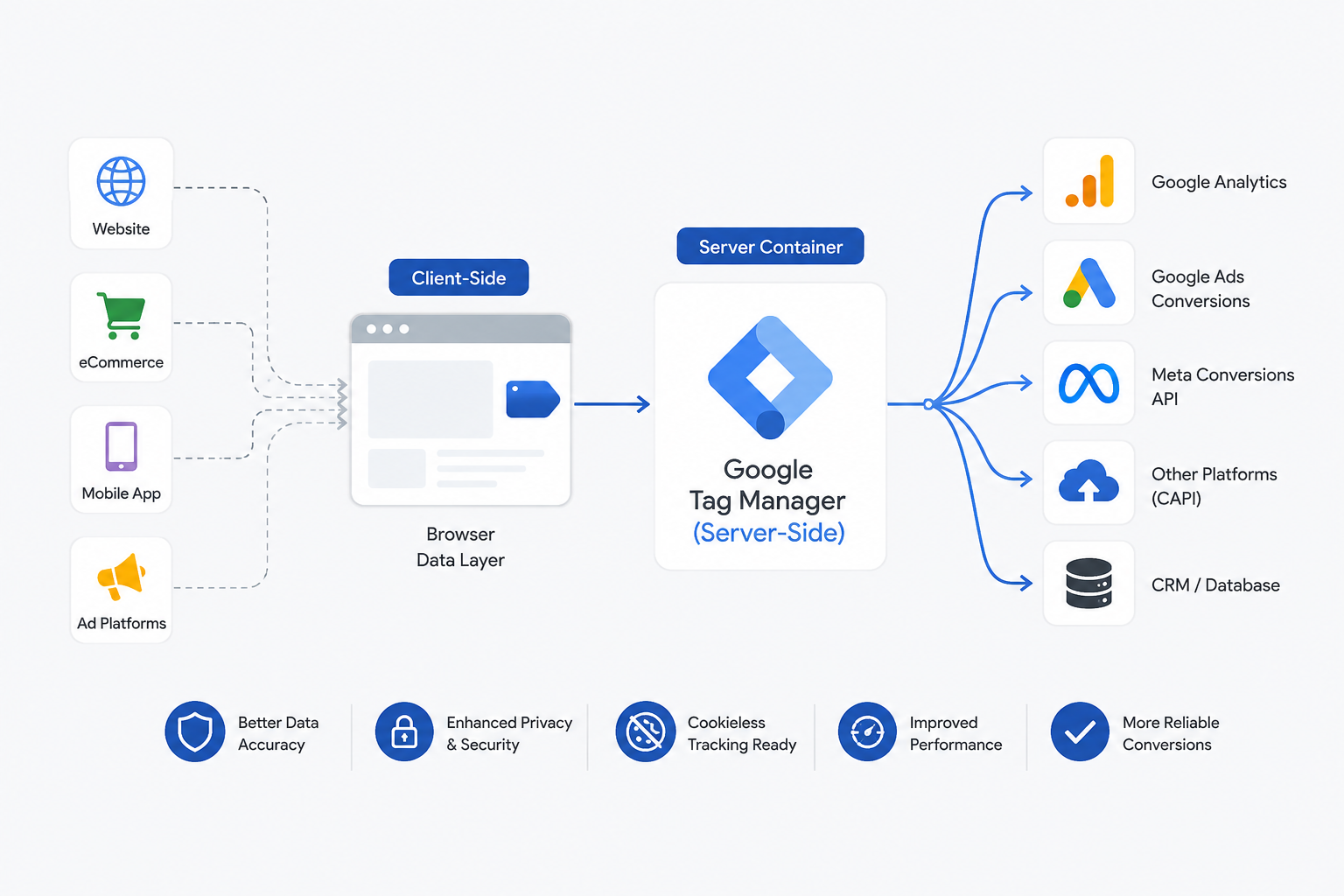
With conventional browser-side tracking, a visitor’s browser sends events directly to tools such as Google Analytics, Google Ads, Meta or a customer data platform. Browser privacy controls, ad blockers, network failures and cookie restrictions can interrupt that journey.
With server-side tracking, the browser sends a smaller, controlled set of events to a server-side endpoint that your business manages. That endpoint validates, enriches and routes the data to approved destinations. In many implementations, Google Tag Manager server-side is the collection and routing layer, hosted on a cloud environment or through a managed provider.
The important distinction is control. A server container does not magically make anonymous users identifiable, nor does it authorise the collection of data without consent. It allows you to decide which fields are useful, remove fields that should not leave your environment and standardise data before it reaches each platform.
For an eCommerce business, a purchase event might include an order ID, transaction value, currency, product IDs and a consent status. The server can check that the order exists in the commerce platform, remove unnecessary customer details, then send appropriately formatted events to analytics and advertising platforms. That is materially more reliable than relying solely on a thank-you-page browser tag.
Start with a measurement plan, not a server container
The common implementation mistake is treating server-side tracking as an IT task. It is a commercial measurement project first. Before choosing infrastructure, define what decisions the data needs to support.
For most businesses, that means agreeing on the conversion events that move revenue: lead submitted, qualified lead, checkout started, purchase completed, subscription renewed or booked consultation attended. Each event needs one accountable definition. If the sales team calls a lead qualified only after a phone assessment, do not label every form completion as a qualified lead in your reporting.
Create an event specification for each priority event. It should document the event name, trigger, owner, required parameters, destinations, consent requirements and deduplication method. This prevents the familiar situation where Google Ads, Meta, GA4 and the CRM all report a different number because each has been configured independently.
A practical event specification answers four questions:
| Question | Example for a purchase event |
|---|---|
| What happened? | A paid order was created in the commerce platform. |
| What proves it? | A confirmed order ID and payment status. |
| What value matters? | Net revenue, currency, tax and shipping treatment. |
| Who can receive it? | Only platforms permitted under the customer’s consent choice. |
This work is unglamorous. It is also where measurable success begins.
Choose the right server-side architecture
There is no single best setup. The right architecture depends on your traffic volume, commerce platform, engineering capability, data sensitivity and the tools that need events.
For a smaller lead-generation site, a managed server-side Google Tag Manager environment may be enough. It can receive browser events, apply consent rules and forward conversions to Google Ads, GA4 and Meta’s Conversions API. The trade-off is ongoing hosting cost and less flexibility than a fully custom event pipeline.
For a high-volume eCommerce operation, a hybrid approach is often stronger. Browser events capture customer interactions such as product views and add-to-cart actions, while the backend sends authoritative purchase, refund and subscription events directly from the order system. The backend should be the source of truth for revenue. A browser confirmation page can fail; a paid order record is harder to dispute.
Avoid sending every available data point simply because the server can process it. Data minimisation reduces risk, makes debugging easier and keeps your event model useful. If a field does not improve reporting, attribution, personalisation or operational delivery, question why you are collecting it.
The practical steps to implement server-side tracking
1. Audit the current tracking setup
Document every existing browser tag, pixel, conversion action and data layer event. Look for duplicate tags, inconsistent event names, hard-coded scripts and conversions firing on page loads rather than confirmed business outcomes.
Then compare platform reporting with source systems. For example, reconcile website purchases against the commerce platform and leads against the CRM. The purpose is not to force every tool to match exactly. Attribution models differ. The goal is to expose preventable implementation errors before you move them server-side.
2. Build a clean first-party event layer
Your website needs a consistent way to pass event data. For many sites, that is a structured data layer; for more advanced stacks, it may be an application event bus or backend API.
Use stable identifiers. An `event_id` should be generated for each conversion so the same event can be recognised across browser and server channels. An `order_id` should identify the commercial transaction. Product IDs, currency and revenue should follow one agreed format.
Do not use email addresses, phone numbers or other personal information as casual tracking parameters. Where advertising platforms support privacy-safe matching, apply their required hashing methods and only send data when your consent framework permits it. Hashing is a security control, not a substitute for consent.
3. Configure consent before data is routed
Consent must influence what the server does, not merely what a cookie banner displays. Map your consent categories to each vendor and event type. If an individual declines advertising storage, the server should not forward advertising identifiers or user data for advertising measurement.
Google’s Consent Mode can support consent-aware measurement when correctly configured, while platform-specific APIs have their own requirements. The Office of the Australian Information Commissioner’s guidance on privacy emphasises transparency, purpose limitation and reasonable handling of personal information. Your legal and privacy teams should validate the configuration for your circumstances, particularly where customer data is shared with overseas platforms.
4. Deploy the server endpoint and destinations
Set up the server-side environment, configure a first-party subdomain where appropriate, and route approved web events to it. Then configure destination tags or APIs for the platforms that matter to your acquisition strategy.
Start with a narrow set of high-value events. For most brands, that is purchase, lead, qualified lead and perhaps add to cart. Expanding to dozens of low-value events before the core events are verified creates noise, not insight.
Use a shared event ID when sending the same conversion from browser and server to a platform that supports deduplication. Meta’s Conversions API and Meta Pixel, for example, rely on aligned event names and event IDs to identify duplicate events. Without this, reported conversions can rise for the wrong reason.
5. Validate against business records
Testing should happen at three levels: the browser, the server endpoint and the receiving platform. Use test orders or test leads, inspect the event payload and confirm that the destination received the correct event once.
For revenue events, check order ID, value, currency and product data. For leads, check that a genuine successful submission triggers the event once, while validation errors, refreshes and duplicate submissions do not.
Run a reconciliation report weekly during the first month. A useful formula is:
Tracking coverage = confirmed conversions received by the measurement system / confirmed conversions in the source system × 100
Coverage will not be 100 per cent in every channel because consent choices and platform rules affect what can be shared. The objective is to understand the gap, reduce technical loss and avoid pretending that modelled attribution is the same as a verified sale.
The trade-offs decision-makers should expect
Server-side tracking improves control, but it creates new responsibilities. Hosting has a cost. Implementations require technical ownership. Debugging shifts from a marketing browser extension to logs, payloads and server configurations. If nobody owns the event schema after launch, it will drift as the website, checkout and CRM change.
It also does not remove platform dependency. Google, Meta and other vendors still apply their own attribution rules, matching logic and reporting windows. Better event delivery can improve campaign optimisation, but it cannot tell you with certainty that one channel caused every reported conversion.
For that reason, pair server-side tracking with a broader measurement approach: source-of-truth revenue reporting, CRM lifecycle tracking, incrementality testing where budgets justify it, and regular channel-level profitability reviews. Attribution is directional intelligence. Finance-grade revenue records remain the final reference point.
When server-side tracking is worth prioritising
Prioritise it when paid media is a meaningful growth lever, browser tracking is visibly unreliable, or the business needs cleaner conversion data across advertising platforms and a CRM. It is particularly valuable for eCommerce brands with meaningful transaction volume, lead-generation businesses with offline qualification stages and organisations managing customer data across several systems.
If your website has low traffic, no defined conversion events and an unreliable CRM, fix those foundations first. A sophisticated server container cannot repair vague lead definitions or sales data that is never reconciled.
The strongest implementation is not the one with the most tags. It is the one that gives leadership a clearer view of demand, lets media teams optimise toward outcomes that matter and respects the choices customers make about their data. That is measurement built to move revenue.