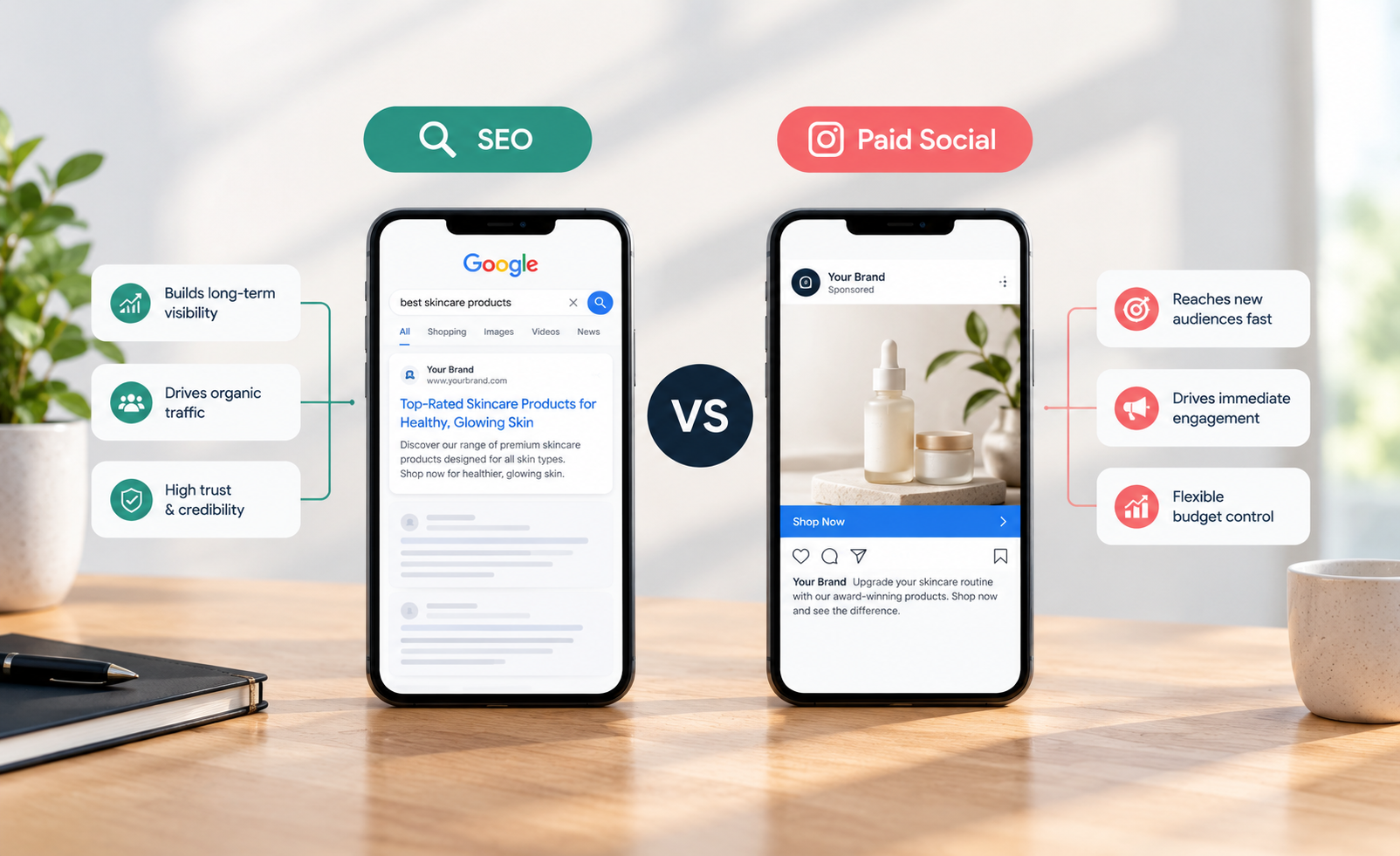

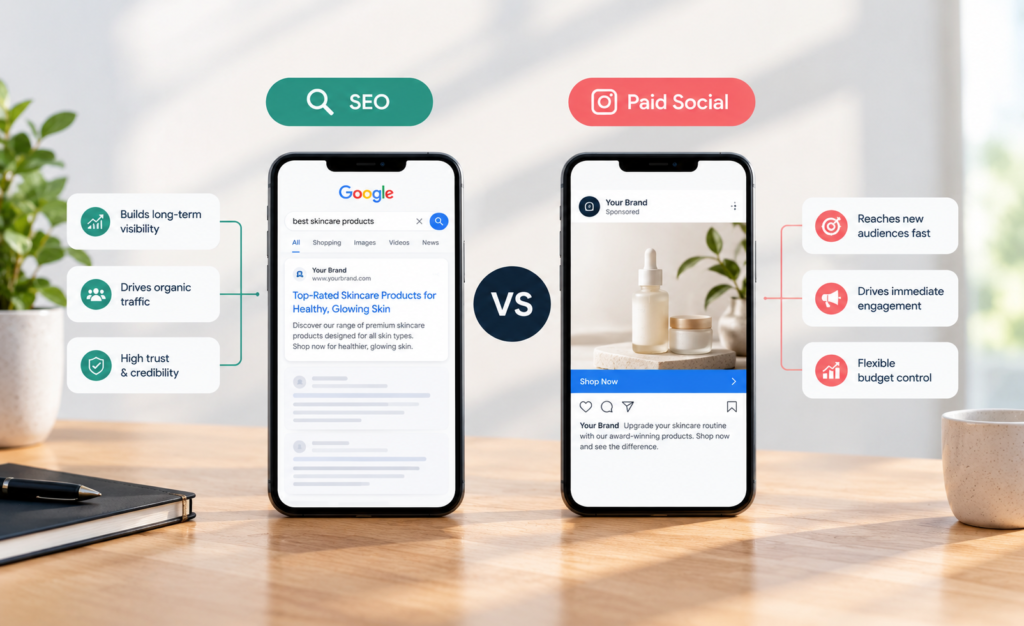
A founder searching for “best accounting software for small business” and a scroller pausing on an Instagram video are not in the same buying state. That is the central distinction in SEO vs paid social. One channel captures existing demand; the other creates, shapes and accelerates demand before a buyer starts searching.
Treating them as interchangeable budget lines leads to poor channel decisions. SEO can look slow when a business needs immediate revenue. Paid social can look expensive when teams measure it only against last-click sales. The smarter question is not which channel wins. It is what role each channel should play in a measurable acquisition system.
Key takeaways
- SEO is strongest when people already have a problem, category or brand in mind and are actively looking for answers.
- Paid social is strongest when a business needs to reach defined audiences, test messages quickly or create demand for products people are not yet searching for.
- SEO compounds over time, but requires technical quality, useful content and credible brand signals. Paid social delivers speed and control, but its reach stops when spend stops.
- The best allocation depends on purchase frequency, sales cycle, search demand, creative strength, margins and the quality of measurement.
SEO vs paid social: the commercial difference
SEO earns visibility in organic search results. Its core advantage is intent. When a person searches “emergency plumber Melbourne”, “reformer Pilates near me” or “compare business energy plans”, they are signalling a need now. A well-built search presence can put a business in front of that demand without paying for every click.
Paid social buys attention within platforms such as Meta, TikTok and LinkedIn. Targeting can use broad audiences, first-party customer lists, engagement signals and platform optimisation models. Its core advantage is interruption with relevance: putting an offer, product demonstration or point of view in front of people who may fit the customer profile but have not begun a search journey.
That difference affects every major planning decision. SEO is usually demand capture. Paid social is usually demand creation, consideration and retargeting. Both can contribute to revenue, but they should not be judged by identical timelines or attribution rules.
| Decision factor | SEO | Paid social |
|---|---|---|
| Primary strength | Captures high-intent demand | Creates and accelerates demand |
| Time to meaningful signal | Often months | Days or weeks |
| Cost structure | Upfront investment in content, technical work and optimisation | Ongoing media spend plus creative production |
| Durability | Can generate traffic after publication and optimisation | Delivery declines when spend is paused |
| Best measurement lens | Non-brand visibility, qualified organic traffic, assisted and direct conversions | Incremental lift, new-customer acquisition, contribution margin and blended efficiency |
When SEO deserves more budget
SEO services in Australia deserve priority when a business operates in a category with clear, recurring search demand and can convert that demand effectively. For an Australian eCommerce retailer, that may mean category, comparison and problem-solving searches. For a B2B software company, it may mean solution pages, use cases and high-quality educational content that supports a long consideration cycle.
The commercial case becomes stronger when paid search costs are high. Organic visibility for valuable non-brand terms can reduce reliance on auction-based acquisition, especially where customers research repeatedly before purchasing. It also provides an owned discovery asset. A useful guide or category page can continue attracting qualified visitors long after the initial production cost.
However, “invest in SEO” is not a strategy on its own. Search performance depends on technical accessibility, site architecture, product or service page quality, internal linking, content depth, page experience and genuine authority. Publishing a high volume of generic articles will not create a defensible organic channel, particularly as search results increasingly answer simple queries directly and AI-generated content raises the quality bar.
SEO is less attractive as the sole growth lever when there is little relevant search volume, the proposition is genuinely new, or a business needs evidence of demand within weeks. In those cases, waiting for rankings can be a costly form of indecision.
What to measure in SEO
Avoid reporting organic sessions as the headline outcome. Separate branded from non-branded traffic, then track rankings and impressions for commercially relevant topics, qualified leads or purchases, conversion rate, revenue, and assisted conversions. For eCommerce, measure organic revenue by category and new versus returning customer behaviour. For lead generation, connect form fills and calls to qualified pipeline where possible.
Search Console, analytics platforms and CRM data each show part of the picture. None should be treated as the entire truth. SEO often influences a buyer before a later direct, paid or branded conversion.
When paid social deserves more budget
Social media services are built for speed, creative testing and audience development. It is particularly valuable when a brand has a product worth demonstrating, a distinctive offer, strong customer proof, or a need to learn which messages actually change behaviour.
A direct-to-consumer brand launching a new product may use short-form video to test objections, usage occasions and price framing within a fortnight. A B2B company may use LinkedIn to distribute a useful research asset to a defined seniority and industry group, then retarget engaged visitors with a conversion-focused message. Neither use case relies on customers knowing the exact phrase to search.
The trade-off is volatility. Auction prices, creative fatigue, privacy settings, platform changes and competitive activity all affect results. A campaign that performs well in one month can weaken quickly when its creative stops earning attention. Paid social therefore requires a production system, not one polished ad that runs indefinitely.
Creative is also a targeting tool. With platform targeting becoming broader and more automated, the ad itself does more of the filtering. The first two seconds, the problem being shown, the proof offered and the clarity of the landing-page promise influence both response and quality of traffic.
What to measure in paid social
Platform-reported return on ad spend is useful, but it is not a complete measure of business performance. It can over-credit ads that reached people already likely to buy, especially in retargeting-heavy accounts.
Assess paid social through a wider scorecard: new-customer revenue, customer acquisition cost, contribution margin after media spend, frequency, creative-level conversion rate, blended revenue efficiency and cohort retention. Where spend is material, use holdout tests, geo experiments or carefully designed budget changes to estimate incrementality. The question is not merely whether Meta reported a sale. It is whether the spend generated sales that would otherwise not have occurred.
The channel mix that usually works
For most growth businesses, the practical answer to SEO vs paid social is sequencing rather than substitution. Paid social identifies messages and offers that earn attention. SEO turns proven themes into durable pages that capture future search demand. SEO content then gives paid social stronger audiences for retargeting, while social campaigns can increase branded search and direct traffic that signal growing market awareness.
Consider a premium skincare brand. Paid social might test whether customers respond more strongly to sensitive-skin reassurance, ingredient transparency or before-and-after proof. Once a theme consistently drives quality purchases, the brand can build organic content around related search behaviour: ingredient comparisons, routines, product selection and common skin concerns. The channels perform different jobs but inform the same commercial strategy.
Budget allocation should follow constraints, not habit. A business with a low-margin impulse product may need tightly controlled paid social tests and rapid creative iteration. A firm with a high-value, research-heavy purchase may gain more from building authoritative organic resources while using paid social to stay visible during a long decision cycle.
A useful planning formula is:
Channel investment = expected incremental profit over the decision period, adjusted for confidence and time to return.
This prevents a common error: comparing this month’s paid social revenue with SEO activity that may produce value for years. Put both channels on a consistent time horizon, then account for the residual value of organic assets and the ongoing cost required to sustain paid reach.
Common mistakes that distort the decision
The first mistake is forcing paid social to deliver immediate last-click profitability when its job is prospecting. The second is treating SEO as free traffic and underfunding the technical, editorial and conversion work required to make it perform. The third is using channel-level attribution as proof of causation.
There is also a measurement mistake: optimising each channel in isolation. If cutting prospecting spend causes branded search, direct traffic and conversion acquisition cost to fall, the paid social campaign may have been creating more value than its dashboard suggested. If paid social repeatedly retargets organic visitors, its reported revenue may be overstated. Cross-channel reporting and controlled testing matter because customer journeys are rarely tidy.
The right decision is not to crown a winner. Build SEO where intent and long-term economics justify the investment. Use paid social where creative, targeting and speed can create momentum. Then measure both against the outcome that matters: profitable customer growth, not channel vanity metrics.
The businesses that outperform do not ask which dashboard looks better this week. They build a system where attention becomes demand, demand becomes search, and search becomes measurable revenue.