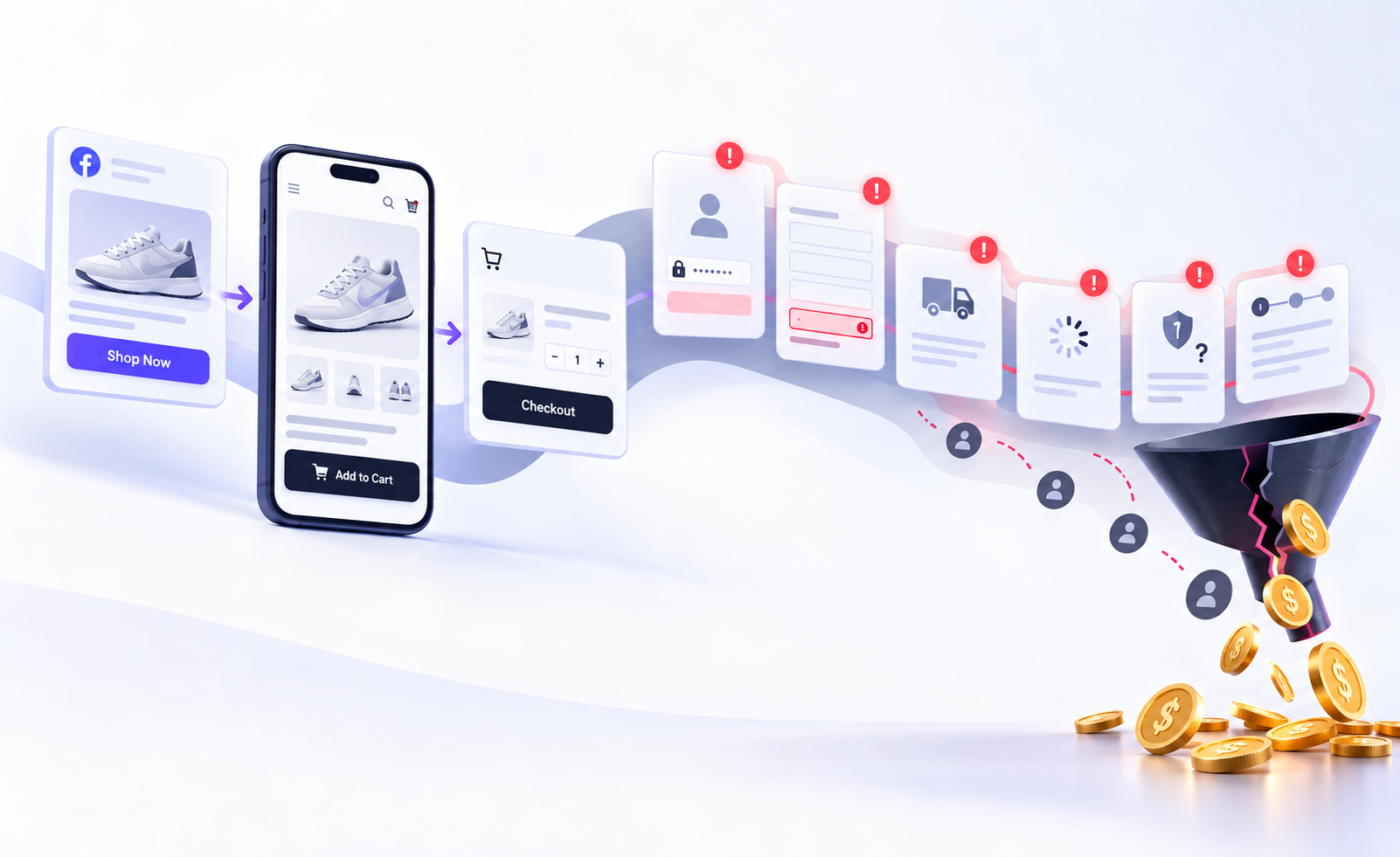

A customer has found the right product, accepted the price and clicked through from an ad. Then they are asked to create an account, hunt for delivery information or re-enter details their browser already knows. That is conversion friction: any unnecessary effort, uncertainty or delay between intent and a valuable action.
For founders and marketing leaders, friction is not a design nitpick. It is a revenue problem that can make paid acquisition look unprofitable, depress organic conversion rates and distort decisions about product demand. The practical goal is not to remove every step. It is to remove work that does not help the customer make a confident decision or help the business manage genuine risk.
Key takeaways
- Conversion friction combines effort, confusion, perceived risk and delay. It occurs well before checkout, not only on forms.
- The highest-value fixes sit where substantial traffic meets a clear behavioural drop-off and a plausible customer problem.
- Reducing friction without protecting trust can backfire. Some fields, proof points and confirmation steps earn their place.
What conversion friction actually means
Conversion friction is the gap between a buyer’s motivation and their ability to act. It can be functional, such as a slow product page or an error-prone postcode field. It can be cognitive, such as unclear plan differences or a button label that gives no clue what happens next. It can also be emotional: a shopper who is unsure about returns, delivery timing, data security or whether a business is legitimate may postpone the decision rather than object.
This distinction matters because teams often treat friction as a UX issue alone. A faster checkout is valuable, but it will not repair an offer that lacks proof, a confusing pricing structure or an ad that promises something the landing page does not explain. Conversion rate optimisation works when the whole decision path is considered: message match, information hierarchy, usability, reassurance and measurement.
Baymard Institute’s ongoing checkout usability research is useful context. Its aggregated research has consistently placed average online cart abandonment at about 70%, while identifying avoidable checkout complexity as a material contributor. Not every abandoned cart represents a preventable loss. People compare prices, save products for later and use carts as wish lists. The commercial task is to isolate abandonment caused by obstacles your business can credibly remove.
Where conversion friction appears
Friction usually compounds. A single awkward field may not matter. An unclear delivery promise, a surprise fee, a forced account, and a coupon box that sends shoppers searching for discounts can turn a willing buyer into an abandoned session.
| Stage | Common friction | Commercial consequence |
|---|---|---|
| Ad to landing page | Message mismatch or slow load time | Paid clicks fail to become engaged visits |
| Product or service page | Weak proof, vague specifications or unclear value | Visitors cannot justify the next step |
| Cart | Delivery costs revealed late or distracting promotions | Purchase intent weakens |
| Checkout | Excess fields, account creation or validation errors | High-intent customers abandon |
| Lead generation | Generic forms and uncertain follow-up expectations | Fewer qualified enquiries |
For B2B businesses, the equivalent of checkout friction is often a contact experience that asks for too much before providing enough. A prospect researching a complex purchase may accept a short form in return for a useful benchmark, but not a demand for budget, staff count and phone number before they understand the value of the asset. The right amount of friction depends on the commitment being requested.
The four types of conversion friction
1. Effort friction
Effort friction is physical or procedural work. It includes lengthy forms, poor mobile tap targets, hard-to-edit carts, mandatory account creation and address fields that do not support autocomplete. Mobile deserves special attention because users are often interrupted, on a weaker connection or less willing to type.
A useful question is simple: could this task be completed with fewer inputs, fewer screens or better defaults? Removing a field is not always the answer. For example, collecting a delivery preference may reduce support costs and failed deliveries. The test is whether the information creates customer value or meaningful operational value at that moment.
2. Clarity friction
Clarity friction occurs when people cannot quickly understand what they are buying, what it costs or what follows a click. Ambiguous calls to action such as “Submit” add uncertainty. So do pricing pages that make comparison difficult, product pages that bury key specifications, and lead forms that fail to explain who will respond or when.
Good conversion copy reduces interpretation. Replace generic labels with specific expectations: “See available appointment times”, “Get the trade account application” or “Continue to secure payment”. This is not cosmetic wording. It lowers the perceived risk of moving forward.
3. Trust friction
Trust is earned through evidence, not decorative badges. Reviews, clear returns information, delivery dates, warranty details, transparent fees and accurate stock status can all reduce hesitation when they answer a real buying question.
Trust friction is especially costly when the request is sensitive. A first-time visitor may be comfortable sharing an email for a useful resource but reluctant to enter card details if shipping and returns are unclear. The solution is not to cover every page in logos. Put proof close to the moment of doubt and make policies easy to understand.
4. Performance friction

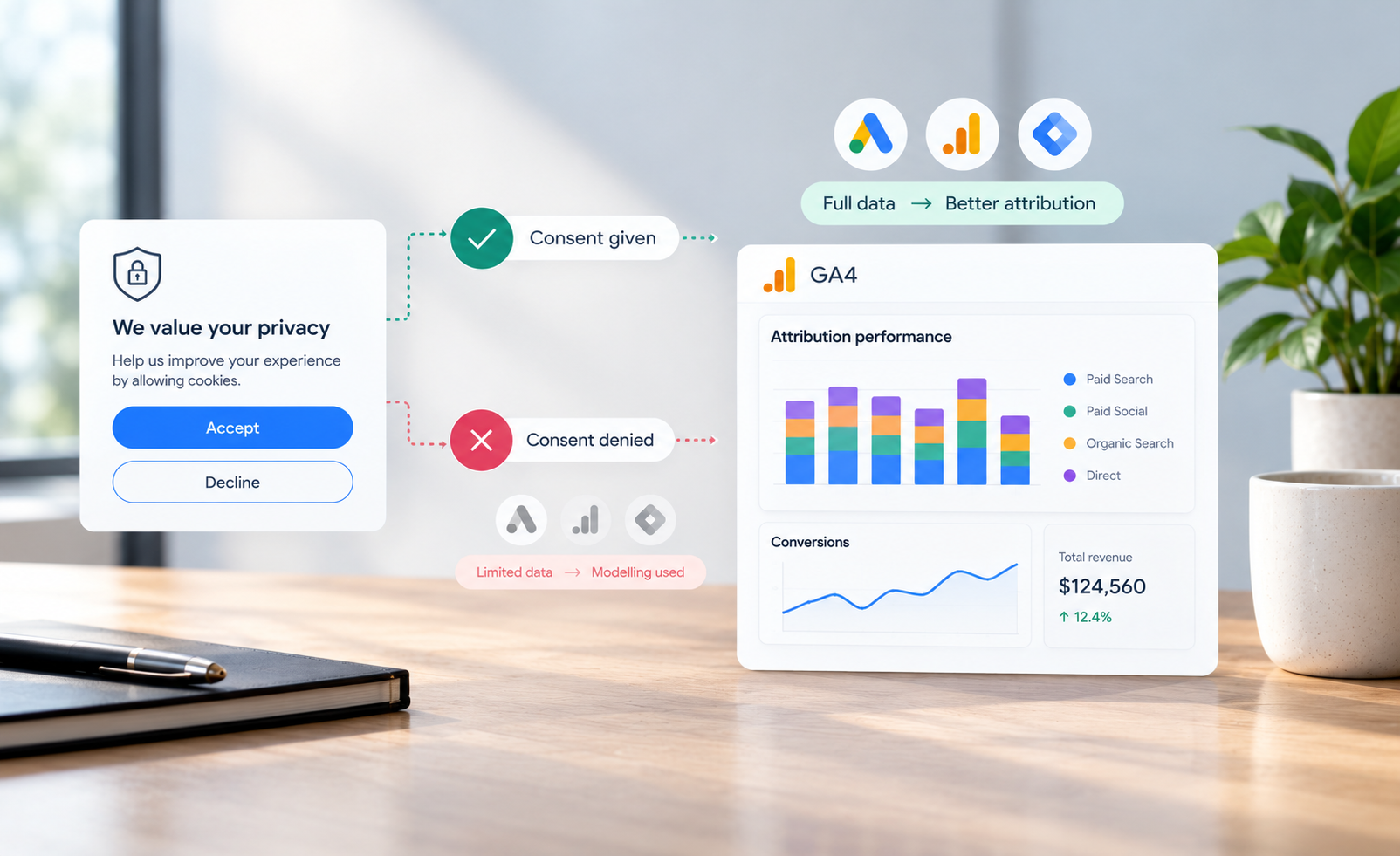
Performance friction includes page speed, broken variants, failed payment methods, stock errors and analytics or consent tools that interrupt core actions. It often receives less attention because it is spread across marketing, development and operations. Yet it can waste demand that has already been paid for.
Monitor real user behaviour by device, browser and channel. A checkout problem affecting a small Android browser segment can be invisible in an overall conversion rate while materially damaging a campaign built around mobile traffic.
How to find the friction worth fixing
Start with a journey, not a page-level opinion. Map the key route from acquisition source to conversion and identify where users leave, stall or repeat actions. In GA4, examine funnel progression by device, channel, new versus returning users and landing page. Pair this quantitative view with session recordings, onsite surveys, customer-service themes and form-error reporting.
The strongest opportunities appear when multiple signals agree. A large checkout drop-off alone may be normal. A large mobile checkout drop-off, repeated recordings of users editing the same field, and support questions about delivery costs is a clear investigation priority.
Use a simple prioritisation formula:
Opportunity score = affected traffic × observed drop-off × conversion value × confidence in the diagnosis
This is not a perfect forecast. It forces useful discipline. A small form improvement on a low-traffic page may be easy to ship, but it should not distract the team from a broken payment option affecting thousands of high-intent sessions each month.
Avoid treating averages as the whole story. Overall conversion rate can rise while a profitable customer segment struggles, or it can fall because the business has expanded top-of-funnel activity. Segment results before deciding that a page has a conversion problem.
Reducing conversion friction without reducing confidence
The most effective fixes are usually specific. Show delivery cost and timing earlier where possible. Preserve cart contents across sessions. Make guest checkout prominent. Use inline validation that explains how to correct an error. Place sizing, compatibility or eligibility information beside the decision rather than in a separate help page.
For lead generation, make the exchange explicit. State what the user will receive, whether a sales call follows and how quickly the team responds. If qualification is necessary, consider progressive profiling: ask for the essentials first, then gather further detail after trust has been established.
Test changes with a clear hypothesis rather than a blanket belief that less is always better. Removing a confirmation step may lift form submissions but increase low-quality leads. Hiding delivery information may create a short-term click gain while increasing checkout abandonment. Measurable success means tracking the downstream outcome: completed orders, qualified opportunities, refund rate, support contacts or customer lifetime value.
A practical testing sequence
Begin with reliability. Confirm that forms, payments, promo codes, inventory and analytics events work across your key devices. There is little value in copy testing a page with a technical failure.
Next, address major uncertainty. Align ad messages with landing pages, clarify the primary offer and make price, availability, delivery and returns easy to find. Then reduce unnecessary effort through field removal, autofill, clearer navigation and better mobile interaction.
Finally, run controlled experiments where traffic and measurement quality support them. Test one coherent change or tightly related group of changes, define the primary metric before launch and allow enough time to account for weekday patterns and campaign variation. For low-traffic sites, qualitative research and obvious usability repairs may be more reliable than waiting months for statistical certainty.
The relevant capability is conversion rate optimisation, but the work should connect to paid media, analytics and customer experience rather than sit in a silo. A better landing page changes the value of every future click. A clearer checkout changes the economics of every acquisition channel.
Conversion friction rarely announces itself as a single dramatic failure. More often, it is the accumulated cost of small doubts and unnecessary tasks. Treat each high-intent moment as a decision environment: make the next action clear, make the value credible and ask customers only for what the transaction genuinely requires.