
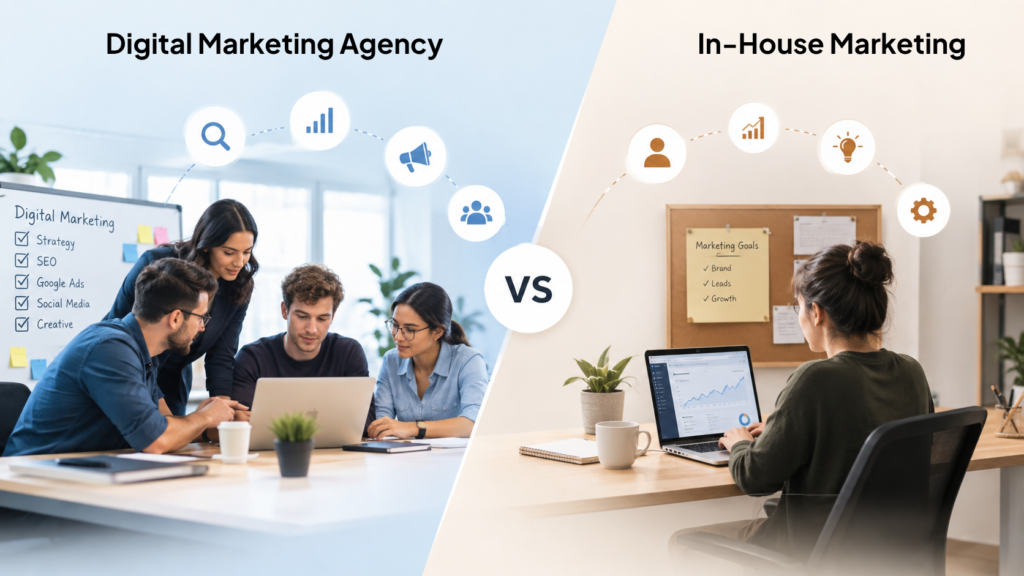
A paid search account misses its revenue target, creative fatigue is rising, and the board wants an answer before the next trading period. This is where the agency vs in-house marketing debate stops being an organisational preference and becomes a commercial decision. The right model gives your business the capabilities, pace and accountability needed to move revenue, not simply the lowest line item in a budget.
For many Australian businesses, choosing between an internal team and a digital marketing agency comes down to the work that needs to be done, the expertise required and how quickly the business needs to act.
There isn’t always a single answer. A focused internal team paired with specialist external support can be more effective than trying to build every capability internally.
Key takeaways
- In-house teams usually win on business context, brand proximity and fast access to internal stakeholders.
- Agencies provide specialist expertise, broader channel experience and flexible capacity across paid media, SEO, CRO, analytics and creative.
- Salary is only one part of the cost of an internal team. Recruitment, management time, software, training, leave and capability gaps also matter.
- A hybrid model can give businesses internal ownership while bringing in specialists for areas that are difficult to build and maintain internally.
- The right model depends on workload, capability gaps, budget, business complexity and the speed required to execute.
Agency vs in-house marketing: start with the work, not the org chart
The common mistake is choosing a structure before defining the marketing problem.
A founder might assume an in-house hire will solve slow growth, when the actual issue is weak attribution and an untested landing-page proposition. Another business may retain an agency for social content when the bottleneck is internal approval cycles and no one owns the customer offer.
Start by separating work into three categories: strategic decisions, repeatable execution and specialist problem-solving.
Strategic decisions include growth targets, customer segments, positioning, budget allocation and the definition of profitable acquisition. These decisions should stay close to business leadership, even when an external team helps shape the plan.
Repeatable execution includes campaign trafficking, content production, reporting routines and CRM operations. This can sit internally or externally depending on volume and process maturity.
Specialist problem-solving includes technical SEO, server-side tracking, feed management, conversion research, experimentation and measurement architecture. These areas can be difficult to hire for, particularly when the business doesn’t have enough ongoing work to justify a dedicated specialist.
Before choosing a model, build a clear digital marketing strategy and identify which capabilities the business needs every week, every month and only occasionally.
What an in-house team does better
An internal marketing team has context that takes time to transfer.
They hear product conversations, understand stock constraints, know which customers create the best margin and can pressure-test a campaign against what the sales or service teams are seeing.
That proximity matters most where marketing is tightly connected to product, retail operations, customer experience or fast-moving commercial decisions.
In-house teams can also build institutional knowledge. Over time, they learn why previous tests failed, which messages create qualified demand and where the business has historically wasted budget. When that learning is documented well, it becomes a compounding asset rather than knowledge held by an individual supplier.
This model suits businesses with sustained channel workload and enough marketing complexity to justify dedicated roles. An established eCommerce brand spending consistently across paid search, paid social, email and content may need a marketing lead who can coordinate trading calendars, merchandise priorities, creative and retention activity every day.
But internal proximity does not automatically equal performance.
A small team can become reactive, especially when one person is expected to manage strategy, creative, media buying, analytics, reporting and stakeholder requests. Generalists are valuable. They should not be asked to impersonate a full specialist department.
Where agencies create an advantage
An agency is most useful when it brings capabilities that would be expensive or slow to assemble internally.
This includes channel specialists who work across multiple accounts, analysts who understand tracking failure modes, CRO practitioners who know how to design credible tests and strategists who can challenge assumptions with evidence.
That cross-market exposure is a practical advantage. Agencies see different creative approaches, auction conditions, attribution setups and website constraints. They can recognise patterns earlier because they are working across a wider set of scenarios. The value is not access to a secret tactic. It is faster diagnosis and fewer expensive learning cycles.
External teams also provide variable capacity.
A business preparing for a new market launch, replatform, major promotion, website migration or measurement rebuild can bring in concentrated expertise without permanently expanding payroll. This is particularly useful when the work is project-based or requires several disciplines at once.
The trade-off is distance from the business. An agency needs a clear commercial brief, access to reliable data and prompt feedback to perform at its best. If the relationship becomes a monthly reporting ritual rather than a working operating rhythm, decisions slow down, and results usually follow.
Before appointing an agency, review how to choose the right performance marketing agency and assess the team, scope, reporting and commercial accountability.
Compare total cost, not fees, against salaries
The agency fee versus employee salary comparison is incomplete because both options carry additional costs.
For an internal hire, factor in:
- Superannuation
- Recruitment
- Onboarding
- Leave,
- Management time
- Training
- Software and data tools
- The risk of turnover.
Then consider how much of the person’s time will be spent on work that genuinely needs their level of skill.
For an agency, assess:
- Monthly or project fees
- Scope boundaries
- The actual team assigned
- Senior oversight
- Technology access
- Reporting
- Strategic involvement
- Additional project fees
- Contract terms
A low monthly agency fee can become costly if it delivers junior execution without a clear test plan, measurement discipline or accountability for commercial performance.
The same applies to an internal hire. A senior marketer who spends most of their time producing reports, managing platforms and chasing approvals may be expensive capacity for work that could be handled elsewhere.
A useful calculation is:
Effective marketing cost = direct cost + enablement cost + cost of capability gaps + cost of delayed decisions
The final two elements matter most. A capable but overstretched internal marketer may delay profitable experiments for months. An agency without access to customer, margin or inventory data may optimise toward revenue while eroding profit.
Neither problem appears clearly in a rate card.
Agency vs in-house marketing: Direct Comparison
| Factor | In-house team | Marketing agency | Hybrid model |
|---|---|---|---|
| Business knowledge | Very high | Requires onboarding | High internally |
| Specialist expertise | Depends on team size | Broad access | Broad access |
| Hiring requirements | High | Low | Moderate |
| Channel coverage | Limited by team | Usually broad | Broad |
| Fixed payroll | Higher | Lower | Moderate |
| Capacity during busy periods | Limited | Flexible | Flexible |
| Strategic control | High | Shared | High |
| External perspective | Limited | High | High |
| Speed to add expertise | Slow | Fast | Fast |
| Best for | Stable, complex workloads | Specialist or variable needs | Growth-stage businesses |
The table points to an important distinction: the decision isn’t simply agency versus employee cost.
You’re deciding where each capability should live.
The hybrid model is often the practical answer
For growth-stage and mid-market businesses, a hybrid model can create stronger control without building an oversized team.
Keep a senior internal owner accountable for commercial priorities, brand knowledge, approvals and cross-functional coordination. Use external specialists where depth, speed or independent perspective will make the biggest difference.
For example, an internal marketing manager may own the annual plan, campaign calendar, product launches and coordination with sales. External specialists can support Google Ads, technical SEO, analytics and conversion experimentation.
The internal owner protects business context; the external team brings focused execution and informed challenge. This only works when responsibilities are explicit. Shared ownership is often no ownership.
Decide who owns:
- Budget allocation
- Creative briefing
- Media optimisation
- Data quality
- Reporting
- Experimentation
- Final decisions
Document meeting rhythms and define what constitutes success beyond vanity metrics.
Build accountability around business outcomes
Whether marketing sits inside or outside the business, measurement needs to connect activity to commercial outcomes. Channel metrics such as click-through rate, cost per click, and follower growth can diagnose performance, but they are not the destination.
Track measures that reflect the economics of the business:
- Contribution margin after marketing
- Qualified pipeline
- Customer acquisition cost by cohort
- Repeat purchase rate
- Payback period
- Incremental revenue where measurement allows
Not every business can measure incrementality perfectly, but every business can improve the quality of its decision-making by aligning reporting with profit and customer value.
The 2026 challenge is that marketing attribution is becoming less certain, not more. Privacy changes, fragmented customer journeys and AI-mediated discovery all reduce the value of simplistic last-click reporting. That makes first-party data, disciplined testing and clear measurement governance essential regardless of who manages the channels.
A decision framework for leadership teams
Choose a more in-house model when marketing requires daily product knowledge, the workload is stable, internal speed is high, and the business can attract and lead the right specialists. Choose external support when capability gaps are specialised, demand is variable, an independent audit is needed, or speed to execution matters more than permanent headcount.
Use a hybrid model when the business needs both strategic control and multi-disciplinary expertise. For most organisations, this is less a compromise than a deliberate operating design.
Before changing the model, audit the last two quarters.
Identify where performance stalled: strategy, creative, technical implementation, approvals, data, budget decisions or execution capacity. Then solve that constraint directly. Hiring or outsourcing without diagnosing the constraint relocates the problem.
The best marketing structure gives capable people clean data, clear decision rights, and a mandate to test what will move the business forward. Build that system first. The agency-versus-in-house answer becomes far clearer once the work is designed around measurable growth.