


Most marketing plans fail before the first campaign launches. They begin with a channel list – SEO, Google Ads, social, email – instead of a commercial decision about where the next dollar can produce profitable growth. This digital marketing strategy guide is built for Australian businesses that need marketing to move revenue, not merely produce activity.
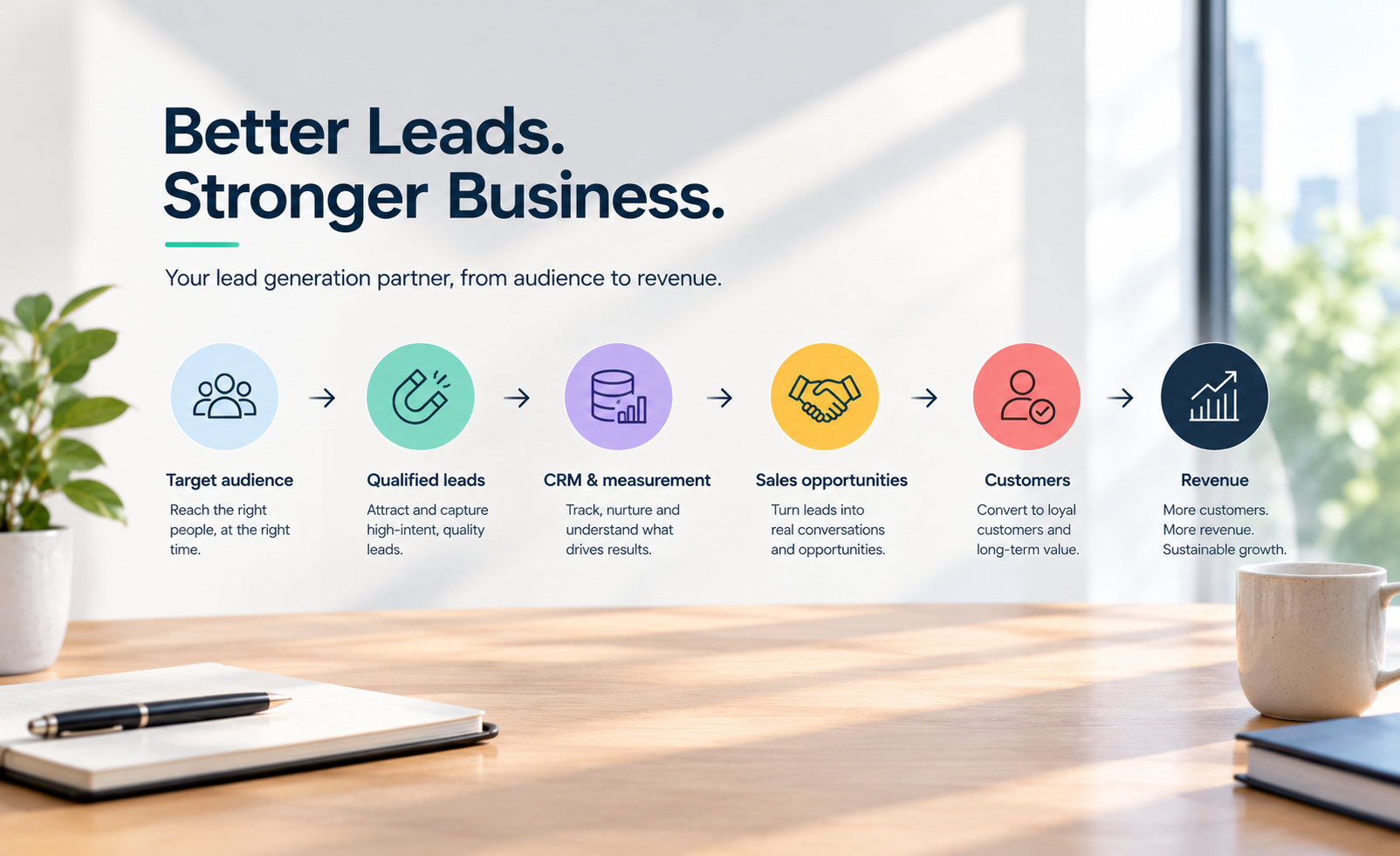
A strategy is not a content calendar, a media budget or a dashboard full of impressions. It is the operating system that connects market demand, customer behaviour, channel investment, measurement and action. Done properly, it gives a CMO or founder a clear answer to four questions: who are we trying to win, why will they choose us, where can we reach them efficiently, and how will we know the growth is real?
Start with the commercial problem
Marketing goals should be specific enough to change a budget decision. “Increase awareness” may be valid, but it is not yet a strategy. Define the business constraint first: insufficient qualified pipeline, falling repeat purchase, low conversion rate, weak category demand, rising acquisition costs or limited geographic reach.
Then set a primary growth outcome and the economics around it. For an eCommerce business, this might be profitable new-customer revenue and repeat purchase within 90 days. For a B2B firm, it may be sales-qualified opportunities from accounts that match an ideal customer profile. The metric must reflect value, not just volume.
A useful starting formula is:
Allowable customer acquisition cost = expected gross profit from a new customer × target acquisition share
If a customer generates $600 in gross profit over their expected relationship and the business can allocate 30 per cent of that profit to acquisition, the allowable CAC is $180. That figure will not solve every bidding decision, but it stops the team from celebrating leads or orders that cannot support the business model.
Targets also need a time horizon. Search activity can capture existing demand quickly. Organic search, brand preference and retention programs usually compound more slowly. Treating every channel as if it should deliver immediate payback is a reliable way to underfund future demand and overpay for today’s clicks.
Build a decision-grade customer view
Demographics alone rarely explain why a customer buys. A 35-year-old Melbourne shopper is not a usable strategy. The better question is what job they are trying to complete, what risk they perceive, what proof they need and what triggers them to act now.
Use evidence already inside the business. Sales call notes reveal objections. Search query reports show the language buyers use. Customer reviews expose the moments that created confidence or frustration. Analytics can show which product categories, landing pages and device types contribute to revenue. Combine these sources into a practical customer view rather than a fictional persona.
For each priority segment, document the following in plain language:
- The situation that starts their search or consideration.
- The outcome they value and the barrier stopping action.
- The messages, proof and offers that reduce perceived risk.
- The channels and search moments where they can be reached.
This work matters because channel performance is often a messaging problem in disguise. A paid search campaign can attract the right clicks but lose at the landing page because delivery expectations are unclear. A social campaign can produce cheap traffic but poor sales because the creative sells aspiration when the buyer needs practical proof.
Map demand, not just the funnel
The classic awareness-to-purchase funnel is useful, but modern buying paths are rarely linear. People compare options, read reviews, ask peers, search branded terms after seeing an ad and return days later on another device. Strategy should therefore map demand states.
High-intent searchers want clear answers, price signals, availability and credible proof. Problem-aware audiences may need education and a compelling point of view. Existing customers need reasons to return, expand their purchase or recommend the brand. Each state calls for different creative, landing-page experience and measurement expectations.
Choose channels based on their job
The strongest marketing mix is not the one with the most platforms. It is the one where every channel has a defined role and can be measured against it.
| Channel | Strategic job | What to watch |
|---|---|---|
| Search | Capture active demand | Qualified conversion rate, margin and impression share |
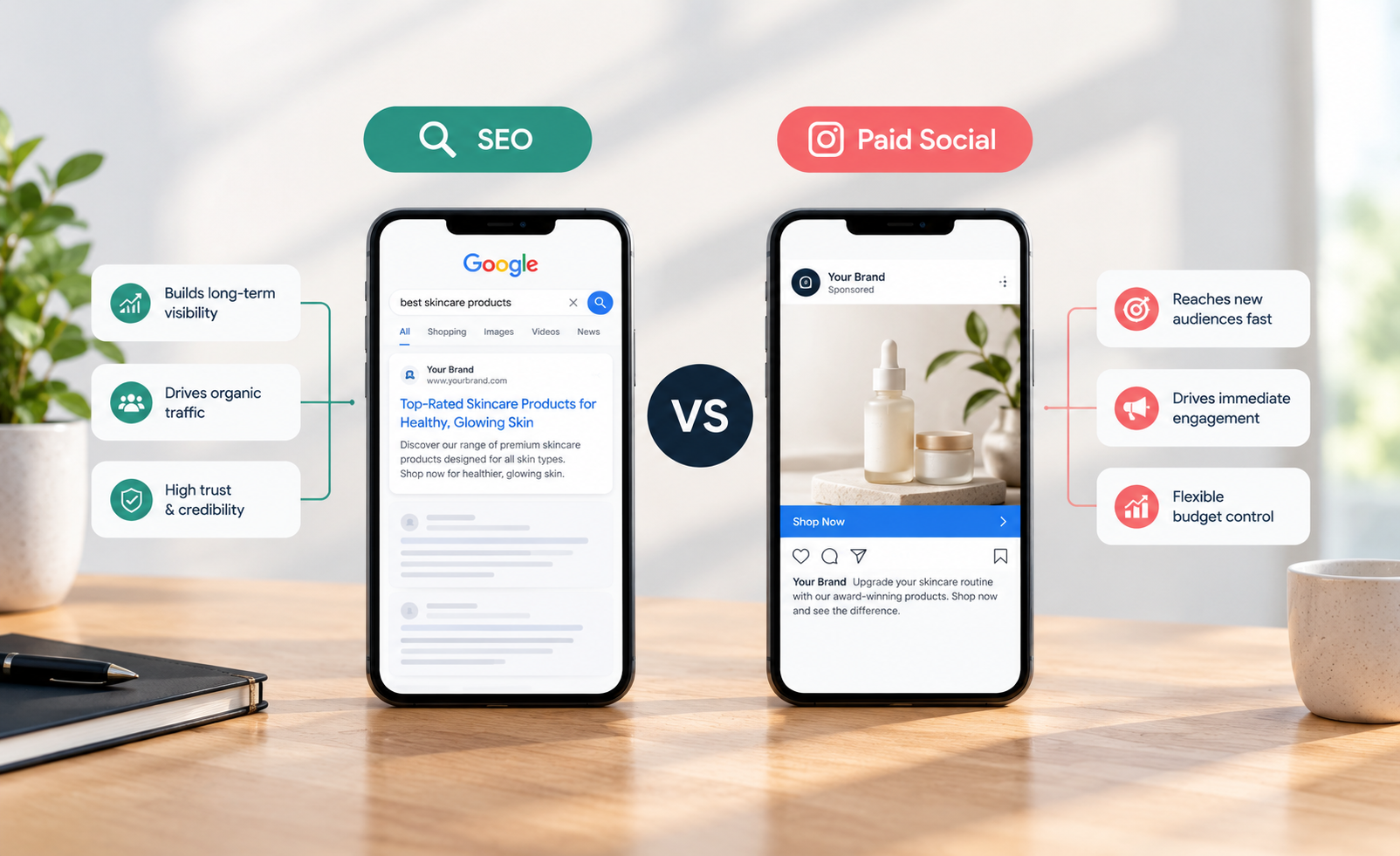
| Paid social and video | Create demand and test propositions | Incremental reach, assisted conversions and creative fatigue |
| SEO and content | Build durable visibility around valuable questions | Non-brand visibility, qualified organic sessions and revenue |
| Email and SMS | Convert, retain and reactivate customers | Revenue per recipient, repeat rate and unsubscribes |
| Conversion rate optimisation | Improve the return on existing traffic | Conversion rate, average order value and form completion |
Channel selection depends on category maturity. A local service business may win by dominating high-intent local search and building a strong review engine. A new consumer brand may need paid social, creators and compelling creative to generate enough demand for search to capture later. A complex B2B offer often needs expert content, account targeting and a sales process that can convert consideration into pipeline.
Avoid spreading a modest budget across every platform. Fragmentation produces too little data to learn and too little scale to negotiate rising costs. Start with the channels closest to proven demand, then add upper-funnel investment when the business can measure its contribution and sustain the spend long enough to learn.
Design the journey after the click
Media efficiency is only half the equation. A campaign that sends 10,000 relevant visitors to a confusing page is expensive conversion-rate research.
Every priority campaign should lead to an experience built for the visitor’s intent. Match the headline to the ad or query, state the primary value quickly, reduce friction in forms and checkout, and place proof close to the decision point. Proof can include genuine reviews, case evidence, delivery details, transparent pricing, qualifications or clear returns policies. The right proof depends on the perceived risk.
Do not assume more information is always better. For a straightforward product, clutter can delay action. For a high-consideration purchase, sparse pages can create doubt. Test the constraint rather than following generic best practice: is the barrier confidence, comprehension, price, speed or relevance?
Make measurement fit the decision
Attribution reports are useful, but they are not a complete record of causality. Platforms naturally give credit to the interactions they can observe. That can overstate the value of retargeting, branded search or channels that appear near conversion, while understating activity that created the initial demand.
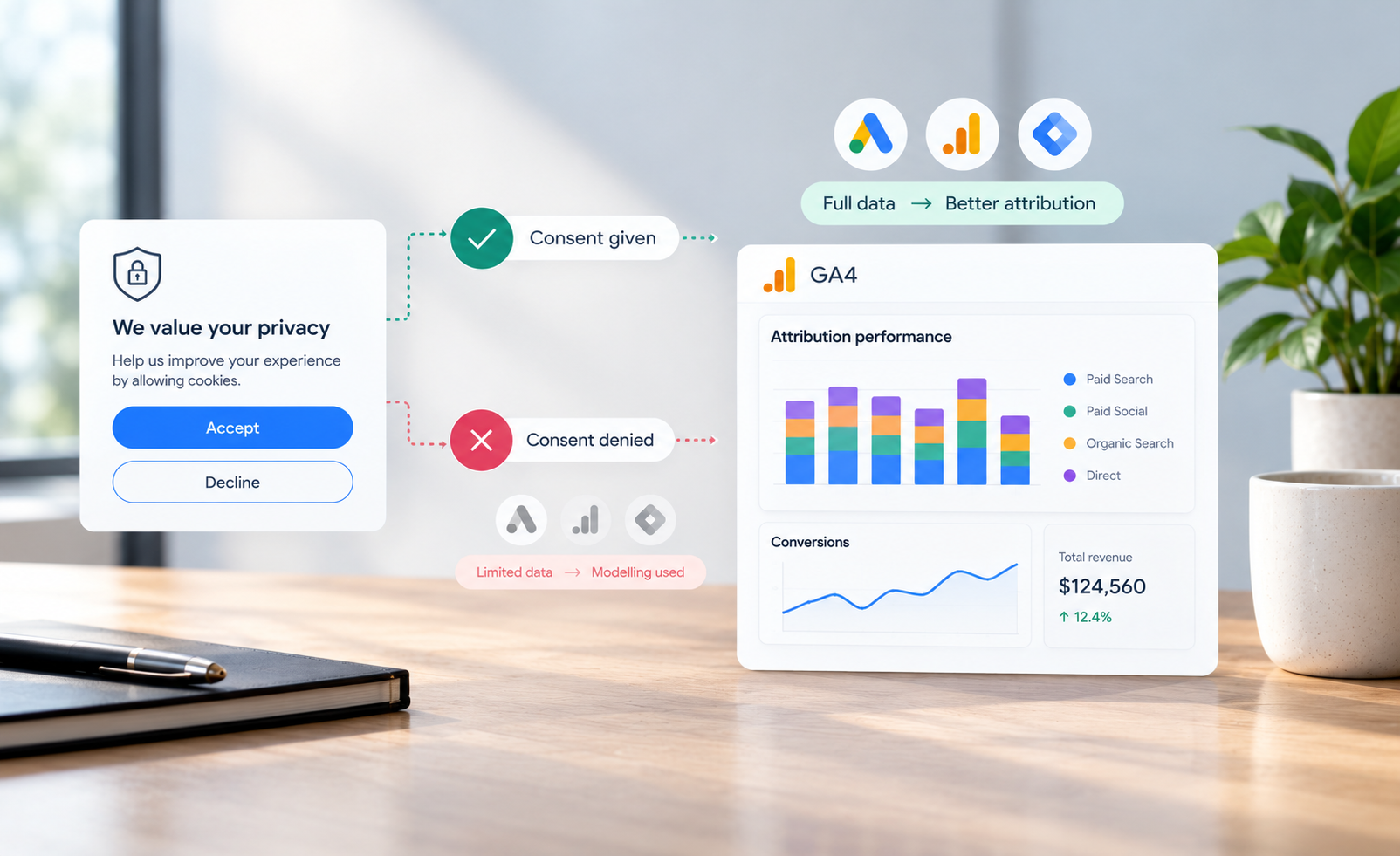
A practical measurement system has three layers. First, ensure operational accuracy: analytics events, consent settings, product feeds, CRM stages and offline revenue are correctly configured. Second, use channel reporting to optimise weekly decisions such as creative, audience, keywords and landing pages. Third, use broader business evidence to judge budget allocation: blended CAC, contribution margin, new-customer revenue, share of search, pipeline quality and retention.
When spend is material, test incrementality. This might mean a geographic holdout, a campaign pause, a matched-market test or a controlled audience experiment. The method depends on traffic volume and risk tolerance. Small businesses may not have enough data for formal experiments every month, but they can still compare performance against disciplined baselines rather than trusting platform-reported return alone.
Data governance is part of this work. Australia’s privacy settings, consent requirements and platform signal loss affect what can be observed. Build first-party data capture into the strategy through meaningful email value exchanges, account creation where it genuinely helps customers, CRM hygiene and clear consent practices. Better data is not a licence to collect everything. It is a way to make fewer, better decisions with customer permission.
Run strategy as a learning system
A strategy document becomes obsolete if it is not connected to a cadence. Set a weekly performance review for tactical decisions and a monthly commercial review for budget, customer quality and channel roles. Quarterly, revisit the bigger assumptions: which segments are growing, which messages are losing relevance, where competitors are changing the category and whether unit economics still support the acquisition plan.
Maintain an experiment backlog with a clear hypothesis, expected commercial impact, effort level and decision rule. “Test new creative” is vague. “Lead with delivery certainty for regional customers because support enquiries show timing anxiety” is a testable hypothesis. Record the result, including failed tests. That institutional memory prevents teams from re-learning the same expensive lessons.
AI can speed up research, copy variations, reporting analysis and creative production, but it cannot decide what the business should optimise for. Use it to increase the rate of informed experimentation, then keep human judgement on positioning, claims, customer empathy and commercial trade-offs.
The businesses that grow consistently do not chase every new platform or declare victory after a strong month. They build a strategy-first system that makes demand visible, turns evidence into action and allocates capital where it can create measurable success. Start with one hard commercial question, measure the answer honestly, and let the next investment earn its place.