
A strong B2B lead generation case study should do more than report a cheaper cost per lead. It should show how marketing created sales-ready demand, where the funnel was leaking, and which decisions improved revenue potential. That distinction matters because a campaign can produce a full CRM while giving the sales team very little to work with.
For founders and marketing leaders, the useful question is not, “How many leads did we get?” It is, “Did we create more qualified opportunities at an efficient acquisition cost?” The case below is an illustrative model, built around the diagnosis and measurement logic that separates activity from measurable success.
Key takeaways
- Lead volume is a weak outcome when qualification, opportunity creation and pipeline value are not tracked alongside it.
- B2B demand generation performs best when the audience, offer and conversion path answer one commercial problem clearly.
- Channel performance should be assessed by qualified pipeline and sales feedback, not platform-reported conversions alone.
- Small funnel changes can have an outsized effect when they remove friction before a prospect books a meeting.
What a B2B lead generation case study should prove
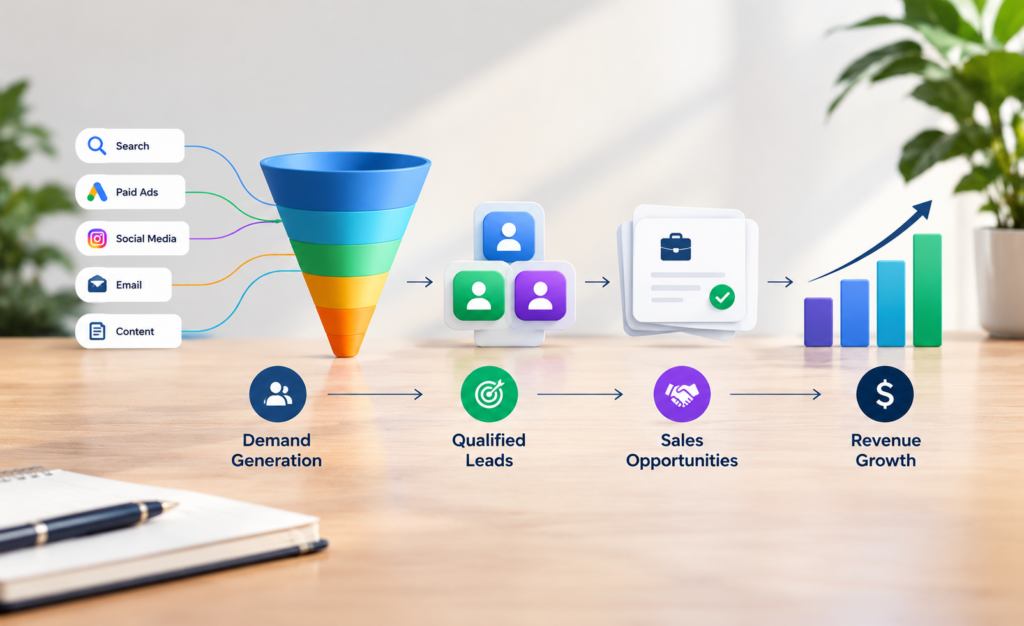
The usual case study format starts with a channel, reports impressions and ends with leads. That is rarely enough for an executive team deciding where to place the next dollar. A commercially useful case study follows the full chain: target account or buyer reached, high-intent action taken, lead qualified, meeting held, opportunity created and revenue influenced.
This is particularly important in longer sales cycles. A cybersecurity platform, specialist manufacturer or enterprise software provider may wait months before an opportunity becomes closed revenue. If marketing only optimises to form fills, it can favour audiences that are easy to convert but unlikely to buy.
A better scorecard connects early and late signals:
| Funnel stage | What to measure | Why it matters |
|---|---|---|
| Reach | Relevant account and role coverage | Shows whether activity is reaching the buying group |
| Intent | Engaged visits, key page views, return sessions | Indicates whether the message is creating consideration |
| Lead | Conversion rate and cost per lead | Measures initial response, not quality |
| Qualification | Sales-accepted lead rate | Tests fit, need and contactability |
| Pipeline | Opportunities and pipeline value | Connects marketing activity to commercial potential |
| Revenue | Won revenue and acquisition payback | Determines whether the programme is built to move revenue |
The right emphasis depends on the business model. A low-volume enterprise sale may value five well-matched discovery calls more than 100 downloadable-guide leads. A business with a short sales cycle can make faster optimisation decisions from opportunity and revenue data.
The case: fixing a lead-quality problem
Consider an illustrative Australian B2B software company selling workforce compliance technology to mid-market employers. The average contract value is meaningful enough to support paid acquisition, but the sales cycle involves multiple stakeholders: HR, operations, finance and IT.
The company had a familiar problem. Paid search and LinkedIn activity were generating leads, yet sales reported that many contacts were students, consultants researching on behalf of clients, or businesses below the company’s ideal customer profile. Marketing could show lead volume. Sales could not see dependable pipeline contribution.
The diagnosis began with CRM data rather than a new campaign brief. The team reviewed the previous quarter’s leads against firmographic fit, job seniority, meeting attendance, opportunity creation and disqualification reasons. Three patterns emerged.
First, broad educational keywords drew people looking for general compliance advice, not software evaluation. Second, the main downloadable asset attracted early-stage researchers but did not establish company size, current process or implementation intent. Third, the landing page treated every visitor identically, even though a payroll manager at a 500-person business has a different buying context from a small-business owner seeking a free template.
That diagnosis changed the objective. The goal was no longer to maximise lead count. It was to increase the proportion of leads that sales accepted and progressed.
The strategy: tighten the path from intent to conversation
The revised programme used three connected changes: higher-intent targeting, clearer qualification and stronger follow-up.
1. Rebuild search around commercial problems
Instead of placing most budget behind broad information searches, the search structure separated research terms from evaluation terms. Queries linked to implementation, software comparison, system replacement and operational risk were routed to solution-focused pages. Broad educational terms remained useful, but were assigned a lower value and measured as audience-building activity rather than direct pipeline generation.
This is a critical trade-off. Removing all informational activity can shrink future demand, particularly in categories buyers research well before they speak to a supplier. The smarter move is to give each search theme a defined job, budget and success metric.
Ad copy also moved away from generic claims such as “simplify compliance”. It named the operational consequence: manual audits, fragmented employee records and reporting delays. Specificity filters out some clicks, which is often a positive outcome. Fewer irrelevant visitors can mean a more efficient route to pipeline.
2. Make the conversion offer match buying intent
The original form offered a general guide and asked for only basic contact details. The replacement offer was a practical compliance-readiness assessment, positioned for teams reviewing their current process. It requested a small amount of qualifying information, including employee range, existing system and implementation timeframe.
More form fields can reduce conversion rate. That does not automatically make them a mistake. If a field helps identify serious prospects or gives sales the context needed for a relevant first conversation, the reduction in raw leads may be commercially worthwhile.
The landing page supported the assessment with proof points that answered predictable objections: who the platform was suited to, how implementation worked, what internal workload was required and which systems it could connect with. This is conversion rate optimisation in its practical form – reducing uncertainty at the moment a buyer decides whether to act.
3. Close the loop with sales
Marketing and sales agreed on a shared lead taxonomy before launching the revised activity. A marketing-qualified lead met minimum firmographic and engagement criteria. A sales-accepted lead had been reviewed and considered worth contacting. Disqualification reasons were standardised, including poor company fit, no active project, competitor or partner enquiry, duplicate record and invalid contact.
That feedback loop is where many programmes fail. Without it, paid media platforms are trained on form submissions while the business needs opportunities. With it, the team can identify whether an apparent channel problem is actually a targeting issue, a weak offer or slow sales follow-up.
How to calculate the commercial impact
A simple funnel model makes the decision clearer. Assume 1,000 relevant landing-page visits in a month. At a 3% form conversion rate, that produces 30 leads. If only 20% are accepted by sales, six are worth pursuing. If half of those become opportunities, the programme creates three opportunities.
Now assume a revised landing page lowers form conversion to 2.5%, producing 25 leads, but improves sales acceptance to 44% because the offer and targeting are more precise. That creates 11 sales-accepted leads. At the same 50% opportunity rate, the programme produces five or six opportunities from less lead volume.
The formula is straightforward:
Opportunities = relevant visits × lead conversion rate × sales-accepted lead rate × opportunity rate
The point is not that every business should add form fields or narrow targeting. It is that optimisation should follow the constraint. If traffic is irrelevant, fix targeting. If visitors are engaged but do not convert, examine the message and conversion experience. If leads do not progress, inspect qualification criteria, response time and sales process.
Measurement decisions that make the case credible
A case study becomes trustworthy when it acknowledges attribution limits. B2B buyers may see a LinkedIn ad, search for the brand later, read several pages, attend a webinar and convert through a direct visit. Assigning all credit to the final channel is convenient, but incomplete.
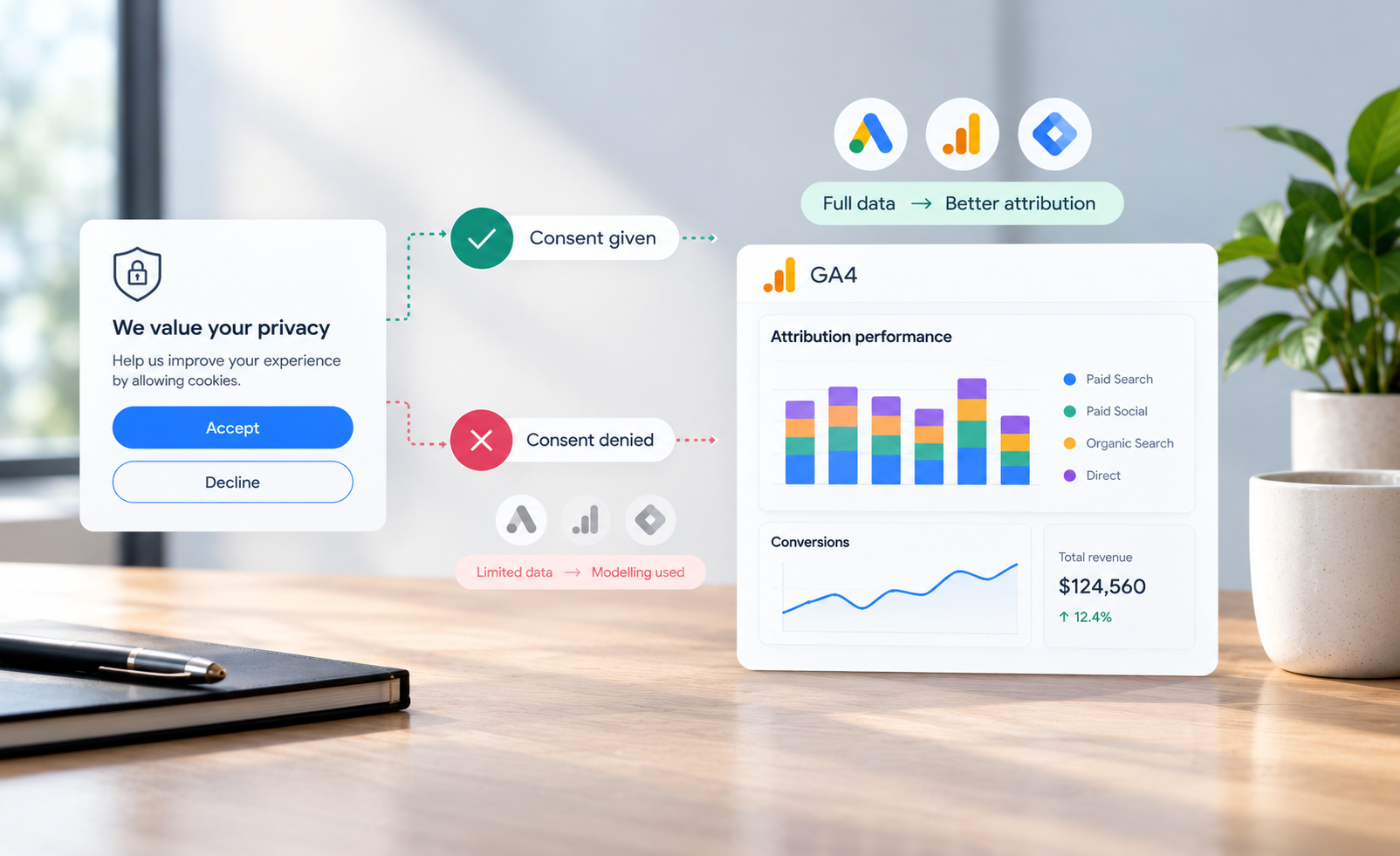
Use a consistent attribution approach for decision-making, then compare it with CRM source data and buyer feedback. Track campaign parameters carefully, capture original source where possible and preserve touchpoint data when leads move between marketing automation and the CRM. Platform dashboards are useful for optimisation, but they should not be treated as the final revenue record.
It also helps to report both rates and absolute numbers. A sales-accepted lead rate can improve simply because lead volume fell sharply. Show the lead count, accepted lead count, opportunities, pipeline value and cost at each stage. This gives decision-makers enough context to judge whether quality improved without sacrificing growth.
For Australian businesses, privacy considerations belong in this process as well. Form design, consent language, CRM access and audience matching should be reviewed against applicable privacy obligations. Better measurement is valuable only when the underlying data practices are sound.
Use the case study to make the next decision
The strongest B2B lead generation case studies do not end with a vanity metric or a dramatic claim. They explain the initial commercial problem, show the intervention, disclose the measurement logic and identify what should happen next.
For this model, the next test might be a separate path for operational buyers and executive sponsors, each with its own proof points and call to action. That is a more intelligent next move than simply increasing media spend. When the funnel is measured from intent through to opportunity, lead generation stops being a volume game and becomes a system for building qualified demand.