
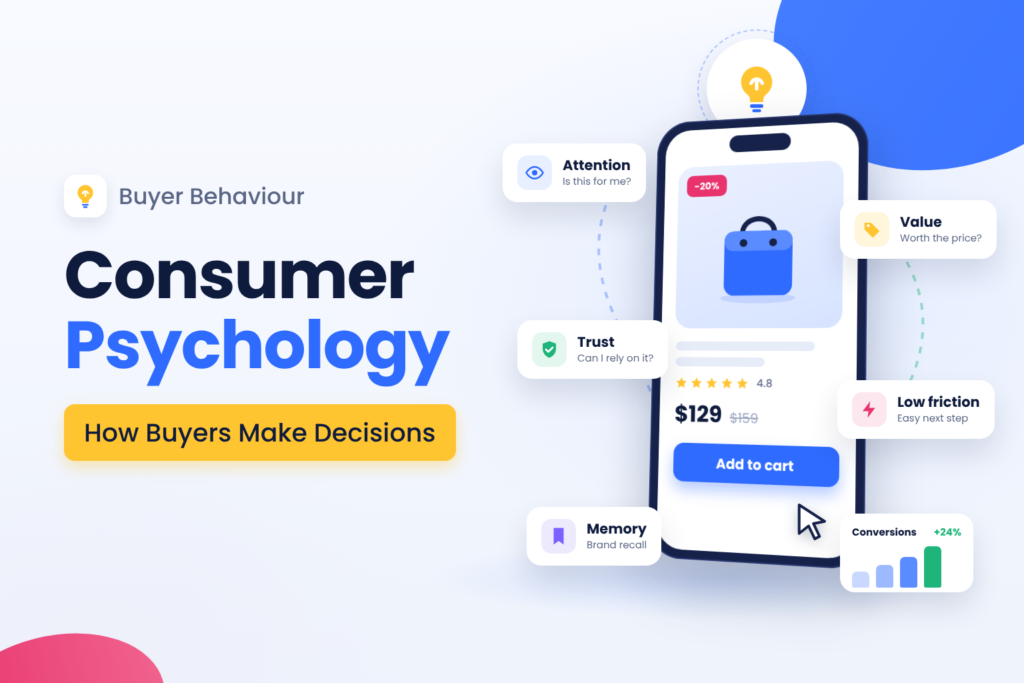
Most conversion problems are not caused by a lack of traffic. They happen when a motivated customer encounters uncertainty, effort or a message that gives them no compelling reason to act now. Consumer psychology is the discipline of understanding those moments: how people notice options, interpret value, manage perceived risk and justify a purchase.
For founders and marketing leaders, this is not an exercise in adding urgency banners or copying a competitor’s checkout. It is a way to form better hypotheses across paid media, landing pages, product merchandising and retention. The commercial question is simple: what is making the next action feel worthwhile, credible and easy?
Key takeaways
- Buyers use shortcuts because attention and time are limited. Clarity usually outperforms cleverness.
- Price is judged in context, not in isolation. Framing, comparison and risk all influence perceived value.
- Trust is built through evidence that answers a buyer’s specific uncertainty at the point it arises.
- Behavioural principles work best when tested as a system, not deployed as isolated conversion tactics.
What consumer psychology actually explains
Consumer psychology studies the cognitive, emotional and social forces behind purchasing behaviour. It helps explain why two products with comparable features can produce very different conversion rates, average order values or repeat purchase patterns.
A customer rarely makes a perfectly rational comparison of every option. They make a decision with incomplete information, competing priorities and limited mental bandwidth. They ask, often implicitly: Is this for someone like me? Can I trust it? Is the value clear? What could go wrong? Can I make this decision without wasting time?
That does not mean buyers are irrational. It means their decisions are contextual. A business buyer assessing software may need proof that implementation will not disrupt the team. A shopper choosing skincare may need reassurance on ingredients, suitability and returns. In both cases, the purchase is shaped by the cost of being wrong as much as the potential upside.
Behavioural science research, including work popularised by Daniel Kahneman and Amos Tversky, shows that people rely on rapid judgements alongside more deliberate analysis. Good marketing respects both modes. It gives the buyer an immediate, understandable reason to care, then provides the evidence required to proceed.
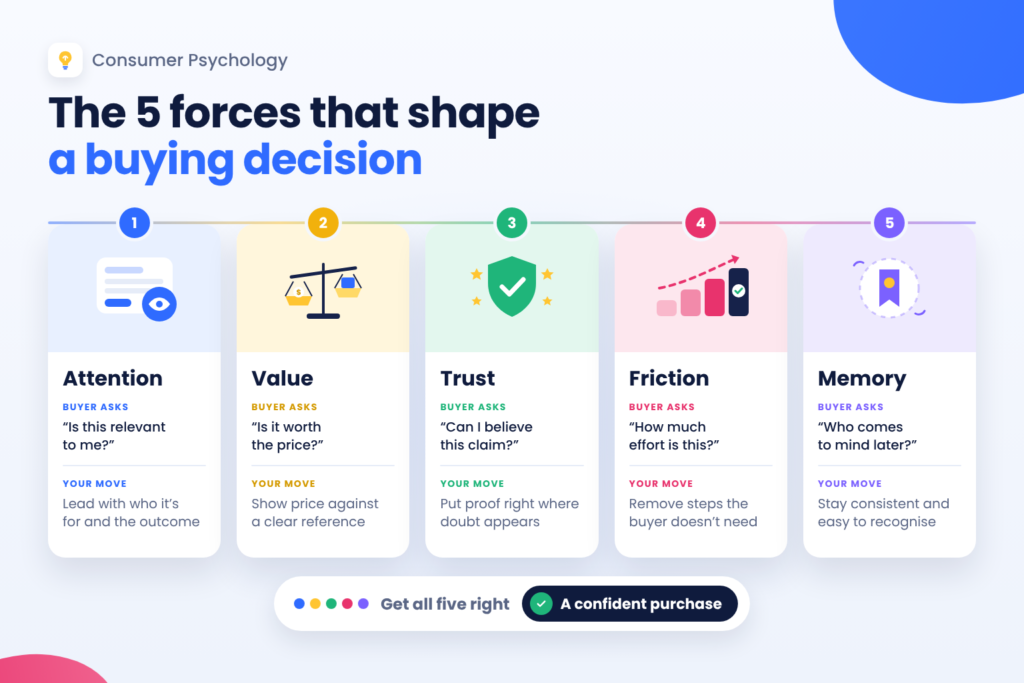
The five forces that shape a buying decision
1. Attention: Relevance earns the first second
People do not read marketing assets from top to bottom. They scan for signals that the offer is relevant. The opening line of an ad, hero section of a landing page or first image on a product page must answer who the offer is for and what outcome it improves.
Generic claims such as “quality you can trust” make the buyer work too hard. Specificity reduces that effort. “Accounting software built for multi-entity Australian businesses” immediately filters the audience and establishes a meaningful use case.
This is why message match matters. If a paid ad promises faster setup, the landing page should lead with setup speed and substantiate it. A mismatch creates a cognitive reset, which is often enough to lose the click.
2. Value: Price only makes sense against a reference point
Consumers do not assess price in a vacuum. They compare an offer with alternatives, previous prices, the cost of doing nothing and their expectation of what the category should cost. This is known as reference dependence.
A higher price can increase perceived quality in categories where quality is hard to assess before purchase. But it can also create friction when the difference is unexplained. The strategic job is not to make every offer look cheap. It is to make the value exchange legible.
For example, a premium service may justify its price by showing what is included, the time it saves, the risk it removes and the standard it delivers. An eCommerce brand may do the same with detailed product comparisons, fit guidance and clear delivery information. The right treatment depends on the buying context. Discounting can drive short-term volume, but overuse can train customers to wait and weaken price integrity.
3. Trust: Proof must answer the real objection
Trust signals work when they reduce a specific concern. Customer reviews can help where product performance is uncertain. Clear warranty terms can help where financial risk is high. Recognised payment options can help when a shopper is hesitant to share card details.
The strongest proof is usually concrete and proximate to the decision. A generic testimonial on an About page carries less weight than a review, product specification or delivery promise placed beside the add-to-cart button.
Social proof also needs care. “Thousands of customers” may create confidence, but only if it is true, current and relevant. The Australian Consumer and Competition Commission has repeatedly taken action on misleading reviews and false representations. Manufactured scarcity, fake counters and selectively edited testimonials may lift a metric briefly, but they create legal and brand risk that is hard to justify.
4. Friction: Every unnecessary step is a decision tax
Friction is not only slow page speed or a long form. It includes unclear navigation, unfamiliar terminology, surprise delivery charges, mandatory account creation and having to hunt for basic answers.
A useful way to assess a customer journey is:
| Decision stage | Buyer question | Marketing response |
|---|---|---|
| Discovery | Is this relevant to me? | Lead with audience, problem and outcome. |
| Evaluation | Why this option over another? | Show differentiators, proof and price context. |
| Purchase | What could go wrong? | Make delivery, returns, security and next steps clear. |
| Post-purchase | Did I make the right choice? | Confirm value, set expectations and support usage. |
Reducing friction does not always mean reducing information. High-consideration purchases often need more detail, not less. The objective is to provide the right information at the right moment, without making the buyer search for it.
5. Memory: Distinctive brands lower future acquisition costs
Not every purchase happens on the first visit. Buyers remember brands that make a clear association between a category problem and a distinctive solution. Consistent language, visual assets and useful content make that association easier to retrieve later.
This matters as AI-generated search results, fragmented media habits and rising paid-media costs make each click more contested. Performance marketing still needs immediate conversion assets, but brand memory improves the efficiency of future demand capture. The two are not competing priorities when the message is consistent.
A practical consumer psychology framework for marketers
The most useful application is a disciplined test process. Start with observed behaviour, not a favourite behavioural bias. If mobile users reach a product page but abandon before checkout, the issue may be price shock, insufficient product information, poor mobile usability or a payment-method gap. Calling it “loss aversion” does not diagnose the problem.
Use this four-step sequence:
- Identify the behavioural break. Find where users hesitate or exit using analytics, funnel analysis, session recordings, onsite search data, customer-service logs and qualitative research.
- Name the likely uncertainty. Translate the data into a buyer question. For example: “Will this fit?”, “Can I return it?” or “Is this worth the premium?”
- Build one focused intervention. Add fit guidance, clearer returns information, a comparison module or a sharper value explanation. Avoid changing five variables at once.
- Measure the commercial result. Track conversion rate, revenue per visitor, average order value, lead quality and cancellation or return rates. A conversion lift that produces more low-quality leads is not measurable success.
The formula is straightforward:
Behavioural insight + relevant evidence + lower effort = a stronger chance of action
A/B testing is essential, but it needs sensible guardrails. Ensure the test has enough traffic, run it across normal trading conditions and assess downstream outcomes. A headline that attracts more clicks but lowers qualified enquiries has not improved the system.
Where marketers get consumer psychology wrong
The most common mistake is treating behavioural principles as manipulation. Countdown timers, low-stock claims and aggressive pop-ups can work in narrow situations, but they often trade trust for a short-term metric. If urgency is genuine, explain the genuine reason: a booking deadline, limited production run or delivery cut-off.
Another mistake is assuming one principle applies to every audience. Social proof may be persuasive for a lower-risk consumer purchase, while procurement teams may need security documentation, integration details and stakeholder-ready business cases. Motivation, risk and decision structure vary by category.
Finally, do not confuse a persuasive experience with a busy one. More badges, more claims and more calls to action can increase cognitive load. The better question is: what is the minimum evidence this buyer needs to confidently take the next step?
Buyers lean on mental shortcuts more than they realise. This short explainer covers 3 of them (anchoring, availability and representativeness) and where they come from.
Use psychology to make better choices easier
Consumer psychology is most valuable when it creates clarity rather than pressure. Make the audience recognisable, articulate the outcome in plain language, prove the claim where doubt appears and remove needless effort from the journey. When a customer can quickly understand the value and safely justify the choice, marketing is built to move revenue without sacrificing trust.