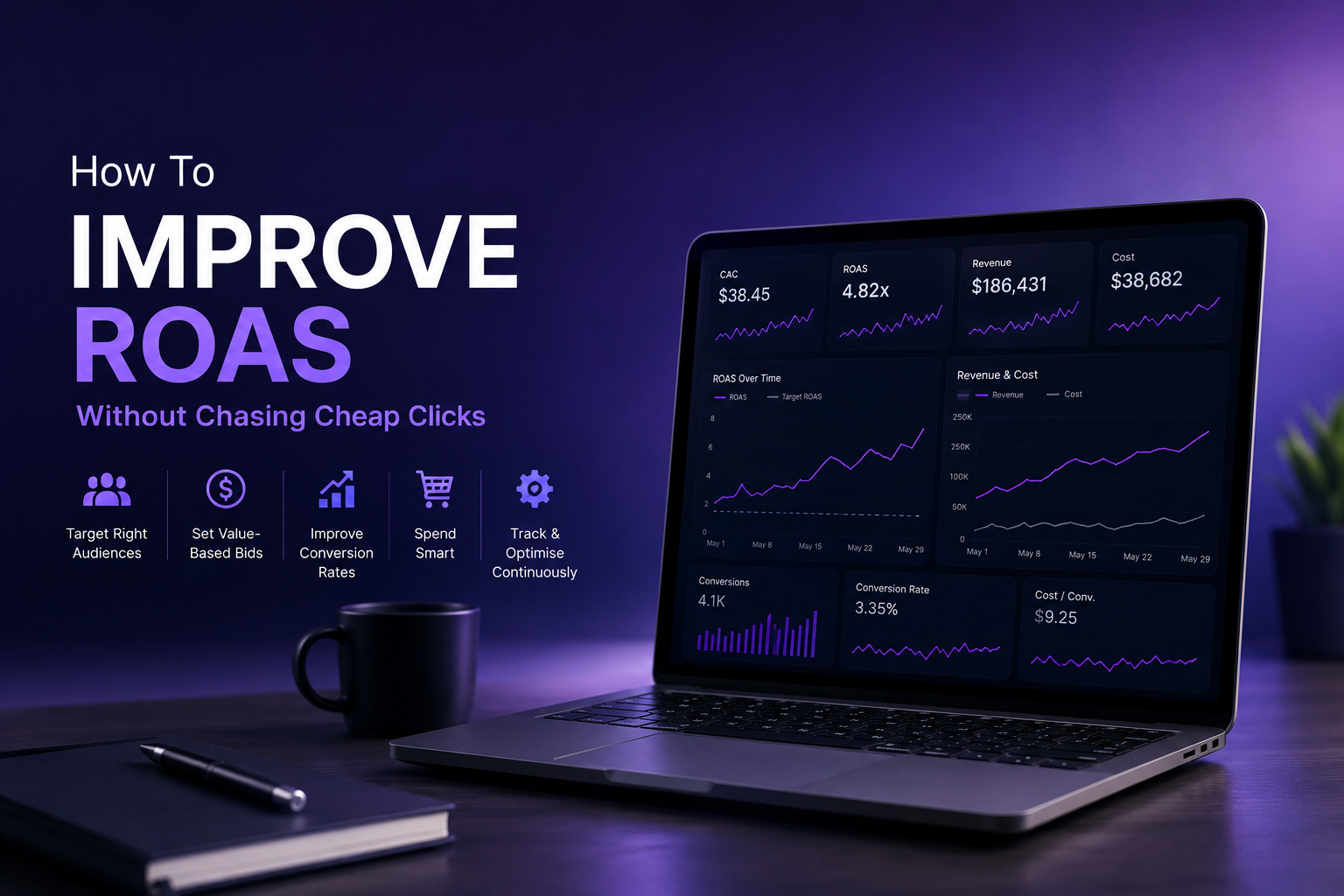

A campaign can report a 6x ROAS and still lose money. That happens when the platform counts low-value conversions, discounts are ignored, repeat purchase is assumed rather than proven, or margins vary wildly by product. Knowing how to improve ROAS starts with correcting that commercial reality, not lowering your cost per click.
Key takeaways
- ROAS is revenue divided by advertising spend, but profitable ROAS depends on gross margin, fulfilment costs, returns and customer lifetime value.
- Fix measurement before changing bids. Poor tracking creates confident decisions from unreliable data.
- Improve ROAS by prioritising high-intent traffic, high-margin products and conversion friction removal, not by blindly cutting spend.
- Scale only after performance holds across a meaningful volume of purchases and a sufficiently long attribution window.
Start with the ROAS number your business actually needs
ROAS, or return on ad spend, is calculated as revenue generated divided by advertising spend. If $10,000 in media spend produces $40,000 in tracked revenue, ROAS is 4.0x, or 400%.
It is useful, but it is not a profit metric. A 4x ROAS may be exceptional for a business with 75% gross margins and poor for one with 25% margins, high freight costs and frequent returns. For eCommerce operators, contribution margin is the more useful decision layer: revenue minus product cost, fulfilment, payment fees, returns, discount cost and advertising spend.
Use ROAS to manage channel efficiency, then pressure-test it against contribution. This prevents a common mistake: cutting a campaign that acquires valuable new customers because its first-order ROAS looks modest, while retaining a campaign that simply harvests existing demand.
A simple way to think about it:
| Metric | What it tells you |
|---|---|
| ROAS | How much tracked revenue advertising generated for each dollar spent |
| Contribution margin | How much revenue remains after variable costs |
| CAC | How much it costs to acquire a customer |
| MER | How efficiently total marketing spend generates total revenue |
| LTV | How much value a customer generates over time |
Calculate a break-even ROAS threshold
A practical starting point is:
Break-even ROAS = 1 ÷ contribution margin before advertising
If a $100 order leaves $30 after variable costs, the contribution margin before media is 30%. Your break-even ROAS is 3.33x. Any lower and the first purchase loses money, unless the customer’s repeat value credibly closes the gap.
This threshold should differ by product category, promotion and customer type. A high-margin accessory and a heavily discounted hero product should not be judged by the same target.
| Commercial situation | Better primary metric | Why it matters |
|---|---|---|
| New product launch | Qualified conversion rate + new-customer CPA | Revenue history is limited and learning matters |
| Established eCommerce range | Contribution ROAS | Product margin and returns can vary materially |
| Lead generation | Cost per qualified lead + pipeline value | Form fills are not revenue |
| Subscription business | Payback period + customer lifetime value | First-purchase ROAS can understate future value |
| High-repeat-purchase business | New-customer CAC + LTV | First-purchase ROAS can undervalue acquisition |
How to improve ROAS by fixing measurement first
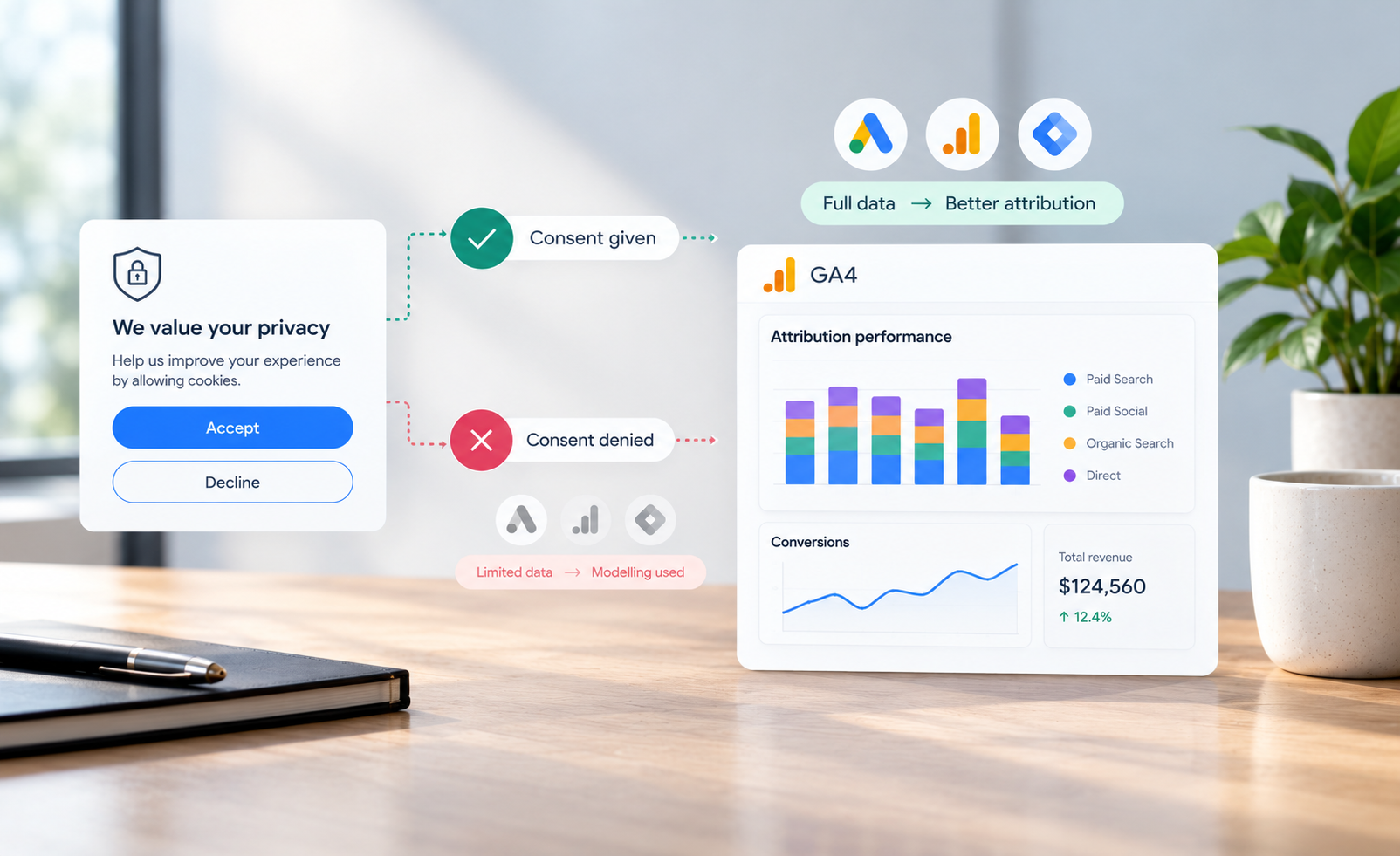
Advertising platforms optimise towards the events they receive. If purchase events are duplicated, values are missing, consent losses are unaccounted for, or leads are counted before qualification, the algorithm is trained on noise.
Audit the complete path from ad click to revenue record. Compare platform-reported purchases with your analytics platform, eCommerce platform or CRM over the same date range and attribution settings. The numbers will not match exactly. They measure different things. What matters is whether gaps are understood, stable and commercially acceptable.
For eCommerce, pass accurate order value, currency, product identifiers and refunds where your setup allows. For lead generation, send qualified leads, opportunities, or closed-won outcomes back to the ad platform. A campaign optimising for cheap enquiries will reliably find people who submit cheap enquiries. It will not necessarily find buyers.
Also separate new and returning customers. Brand search and remarketing often show impressive ROAS because they capture people already close to purchase. That is valuable, but it is different from generating incremental demand. Review performance by campaign role: prospecting, consideration, remarketing and brand defence.
Put budget behind demand with commercial intent
The quickest apparent improvement in ROAS is often to move spend into branded search and remarketing. The trade-off is scale. Those audiences are finite, and excessive credit can hide weak acquisition activity.
A stronger approach is to match the campaign objective to buyer intent. Search terms such as “buy”, “quote”, “near me”, specific model names and problem-led queries usually indicate a more immediate commercial need than broad informational searches. That does not make broad targeting wrong. It means it needs an appropriate budget, creative and evaluation window.
Review search term reports weekly. Add irrelevant queries as negatives, but avoid over-pruning. Some expensive queries create high-value customers, especially in considered purchases where the first click rarely receives final-click credit.
For social and display activity, sharpen the offer before narrowing the audience too aggressively. Strong creative does much of the targeting work. Demonstrate the product in use, make the customer problem recognisable in the first seconds, state the reason to act now, and ensure the landing page continues the same message. A mismatch between ad promise and landing-page experience is paid traffic sent to a dead end.
2026 Australian paid search context
Australian businesses continue to increase their investment in search advertising.Third-party Australian Google Ads benchmarks published in June 2026 report an overall 3.33% CTR, AU$3.34 CPC, 4.14% conversion rate, AU$80.68 CPA and 3.77x ROAS across industries. These figures should be treated as directional benchmarks rather than universal performance targets, as results vary significantly by industry, campaign type and business model.
| Australian Google Ads benchmark | June 2026 |
|---|---|
| Average CTR | 3.33% |
| Average CPC | AU$3.34 |
| Average conversion rate | 4.14% |
| Average CPA | AU$80.68 |
| Average ROAS | 3.77x |
Improve the conversion rate before demanding cheaper traffic
ROAS moves through two levers: the cost of acquiring visitors and the value produced by those visitors. Teams commonly over-focus on bidding because it is visible inside the ad account. Conversion rate optimisation can create a more durable gain.
Start with the pages receiving the most paid sessions, not a full-site redesign. Check mobile speed, product availability, shipping clarity, delivery timing, returns policy, payment options and checkout errors. In Australia, unexpected shipping costs and uncertain delivery dates are regular sources of abandonment, particularly outside metro areas.
Then review the buying decision itself. Is the price easy to find? Are product dimensions, inclusions and compatibility clear? Does social proof answer a genuine concern rather than merely decorate the page? For lead generation, does the form ask only for information the sales team will use?
Test one meaningful variable at a time where traffic volume supports it. A test that changes the headline, offer, images, layout and checkout at once may produce a lift, but it will not tell you what to repeat. For lower-volume businesses, use informed before-and-after comparisons and qualitative evidence such as session recordings, sales-call feedback and on-site search behaviour.
Raise revenue per order, carefully
Higher average order value can improve ROAS without touching media costs. Bundles, volume incentives, replenishment prompts, complementary add-ons and threshold-based free shipping are all viable levers. They work only when they preserve margin and make sense to the customer.
Avoid using permanent blanket discounts as the default solution. A 15% discount may lift conversion while reducing contribution enough to worsen profitable ROAS. Test offers against net revenue and margin, not conversion rate alone. Sometimes a value-add, such as a bonus item or faster dispatch, is commercially better than a deeper price cut.
Use bidding automation with guardrails
Automated bidding can outperform manual bid management when conversion data is accurate, and volume is sufficient. It can also amplify bad inputs at speed. Before applying a target ROAS strategy, confirm that conversion values reflect actual revenue and that the campaign has enough recent purchase data for the platform to learn.
Do not reset campaigns every few days. Major budget, audience, creative and bidding changes overlap, making cause and effect impossible to isolate. Set a review cadence based on sales cycle and volume. A fast-moving retailer may review daily for anomalies and weekly for decisions. A B2B business with a 60-day sales cycle needs a longer view.
When scaling, increase budgets gradually and watch marginal ROAS, not just account-average ROAS. The next $5,000 in spend is usually less efficient than the first $5,000 because the highest-intent audience has already been reached. That is normal. The right question is whether the marginal return remains above your profitable threshold.
A practical ROAS improvement cadence
Use this sequence to keep optimisation tied to measurable success:
- Establish break-even and target ROAS by product, channel and customer type.
- Validate purchase value, lead quality, refund treatment and attribution settings.
- Segment results by new versus returning customers, device, product margin and campaign intent.
- Identify the single largest constraint: weak traffic quality, poor conversion rate, low order value or faulty measurement.
- Run one prioritised test, document the hypothesis and judge results against contribution rather than dashboard vanity metrics.
The discipline matters more than any individual platform tactic. A lower ROAS campaign may deserve more investment if it creates profitable new customers, while a high ROAS campaign may need tighter controls if it relies on discounts or captures demand you would have won anyway.
Better ROAS is not about making a dashboard look efficient. It is about building a paid media system that can buy profitable growth repeatedly, explain where revenue came from and keep improving as the market changes.