
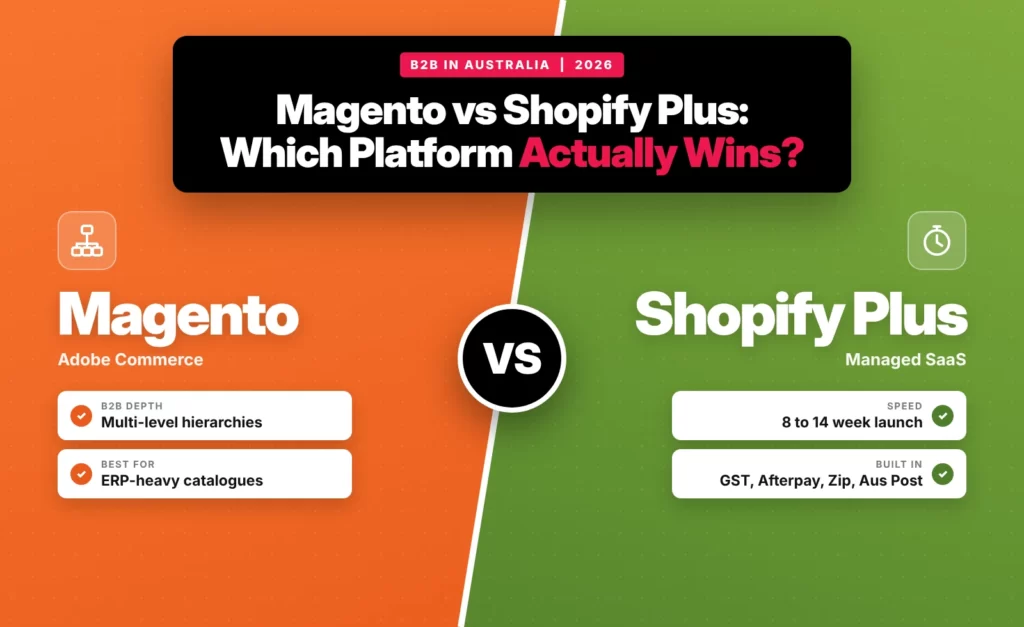
If you run an Australian B2B business, such as a distributor, manufacturer or wholesaler, choosing between Magento (Adobe Commerce) and Shopify Plus used to be an easy call. Magento owned B2B. That is no longer true. Shopify has closed much of the gap, and in 2026 the right choice depends on how your business actually buys and sells, not on which platform used to be “the B2B one”.
We build and maintain stores on both platforms, so we have no reason to push you either way. This guide compares B2B features, total cost and the Australia-specific details that matter, then gives you three questions to settle the decision.
Quick answerShopify Plus suits most Australian B2B businesses with straightforward buyer accounts, one ERP and a team that wants to manage the store without developers. Magento (Adobe Commerce) still wins when you need multi-level company hierarchies, purchase approval chains, very large or complex catalogues, or deep ERP-driven pricing, and you can fund ongoing development.
B2B Capability: How Close Has Shopify Actually Gotten?
Shopify’s native B2B tools now cover the basics well. Buyers log in, see their own pricing and catalogue, order, and pay on terms. For a simple wholesale setup, the experience is fast and clean.
Since April 2026, part of that toolkit is no longer Plus-only. Company profiles, payment terms, volume pricing and up to three B2B catalogues are now available on Shopify’s Basic, Grow and Advanced plans. Shopify Plus keeps the features most wholesalers depend on: unlimited catalogues for customer-specific pricing, catalogues assigned directly to companies and locations, partial payments and deposits.
Where Shopify still falls short is company structure. A Shopify company has locations and buyers, and buyers get one of two roles: ordering only, or location admin. There are no divisions, departments or multi-level approval chains. You can set a location to submit orders as drafts for your team to review, but a buyer’s manager cannot natively approve their purchase. Apps can fill some of that gap, at extra cost.
If a “company account” in your business means one buyer and a few shipping addresses, Shopify Plus handles it well. If it means a corporate parent with a dozen divisions, each with its own procurement officers and budget approvers, Shopify is not built for that yet.
Magento’s B2B module has been part of Adobe Commerce since 2017. It includes company hierarchies with teams and roles, shared catalogues, negotiable quotes, requisition lists, quick order by SKU and purchase order approval rules. The trade-off is setup: you configure most of it with a developer who knows the platform, not through a settings panel.
Total Cost of Ownership: The Real Gap
For most Australian B2B businesses, cost separates the two platforms more than any feature does.
Shopify Plus starts at A$3,700 per month in Australia, and new Australian merchants are billed in AUD. That fee covers hosting, security, PCI compliance and platform updates. At higher sales volumes, Shopify may move you to a variable fee based on revenue. It does not publish a standard threshold or rate, so get yours in writing before you sign. Budget separately for apps, which often fill B2B gaps such as approvals and advanced quoting.
Magento / Adobe Commerce has a licence fee that Adobe does not publish. It is commonly reported to start around US$22,000 per year for stores under US$1 million in annual sales, and it scales with your gross merchandise value. Ask Adobe or an Adobe partner for a written quote in AUD before you budget. On top of the licence, you pay for hosting, the build, and an ongoing development retainer for security patches, extension updates and monitoring. Our Magento 2 upgrade cost guide breaks down each of those numbers for Australian stores.
The gap is less about the platform fee and more about people. A Magento store needs developer time every month to stay patched and compatible. A Shopify Plus store mostly does not. Over the past two years, that ongoing labour cost has moved many mid-sized Australian B2B businesses to Shopify Plus.
Not Sure Which Platform Fits Your Budget?
We build on both Magento and Shopify Plus. Tell us how your buyers order, and we will show you the real cost of each.
Where Magento Open Source Fits
Magento Open Source has no licence fee, which narrows the cost gap considerably. The catch is that Adobe’s B2B module only ships with Adobe Commerce. On Open Source, you add B2B features such as company accounts, quotes and customer-specific pricing through third-party extensions.
That route can suit a B2B business that needs Magento’s flexibility but not Adobe’s enterprise tooling. It also means more extensions to keep compatible at every upgrade. If you are weighing it, price the extensions and their maintenance alongside the build.
The Australia-Specific Factors That Actually Matter
A generic global comparison misses a few things that matter specifically for an Australian B2B operation:
- GST: Both platforms calculate GST and display tax-inclusive or tax-exclusive pricing. Shopify sets this up through its built-in Australian tax settings. Magento uses tax rules and zones that you configure once, usually during the build.
- Afterpay and Zip: Shopify offers both as checkout payment options. Magento supports them through the providers’ official extensions. They are consumer-focused, so they matter most if some of your buyers are sole traders or small businesses.
- Australia Post: Shopify connects through Shopify Shipping and Australia Post’s own app. Magento connects through an extension or a shipping platform. Either handles local rates, labels and tracking without much friction.
- Local developers: In our experience, experienced Magento developers in Australia are harder to find and cost more per hour. Shopify Plus agencies and developers are easier to source, which keeps both build and support costs down.
Shopify Plus vs Magento for B2B: At a Glance
| Factor | Magento (Adobe Commerce) | Shopify Plus |
|---|---|---|
| B2B company hierarchies | Deep, multi-level, department-based | Flat, single buyer or basic roles |
| Setup & launch timeline | 14 to 24 weeks typical | 8 to 14 weeks typical |
| Platform cost | Licence from ~$22,000/year + hosting + dev | From A$3,700/month |
| Ongoing maintenance | Requires dedicated dev/agency retainer | Managed by Shopify; app costs on top |
| Developer talent (AU) | Scarce, specialised, costly | Widely available |
| GST/Afterpay/Zip/Aus Post | Supported via extensions | Native, turnkey |
| Best suited to | Complex, large-catalogue, ERP-heavy B2B | Most B2B operators, $5M to $50M revenue |
Which Platform Is Right for Your Business?
Ask yourself three questions:
- Do you need multi-level company hierarchies and purchase approval chains? Or would one buyer per account, with a few roles, cover 90% of your customers?
- Is your catalogue too complex for native B2B tools? Think SKU count, custom attributes and pricing rules driven by your ERP.
- Can you fund dedicated development long term? Either in-house developers or an agency retainer to maintain a Magento build.
If you answered no to most of these, Shopify Plus will likely run your B2B operation well, at a significantly lower total cost. If you answered yes to two or more, Magento is a worthwhile investment, and our Magento development team can scope it properly.
Still undecided? Talk to the Loud Days team, and we will help you make the call with real numbers.
Get a Straight Answer on Magento vs Shopify Plus
We scope both platforms against your catalogue, buyers and ERP, then recommend the one that fits. No platform bias.
FAQs
Shopify vs Magento: which is better for B2B in Australia?
It depends on the complexity of your B2B operation. Shopify Plus is the stronger choice for most Australian B2B businesses in the $5M–$50M range with straightforward company structures, while Magento remains better suited to businesses with deep company hierarchies, large catalogues, or complex ERP integrations.
Is Shopify good enough for B2B now, or is Magento still necessary?
Does Magento or Shopify handle GST better for Australian businesses?
Is it expensive to find Magento developers in Australia?
Yes. It is expensive. It is getting incredibly hard to find Magento-certified developers in 2026, which is why many B2B companies are switching to Shopify Plus.