
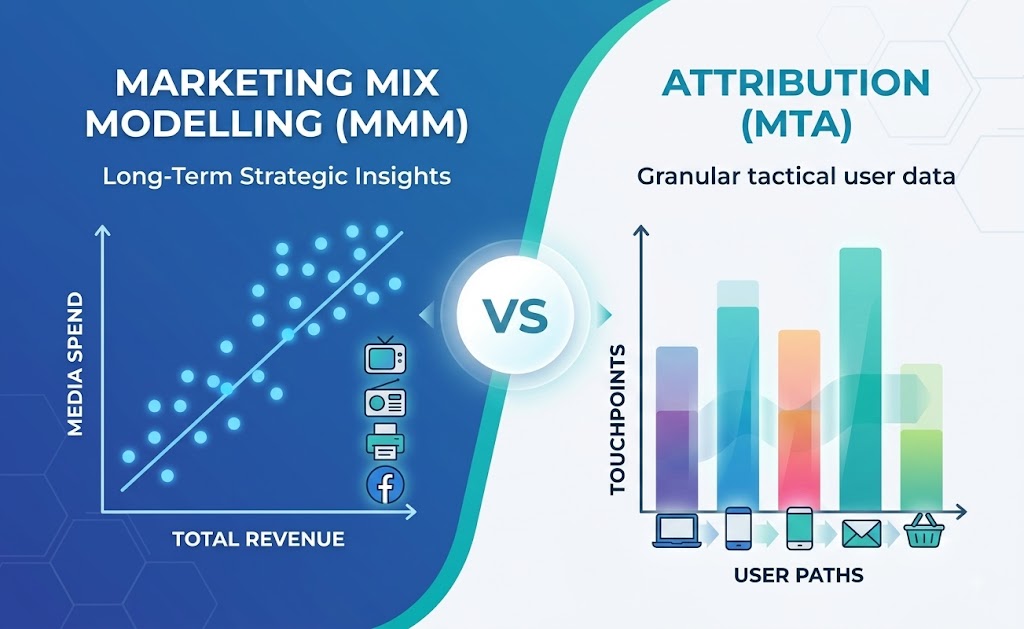

A paid social platform reports strong revenue. Google Ads claims the same sale. Your CRM shows a returning customer who first discovered the brand through a podcast three months earlier. This is the practical tension behind marketing mix modelling vs attribution: both aim to explain marketing’s contribution to revenue, but they answer different questions and can produce very different budget decisions.
For Australian businesses managing fragmented customer journeys, choosing one measurement method as the sole source of truth is usually a mistake. The stronger approach is to understand where each method is credible, where it is blind and how to use both alongside incrementality testing.
The core difference between marketing mix modelling and attribution
Attribution assigns credit for an individual conversion to one or more observed touchpoints. It operates at the user or event level. A customer clicks a paid search ad, visits the site and buys a product. Attribution attempts to determine how much credit paid search should receive.
Marketing mix modelling, usually shortened to MMM, works at an aggregate level. It uses historical time-series data to estimate how changes in marketing activity, price, promotions, seasonality, distribution and external conditions affected business outcomes such as sales, leads or profit.
The distinction matters. Attribution asks, which touchpoints were present before a conversion? MMM asks, what changed total business outcomes over time, after accounting for other drivers?
That makes attribution highly useful for operational optimisation inside a channel. MMM is more useful for strategic budget allocation across channels, including those that cannot be reliably tracked at user level, such as out-of-home, radio, retail activity and brand investment.
Attribution is fast, granular and easy to overtrust
Attribution is built for day-to-day performance management. It can show campaign, keyword, creative, audience, device and landing-page performance quickly. For an eCommerce team adjusting search budgets every week, that level of granularity is valuable.
Common attribution approaches include last-click, first-click, linear, time-decay and data-driven models. Each distributes conversion credit differently. Last-click gives all credit to the final recorded interaction. First-click rewards discovery. Data-driven attribution uses observed path patterns to distribute credit across touchpoints.
None of these models is a direct measure of causality. They analyse recorded journeys, not the counterfactual question: would the customer have converted without that ad?
This is where businesses can make expensive errors. Brand search often appears highly efficient in platform and analytics reporting because it captures people already looking for the brand. Retargeting can have the same issue. It reaches people who have already demonstrated intent, then claims credit when they buy. That does not mean either tactic lacks value. It means reported return on ad spend may overstate its incremental impact.
Attribution also has a shrinking view of the customer journey. Consent requirements, browser restrictions, mobile app environments and walled gardens limit the data available for cross-channel user tracking. Platform reporting remains useful, but it should be treated as directional evidence rather than an impartial ledger.
Where attribution earns its place
Attribution is strongest when the decision is close to the conversion event, and the channel is measurable. Use it to improve paid search query coverage, identify landing pages that leak conversion value, compare creative within a campaign or diagnose where a checkout journey is breaking down.
It is less reliable for deciding whether to shift a major share of spend from TV to paid social, to cut upper-funnel video, or to assess the long-term impact of a brand campaign. Those decisions extend beyond the visible click path.
MMM measures business impact, with different trade-offs
MMM uses statistical modelling to separate the influence of marketing from other forces affecting demand. A useful model may include media spend or impressions, pricing, promotional periods, public holidays, stock availability, distribution changes, competitor activity, weather and underlying market trends.
Modern MMM is not simply an annual spreadsheet exercise. With sufficient clean data and stable processes, models can be refreshed more regularly and used for scenario planning. A business might estimate what happens to incremental revenue, profit or new customer volume if it reallocates 15 per cent of spend from paid social to video, or if it reduces discounting during a peak period.
Its major advantage is scope. MMM can measure channels that attribution struggles to capture and identify the combined effect of activity across the whole market. It can also estimate diminishing returns, sometimes called saturation. This matters when a channel performs well at $20,000 per month but becomes materially less efficient at $100,000.
However, MMM is not magic. It needs enough historical variation in spend and outcomes to distinguish signal from coincidence. A business that uses the same channel mix every month gives the model little evidence to learn from. Poor-quality sales data, frequent tracking changes, major stockouts or too few observations can make results unstable.
MMM also works best where the outcome has enough volume. A low-volume B2B business with a handful of monthly deals may need to model qualified pipeline, lead quality or broader demand indicators rather than closed revenue alone. In these cases, carefully designed experiments and CRM analysis may be more decisive than a complex model.
What a credible MMM programme requires
A credible model starts with commercial data, not media data. Revenue should reconcile to finance records, and the business should decide whether it is optimising for gross revenue, contribution margin, new customers or lifetime value. Optimising media against the wrong outcome simply makes the wrong answer more precise.
Marketing inputs should capture meaningful delivery measures where possible, not just spend. Impressions, reach, clicks and campaign classifications help distinguish brand from performance activity and paid from owned channels. External variables must be selected carefully. Adding every available data point does not improve a model if the variables have no credible relationship with demand.
The model should then be validated against holdout periods and real-world tests. Google’s Meridian, an open-source MMM framework, and Meta’s Robyn have helped standardise modern approaches, but software does not remove the need for informed assumptions, quality assurance and commercial judgement.
A practical comparison for budget decisions
| Decision | Attribution | MMM |
|---|---|---|
| Which keyword or ad set should change this week? | Strong | Limited |
| Which channel generates incremental sales? | Directional, often biased | Stronger when data is sufficient |
| Can we measure offline and untrackable media? | Weak | Strong |
| Can we explain individual customer paths? | Strong | Weak |
| How quickly can teams act? | Hours to days | Weeks, depending on data maturity |
| Can it model saturation and budget scenarios? | Limited | Strong |
The table is not a verdict that MMM replaces attribution. It reflects different levels of decision-making. Attribution is a tactical dashboard. MMM is a strategic planning instrument. Both can mislead when treated as final truth.
The measurement system that works in practice
For most growth-focused businesses, measurement should be a layered system rather than a debate over one winner.
Start with business truth. Finance-reconciled revenue, margin, new customer numbers and qualified pipeline should anchor reporting. Then use attribution and platform data to manage in-channel execution. These data sets tell teams where to investigate and what to optimise, particularly in search, shopping, paid social and lifecycle marketing.
Use MMM periodically to set channel-level investment ranges and challenge apparent efficiency. If attribution says paid social is underperforming, but MMM indicates it creates meaningful incremental demand that later converts through search and direct traffic, cutting social may damage future revenue. The reverse can also be true: a channel with attractive platform-reported ROAS may add less incremental value than it claims.
Finally, use incrementality tests to resolve high-stakes uncertainty. Geo tests, audience holdouts, conversion lift studies and matched-market experiments compare an exposed group with a control group. They are not always cheap or easy, but they produce causal evidence that can calibrate both MMM and attribution.
A practical cadence is to optimise campaigns weekly, review channel performance monthly, refresh strategic budget guidance quarterly or biannually, and run experiments around major investment decisions. The right timing depends on spend, conversion volume and how quickly the market changes.
When to prioritise each approach
Prioritise attribution if your immediate challenge is campaign hygiene: broken tagging, poor landing-page performance, wasted search terms, weak creative or unclear conversion paths. It is also the sensible starting point for smaller businesses without the data volume or media complexity required for MMM.
Prioritise MMM when annual media investment is substantial, customer journeys span multiple channels, offline activity matters, or leadership needs to make material allocation decisions with more confidence. It is particularly valuable for retailers, multi-location businesses and established eCommerce brands where price, promotions and seasonality materially shape demand.
The key is not to wait for perfect measurement. Establish consistent campaign taxonomy, protect your source-of-truth revenue data, document major commercial events and build testing into the marketing plan. These foundations make every measurement method more useful.
The best marketing teams do not ask which dashboard deserves blind trust. They ask which evidence is fit for the decision in front of them. That discipline is what turns measurement from a reporting exercise into a system built to move revenue.