
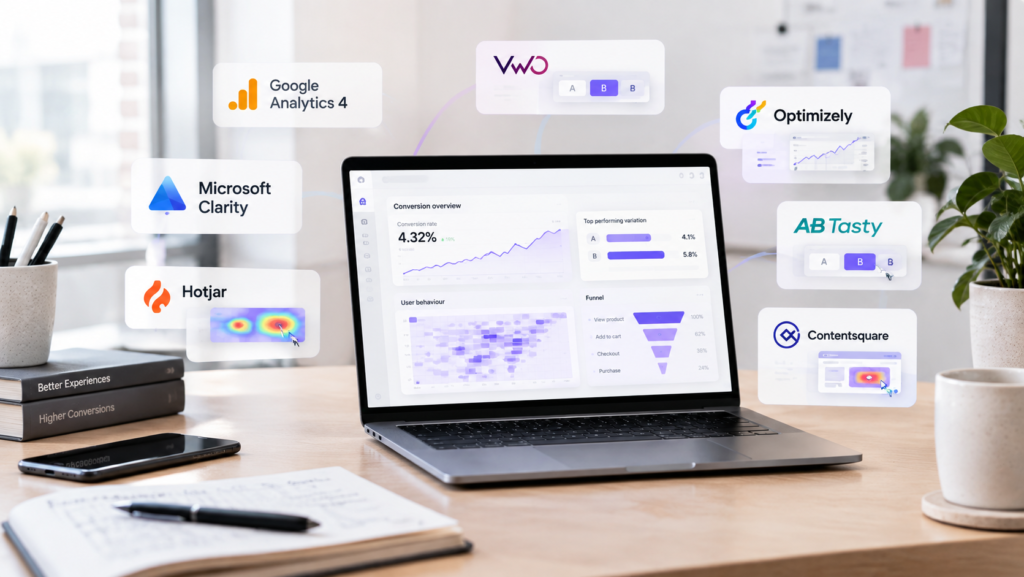
A checkout drop-off is not a testing brief. Neither is a heatmap full of rage clicks. The top CRO tools become valuable only when they help a team answer a commercial question: what is stopping qualified visitors from taking the next step, and is fixing it worth the effort?
For Australian eCommerce teams and lead-generation businesses, conversion rate optimisation is now as much a measurement discipline as a design discipline. The right platform can expose friction, validate a hypothesis and deliver a change with measurable revenue impact. The wrong stack produces recordings, dashboards and experiment backlogs that nobody can confidently prioritise.
Key takeaways
- Use different tools for behavioural evidence, experimentation, analytics and personalisation. One platform rarely leads every category.
- Start with the decision you need to make, not a feature checklist. A low cart completion rate and weak lead quality need different evidence.
- Server-side testing, clean event tracking and statistical discipline matter more as traffic volumes and privacy constraints increase.
- CRO tools should connect to revenue, margin or qualified pipeline. A lift in a soft metric is not automatically a business win.
What separates the top CRO tools from feature-heavy software
Understanding what CRO is helps explain why a useful CRO stack has four jobs: it tells you where users leave, helps you understand why, lets you test a credible solution and measures whether the outcome improved. Most businesses need a primary analytics platform, a behavioural insight tool and an experimentation platform. Personalisation can follow once the team has a reliable testing programme and enough traffic to support audience segmentation.
The trade-off is operational complexity. Adding five platforms may create more data, but it also creates tagging requirements, consent considerations, overlapping event definitions and competing versions of the truth. For many mid-market brands, a focused stack with well-governed tracking will outperform a larger collection of underused subscriptions.
When evaluating a tool, assess four factors: implementation effort, data quality, experiment velocity and commercial fit. A platform that requires developer support for every minor change may be the right choice for a high-traffic enterprise, but excessive for a lean eCommerce team that needs to test landing-page propositions weekly.
Top CRO tools by job to be done
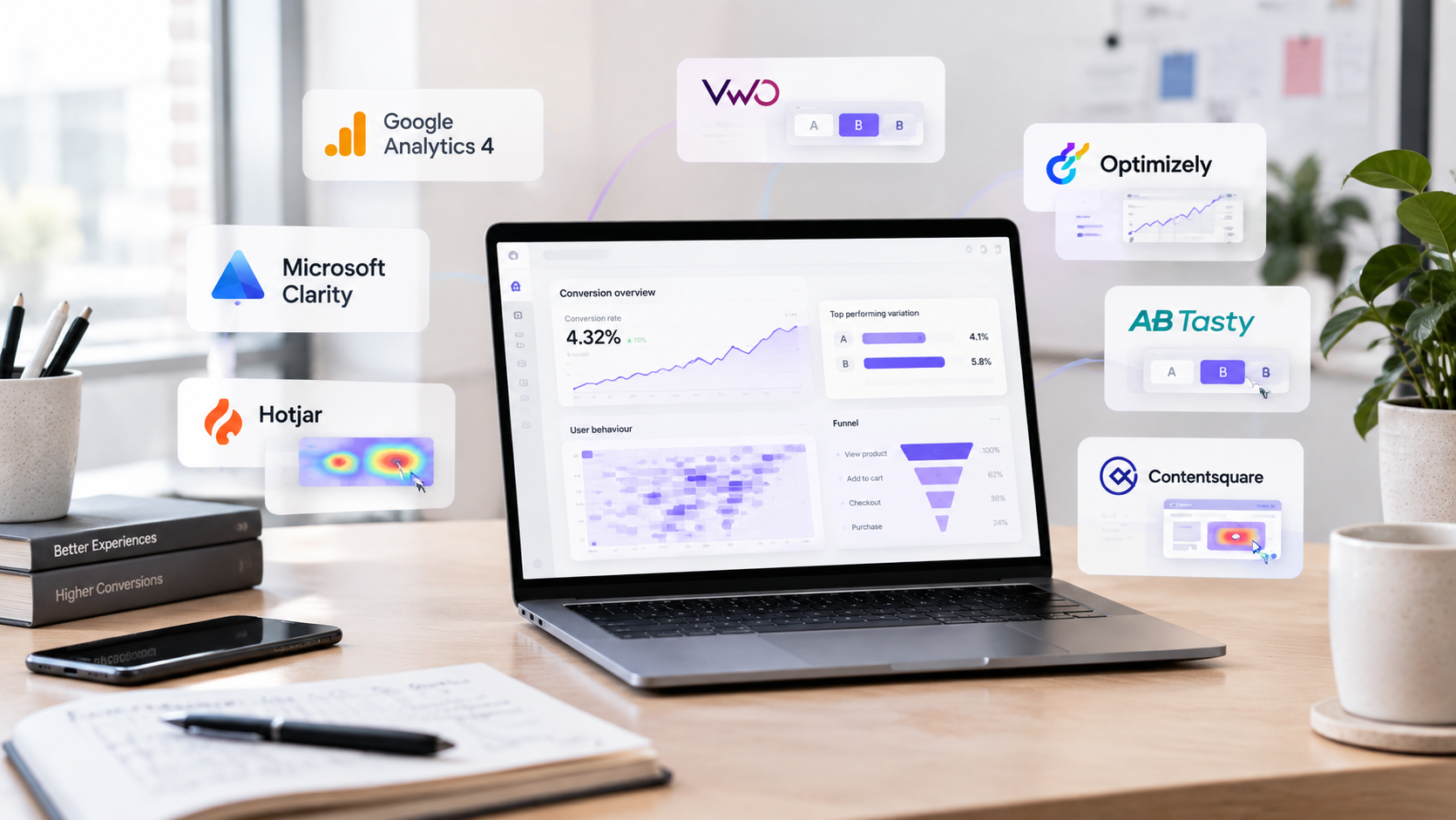
| Tool | Best suited to | Core strength | Watch-out |
|---|---|---|---|
| Google Analytics 4 | Journey and channel analysis | Flexible event and audience analysis | Requires disciplined tracking design |
| Microsoft Clarity | Qualitative behaviour research | Free session recordings and heatmaps | Not a replacement for quantitative analysis |
| Hotjar | Research and on-site feedback | Surveys, recordings and heatmaps in one place | Can encourage observation without action |
| VWO | Structured A/B testing | Broad testing and optimisation toolkit | Needs sufficient traffic for meaningful tests |
| Optimizely | Enterprise experimentation | Governance, feature experimentation and scale | Higher implementation and operating commitment |
| AB Tasty | Testing and personalisation | Strong audience targeting options | Value depends on a mature experiment roadmap |
| Contentsquare | Digital experience analytics | Detailed behavioural analysis at scale | Best suited to larger, complex digital estates |
Google Analytics 4: the measurement foundation
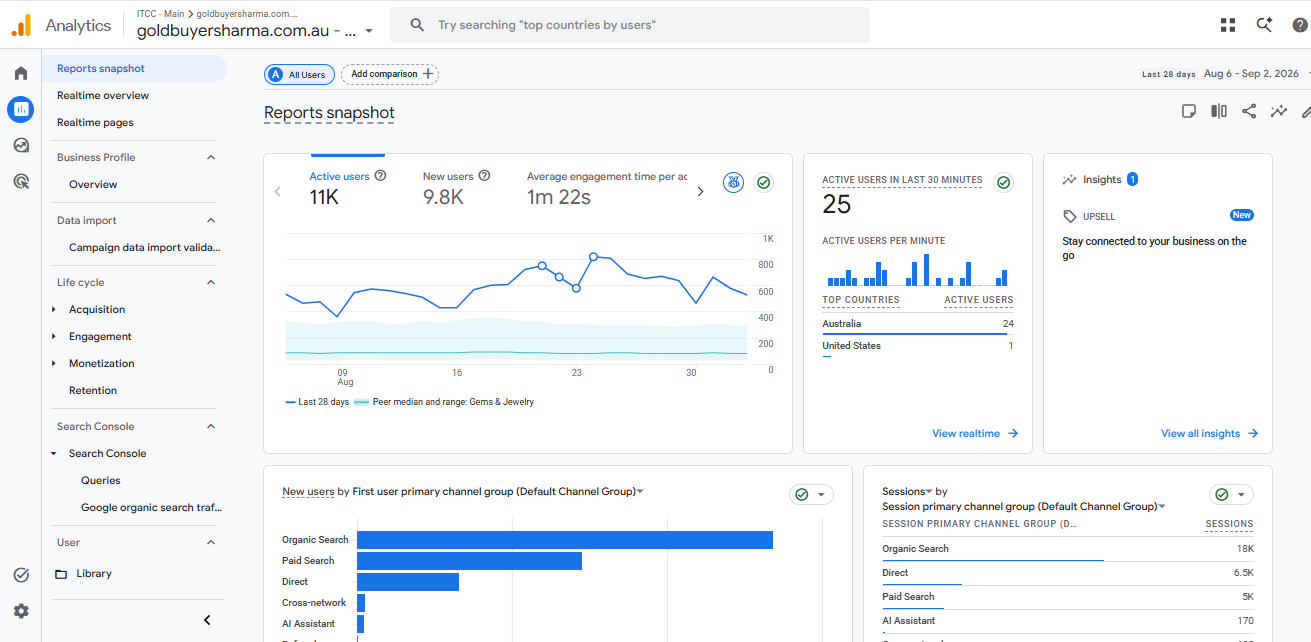
GA4 remains the starting point for most Australian businesses because it connects acquisition, engagement and conversion behaviour in one reporting environment. A well-structured GA4 event tracking setup is particularly important when CRO decisions depend on understanding where users drop out of the journey.
It is particularly useful for finding where performance differs by channel, device, landing page, product category or returning versus new visitor status.
Its limitation is that it shows patterns more readily than motivations. If mobile users abandon a product page at a higher rate than desktop users, GA4 can identify the segment. It cannot tell you whether the cause is page speed, unclear delivery information, an awkward variant selector or lower-intent traffic. Pair it with qualitative research before prescribing a solution.
The practical priority is event governance. Define key events around commercial progress, such as product view, add to cart, begin checkout, quote start, form error and qualified enquiry. A muddled event model will make every downstream CRO decision less reliable.
Microsoft Clarity and Hotjar: understand real behaviour
Microsoft Clarity is a strong entry point for teams that need visual evidence without adding software cost. Session recordings, scroll depth, and heatmaps can reveal usability issues that aggregate analytics hides, particularly on mobile pages and multi-step forms.
Hotjar is often better suited to teams that want to combine recordings with on-page surveys and feedback prompts. For example, a short exit survey on a finance application page may reveal concerns around eligibility or document requirements that a heatmap cannot explain.
Neither tool should be treated as proof. A handful of recordings can generate a useful hypothesis, but they cannot establish causality. Look for repeated behaviour across a meaningful sample, then validate the pattern against analytics, customer service feedback and funnel performance.
VWO: a practical platform for disciplined experimentation
VWO is a sensible option for organisations building a formal A/B testing programme across marketing pages, eCommerce journeys and conversion funnels. Its appeal is breadth: visual testing, audience segmentation, heatmaps and reporting can sit within a single operating environment.
It works best when a team already has a prioritised backlog. A test such as changing a button colour is rarely worth the traffic it consumes. Better candidates address a high-friction step or a major decision barrier: delivery certainty, product comparison, trust signals, offer framing, lead-form complexity or checkout payment options.
For lower-traffic sites, test fewer and bigger ideas. Small changes are unlikely to produce a detectable result without very large sample sizes. A practical rule is to avoid calling a winner simply because one variation briefly looks better in the dashboard.
Optimizely and AB Tasty: for mature experimentation programmes
Optimizely and AB Tasty are built for businesses where experimentation extends beyond campaign landing pages. They can support more sophisticated targeting, personalisation and, depending on implementation, experimentation across product and feature experiences.
That capability comes with a higher bar. These platforms need clear ownership across marketing, product, analytics and engineering. They also need a decision framework: which audiences qualify for personalisation, how holdout groups are managed, which metric decides a winner and how results are documented.
Choose this category when experimentation is becoming an operating system for growth, not an occasional marketing task. If the business is still fixing basic tracking or has limited traffic, the cost and complexity may be premature.
Contentsquare: for complex digital experience analysis
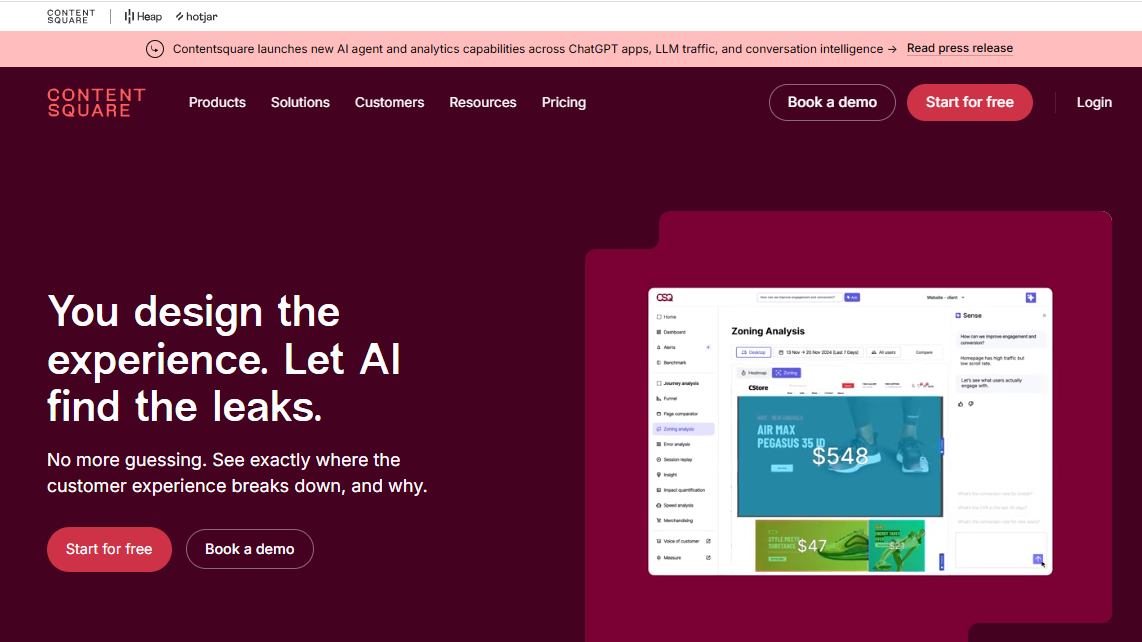
Contentsquare is designed for larger organisations that need detailed visibility across extensive websites, product ranges or digital journeys. Its analysis can help teams identify where users struggle, compare behaviours across segments and quantify the commercial impact of experience issues.
It is particularly relevant when several teams own different parts of the journey and anecdotal debate has replaced evidence. The trade-off is that deeper insight still requires skilled interpretation. A platform cannot decide whether a UX issue, pricing decision, stock availability or acquisition-quality problem deserves priority.
Ready to improve your website’s conversion rate?
The right CRO tools can show you where users are dropping off. We can help you turn those findings into more conversions.
Explore CRO ServicesBuild a CRO stack around your growth constraint
The best combination depends on what is limiting growth. A business with poor traffic quality should fix targeting and landing-page message match before investing heavily in personalisation. A store with healthy product-page engagement but weak checkout completion should focus on checkout friction, delivery clarity, payment options and error tracking.
A lean, effective setup might combine GA4 for funnel measurement, Clarity or Hotjar for behavioural research, and VWO for experiments. Larger teams may add Contentsquare for experience intelligence and Optimizely or AB Tasty where advanced personalisation has a clear commercial case. For businesses that need support turning these insights into structured testing and optimisation, CRO services can bring research, experimentation and implementation into one process.
Before purchasing, run one real use case through the vendor evaluation. Ask how the platform would help answer a current question, such as: why do paid social visitors add products to cart but fail to start checkout? If the workflow is unclear, reporting is difficult to trust, or implementation requires a major rebuild, the platform is unlikely to improve experiment velocity.
Measure the outcome that pays the bills
Conversion rate is useful, but it can be misleading on its own. A promotion may increase conversion while reducing average order value or attracting lower-margin customers. For lead generation, more form completions may mean less qualified pipeline.
Use a primary metric that reflects the purpose of the page, then monitor guardrails. An eCommerce test might use revenue per visitor as the primary metric while tracking conversion rate, average order value, refund rate and margin. A B2B lead test might measure sales-qualified opportunities per visitor while monitoring lead volume and follow-up capacity.
The research standards published by bodies such as the Nielsen Norman Group and the experimentation guidance from major analytics platforms point to the same practical lesson: behaviour data is evidence, not a verdict. Strong CRO teams triangulate quantitative patterns, qualitative research and business context before committing resources.
The tool is rarely the constraint. A clear hypothesis, reliable measurement and the discipline to act on what customers are showing you will move revenue far more reliably than another dashboard.