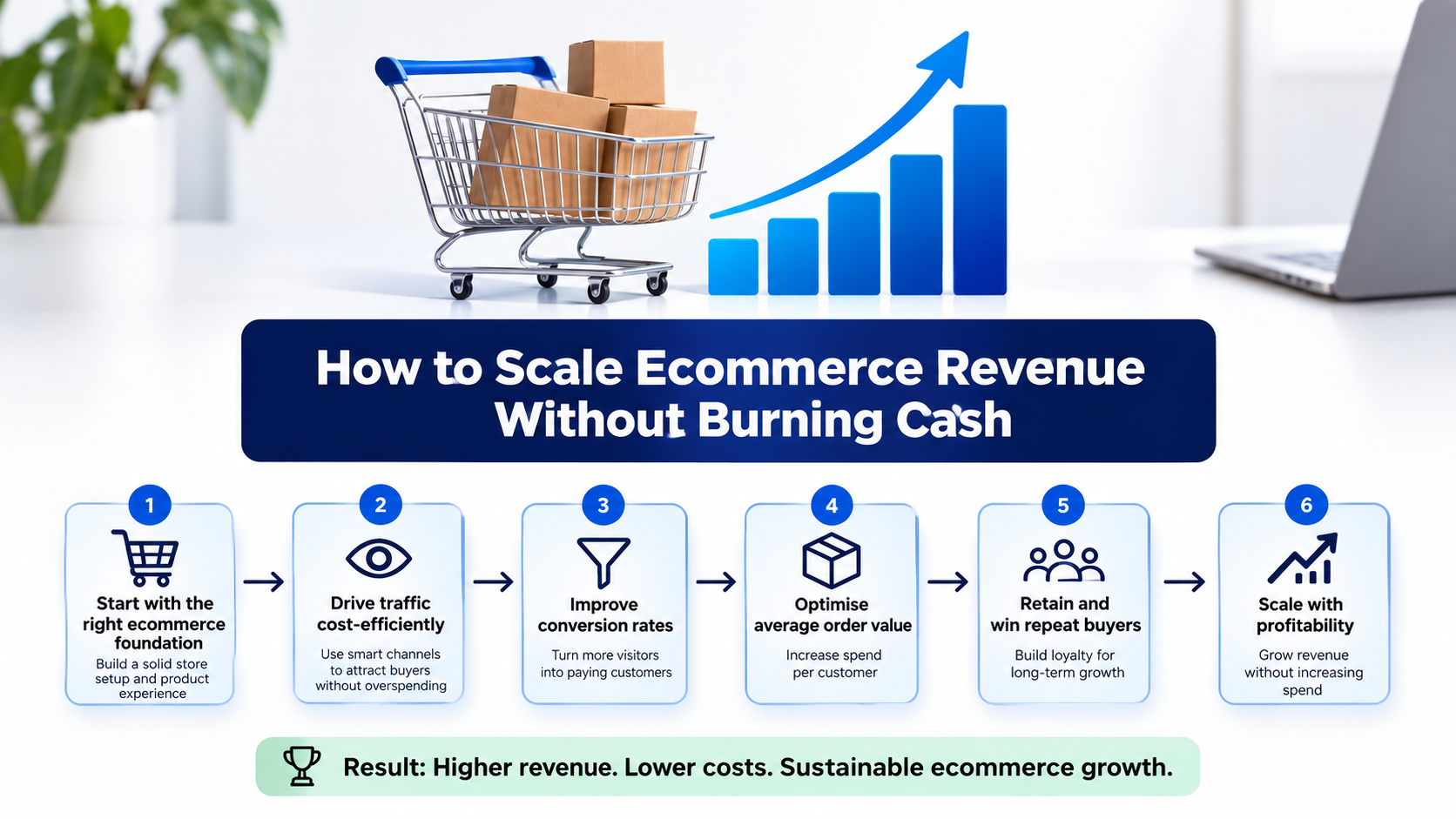

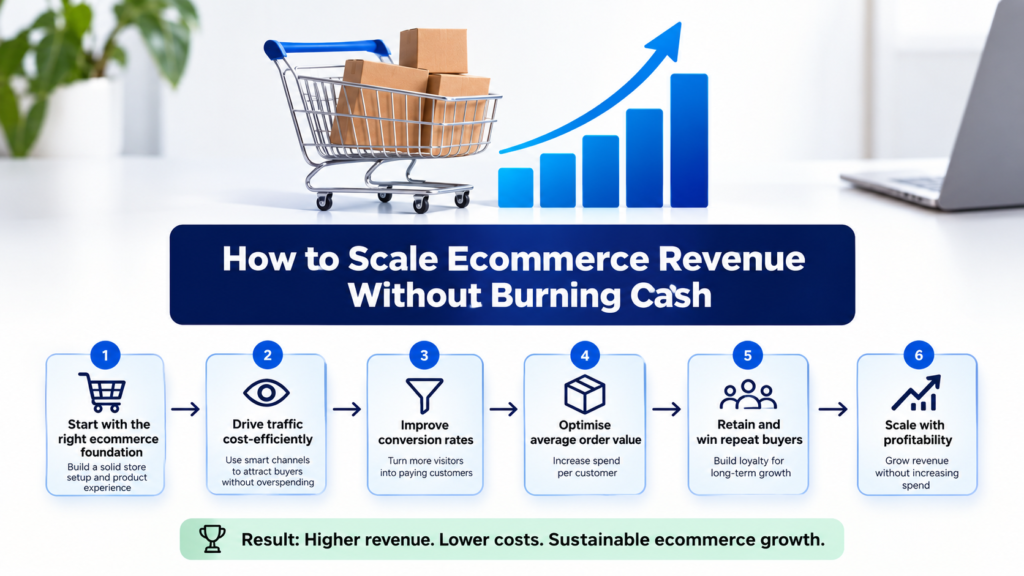
A store can double its paid media spend and still become less valuable. That is the central problem with growth plans built around traffic alone. Knowing how to scale ecommerce revenue means building a commercial system that can acquire customers profitably, convert more of the demand already arriving, and generate repeat revenue without relying on permanent discounts.
For Australian ecommerce operators, the constraint is rarely a shortage of marketing channels. It is usually weak unit economics, fragmented data or a website that cannot carry more demand. Scaling amplifies whatever is already in place. If your acquisition is inefficient, your conversion rate is low or your fulfilment experience creates churn, more spend simply makes those problems more expensive.
Start with the revenue equation, not the channel
Ecommerce revenue is often simplified as:
Revenue = Traffic × Conversion Rate × Average Order Value
That formula is useful, but incomplete. A scalable business also needs to account for gross margin, customer acquisition cost (CAC), repeat purchase rate, returns, fulfilment costs and contribution margin. Revenue that disappears into advertising, shipping and discounts is not growth. It is activity.
Before setting an aggressive growth target, establish a baseline across these metrics:
| Metric | What it tells you | Commercial question |
|---|---|---|
| Conversion rate | How efficiently the site turns visits into orders | Can the site handle more traffic? |
| Average order value | The value created per transaction | Can revenue grow without acquiring every extra dollar? |
| CAC | The cost to acquire a new customer | Is paid growth economically viable? |
| Repeat purchase rate | The strength of retention | Are customers worth acquiring at current costs? |
| Contribution margin | Profit after variable costs | Does each order create cash for growth? |
Use blended metrics alongside channel-level reporting. A Meta campaign may look efficient in-platform while branded search, email and direct traffic are doing much of the conversion work. Equally, a channel that appears expensive on last-click attribution may be creating the demand later captured elsewhere. The objective is not to find a perfect attribution model. It is to make better budget decisions with a clear view of incremental revenue and margin.
Set a growth target that protects margin
A useful starting point is a contribution-margin target per first order, paired with an allowable CAC. If a customer’s first order is marginally unprofitable but the cohort reliably repurchases within 60 or 90 days, that can be rational. If repeat behaviour is inconsistent, it is a risk disguised as a growth strategy.
Segment this analysis by product category, customer type and acquisition source. A high-AOV bundle buyer acquired through Google Shopping may behave very differently from a discount-led first-time customer acquired through paid social. One blended CAC target across the whole business hides these differences.
How to scale ecommerce revenue through better demand capture
Growth has two sides: creating demand and capturing existing intent. Businesses often overinvest in the first because it is more visible. Capturing high-intent demand tends to produce faster, more measurable gains.
Fix the paths closest to purchase
Start with product pages, collection pages, cart and checkout. These are not design assets. They are revenue assets.
A product page should reduce hesitation with clear value propositions, accurate stock and delivery information, useful product details, sizing or compatibility guidance, reviews and objections answered before checkout. For Australian shoppers, delivery expectations are particularly material. Vague shipping information, unexpected costs and unclear returns policies create friction at precisely the point where intent is highest.
Prioritise improvements based on evidence. Review GA4 funnel data, heatmaps, on-site search terms, customer service tickets and return reasons. If customers repeatedly ask whether a garment runs small, whether a supplement is suitable for a specific need, or when regional delivery will arrive, the site should answer that question before they have to ask.
Test one meaningful variable at a time where traffic allows. A conversion rate increase from 2.0% to 2.4% is not a cosmetic improvement. It creates 20% more orders from the same traffic base, often at a far better marginal return than increasing media spend.
Make merchandising work harder
Merchandising is a major but underused lever in ecommerce growth. Do not send every shopper to a generic homepage and expect the navigation to do the selling. Build landing experiences around the intent behind the ad, query or email.
For example, a skincare brand advertising a winter hydration routine should land visitors on a curated routine with a clear order of use, relevant proof points and a bundle option. A retailer promoting workwear should separate high-intent categories such as men’s trade pants, women’s work boots and site-ready layers rather than pushing visitors into an all-products grid.
This approach improves relevance, supports a higher average order value and gives advertising platforms stronger signals about the kind of customer you want more of.
Increase average order value without training customers to wait for sales
Discounting can lift short-term conversion, but repeated sitewide offers erode margin and condition customers to delay purchase. Scale requires more thoughtful ways to increase basket value.
Bundles, replenishment plans, threshold-based free shipping, complementary product recommendations and volume incentives can all work. The right method depends on category behaviour. A consumables brand may benefit from subscribe-and-save or multi-pack offers. A furniture retailer may see better results from complementary accessories and post-purchase cross-sells. A fashion brand may need carefully chosen outfit-building recommendations rather than more price-led promotions.
The test is simple: does the offer increase contribution margin per visitor, not just average order value? A bundle that increases AOV but requires a deep discount may be less valuable than a smaller upsell with strong margin.
Build retention before paying more for acquisition
The cheapest customer acquisition strategy is not retention. That phrase is too simplistic. Retention still requires investment in product quality, service, CRM and customer experience. But improving the value of an acquired customer gives the business more room to compete for the next one.
A practical retention programme begins with lifecycle messaging rather than generic newsletters. Map communication to customer behaviour: welcome, browse abandonment, cart abandonment, first purchase, post-purchase education, replenishment, cross-sell, win-back and VIP recognition.
The strongest flows are useful, not merely frequent. A first-time buyer of a complex product may need setup guidance and usage advice before they need another promotion. A customer who buys a seasonal item may need a different follow-up path to someone who buys every month.
Measure retention by cohorts. Look at customers acquired in a given month and track their repeat rate, revenue and margin over time. This reveals whether changes to offers, channels or onboarding are attracting better customers or simply more customers.
Scale paid media with creative volume and controlled experimentation
Paid media scales when the account has enough creative, audience insight and conversion data to keep finding profitable pockets of demand. It does not scale because budgets are increased by 20% every Monday.
Creative is often the limiting factor, especially in paid social. Develop a repeatable testing system around different customer problems, product demonstrations, use cases, social proof, founder expertise, comparisons and objections. A polished brand film may build awareness, but short-form product proof can be more effective at moving a hesitant buyer towards purchase. You need both, allocated according to the role each plays.
Search and Shopping activity should be structured around commercial intent, product feed quality and margin. Product titles, imagery, pricing, stock availability and category mapping all affect performance. Do not allow a platform to push budget towards products that sell well but deliver poor contribution margin or high return rates.
Set clear test conditions. Define the hypothesis, success metric, budget, time frame and decision rule before launching. If a campaign cannot produce a meaningful read because the spend is too low or the target is vague, it is not an experiment. It is a guess with a media budget.
Build a measurement system leaders can use
The reporting pack should make it easier to decide what to scale, stop or fix. It should not be a dashboard full of decorative metrics.
At minimum, monitor revenue, gross margin, contribution margin, blended CAC, new versus returning customer revenue, conversion rate, AOV, repeat purchase rate, refund rate and stock availability. Review these by channel, campaign, product category and cohort where possible.
Be alert to false growth signals. Revenue can rise while profitability falls because of increasing discount rates, freight costs, return rates or an unfavourable product mix. Similarly, a falling CAC can be misleading if it is caused by more branded demand rather than stronger prospecting.
For businesses operating across Shopify, paid platforms, email tools and finance systems, data definitions matter. Ensure revenue, refunds, new customers and marketing costs are calculated consistently. A board report, finance report and advertising dashboard should not tell three different stories about performance.
Remove operational ceilings before they become revenue problems
Marketing can create demand faster than operations can fulfil it. Stockouts, delayed dispatch, poor customer support and unclear returns processes can rapidly destroy the economics of a growth campaign.
Coordinate growth plans with inventory forecasting, customer service capacity and warehouse operations. If a hero SKU is central to a campaign, establish what happens when stock is low. If a promotion will create a spike in orders, ensure fulfilment partners can meet the delivery promise. This is especially relevant in Australia, where geographic distance can make freight costs and delivery expectations more complex than they appear in a media plan.
The best growth plans are cross-functional. Marketing owns demand generation, but revenue performance depends on product, operations, finance and customer experience working from the same commercial priorities.
A business ready to scale does not ask, “Which channel should we spend more on?” It asks, “Where will the next dollar create the greatest incremental contribution margin?” That question keeps growth strategy-first, measurable and built to move revenue.