
A keyword can look perfectly relevant in a Google Ads account and still waste budget. That is the practical tension behind broad match vs exact match: one keyword type gives Google room to find demand you did not explicitly map; the other places tighter boundaries around when you enter an auction. Neither is automatically better. The commercial question is which level of control your account needs to move revenue profitably.
For Australian advertisers managing rising media costs, this choice affects more than click volume. It shapes query quality, conversion volume, learning speed, reporting clarity and how confidently you can scale a campaign.
Key takeaways
- Broad match is built to find related, intent-led searches beyond the exact wording of your keyword.
- Exact match provides tighter query relevance, but it no longer means a search must be identical to the keyword.
- Broad match generally performs best when paired with Smart Bidding, reliable conversion tracking and an active negative keyword process.
- Exact match remains valuable for high-intent terms, brand protection, sensitive offers and situations where query control matters more than expansion.
- The right test measures incremental profit or qualified leads, not just lower cost per click.
Broad match vs exact match: the real difference
Google Ads uses keyword match types to decide how closely a user’s search needs to relate to your chosen keyword. The platform has changed materially from the old match-type playbook. Phrase match absorbed much of the former modified broad-match behaviour, while exact match began including close variants and searches with the same meaning.
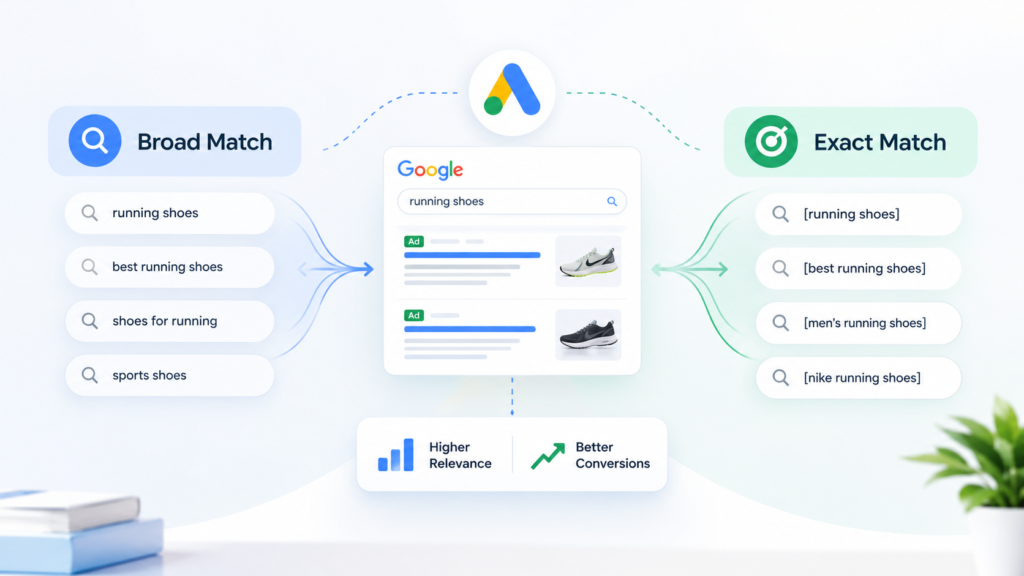
Broad match is the least restrictive option. A keyword such as `commercial solar installation` may be eligible for searches around business solar panels, solar installers for warehouses or reducing factory energy bills. Google considers the meaning of the search, your landing page, other keywords in the ad group and a user’s predicted intent.
Exact match, written in square brackets such as `[commercial solar installation]`, narrows that eligibility. It can still match close variants, reordered wording and searches Google interprets as having the same intent. It is not a literal-match setting. But it gives advertisers a more concentrated route into searches closely aligned with the commercial proposition.
| Match type | Main strength | Main risk | Best fit |
|---|---|---|---|
| Broad match | Captures unanticipated demand and supports scale | Can spend on loosely relevant queries without strong controls | Mature accounts with quality data and Smart Bidding |
| Exact match | Higher relevance and clearer intent management | Can limit volume and miss valuable demand | High-intent, regulated, branded or tightly defined offers |
The distinction matters because search behaviour is not static. People use longer, more conversational queries, switch between devices and refine their search as they learn. Google’s AI-led matching systems are designed to interpret that context. The upside is broader discovery. The trade-off is less manual certainty about every query that triggers an ad.
When broad match earns its place
Broad match works best as an expansion mechanism, not as a set-and-forget shortcut. It gives Smart Bidding more auctions to evaluate, which can help a campaign find converters that an exact-keyword list would never capture.
Consider an eCommerce retailer selling ergonomic office chairs. An exact-only structure might target `[ergonomic office chair]`, `[office chair for back pain]` and several colour or size variations. A broad-match campaign can identify additional commercial intent in searches such as “comfortable chair for eight-hour work day” or “desk chair for tall person”. Those searches may never appear in a conventional keyword plan, yet they can produce profitable orders.
That benefit depends on the quality of the signals feeding the bidding system. If Google is optimising towards a shallow action, such as a page view, generic enquiry or add-to-cart event, broad match has more room to find the wrong kind of volume. If it is optimising towards completed purchases with revenue values, or qualified leads verified in a CRM, it has a far stronger commercial signal.
Before expanding broad match, establish four conditions:
- Primary conversions reflect genuine business value, not merely activity.
- Conversion values, offline lead outcomes or both are passed back where possible.
- Smart Bidding has enough consistent conversion data to learn from.
- Negative keywords and search-term reviews are part of weekly account management.
Google recommends broad match alongside Smart Bidding because bidding and matching use shared signals. That does not make it universally appropriate. A business with very low conversion volume, incomplete tracking or a narrow service area may need to build data and control first.
When exact match is the smarter commercial choice
Exact match is still essential where relevance has a high financial or operational cost. Think legal services, finance, health, B2B solutions with tightly defined use cases, or products where a wrong click is unlikely to recover its cost.
It is also useful when intent is proven. If `[buy standing desk australia]` consistently produces profitable sales, keeping it in an exact-match campaign gives that query a clear budget, bid strategy and reporting view. You can assess performance without it being diluted by a wide cluster of related searches.
For lead-generation accounts, exact match can protect sales-team capacity. A specialist software provider may want enquiries for enterprise implementation, not students researching a career, jobseekers or people seeking a free tool. Negative keywords do much of the filtering, but exact match provides another level of discipline.
The common mistake is treating exact match as the safe option in every account. It can be safe, but safety can become a growth ceiling. Restricting campaigns to the handful of terms already known to convert may miss new category language, competitor alternatives and problem-led searches that signal demand before buyers know the product name.
A practical testing framework for match types
Do not compare broad and exact match by dropping both into the same campaign and judging them on a few days of cost per acquisition. They will compete in overlapping auctions, and short-term results can be distorted by attribution delays, seasonality and budget allocation.
Start with a commercially coherent campaign theme. For example, an Australian homewares retailer could separate “linen bedding” from “cotton bedding” rather than placing every bedding term into one catch-all campaign. Keep the landing page, ad messaging and conversion goal consistent across the test.
Run exact match as the control for proven high-intent terms. Then build a separate broad-match test using the same core themes, Smart Bidding and a dedicated budget. This lets you judge whether broad match is generating additional value rather than simply taking conversions that exact match would have captured.
Assess the result through a hierarchy of metrics. For eCommerce, begin with revenue, gross-margin-aware return on ad spend and new-customer contribution. For lead generation, use qualified lead rate, pipeline value and cost per sales-qualified opportunity. Click-through rate and cost per click can help diagnose relevance, but they are not success metrics on their own.
A simple decision rule is useful:
`Incremental profit = additional gross profit from broad match – additional media spend – fulfilment or sales costs`
If broad match creates more conversions but lowers margin, increases unqualified leads or merely shifts existing exact-match conversions, it has not earned a larger budget. If it expands qualified demand at an acceptable marginal cost, scale it gradually.
The controls that make broad match safer
Broad match does not remove the need for account structure and campaign organisation. It changes where the work sits. Instead of manually adding every possible keyword variation, the focus moves towards data quality, exclusions, creative relevance and business outcomes.
Search-term reports remain critical, although Google’s reporting does not show every low-volume query. Review visible themes regularly. Add negative keywords for clearly irrelevant demand, but avoid over-blocking useful discovery. A negative keyword such as “cheap” may be sensible for a premium B2B service, but harmful for a retailer with an entry-level product range.
Use campaign-level negatives for universal exclusions such as careers, support requests or unrelated product categories. Use ad-group or campaign exclusions where context changes the meaning. This protects relevance without preventing valid searches elsewhere in the account.
Creative and landing pages also act as filters. Specific ad copy – including price positioning, audience, location coverage or minimum order values – discourages poor-fit clicks before they happen. A landing page that makes the offer and next step clear improves both conversion quality and the signals available to bidding.
Finally, check whether your attribution setup is telling the truth. If only last-click platform conversions are used, campaigns that introduce new prospects can appear weaker than they are. If every micro-conversion is weighted equally, broad match can appear stronger than it is. The measurement model needs to reflect the way the business makes money.
Common mistakes to avoid
The first mistake is assuming exact match means exact wording. Google’s close-variant matching means it does not. Check search terms rather than relying on brackets as a guarantee.
The second is launching broad match before conversion tracking is fit for purpose. Broad match amplifies the optimisation signal it receives. Poor signals create efficiently purchased poor outcomes.
The third is over-segmenting campaigns by match type until there is too little data in each one. Separate match-type tests can be useful, but fragmentation slows learning and makes budget decisions harder.
The fourth is declaring a winner too early. Allow enough time for conversion lag and enough volume to assess quality. For longer B2B sales cycles, connect lead outcomes from the CRM back to Google Ads before making major decisions.
Choose the match type your measurement can support
Exact match gives advertisers a disciplined way to protect proven intent. Broad match gives modern Google Ads campaigns access to demand that keyword lists cannot fully anticipate. The better option is determined by tracking quality, conversion volume, margin, sales capacity and how much variation exists in the way customers search.
Treat exact match as your control layer and broad match as a structured source of incremental growth. When the account is built around meaningful conversion data rather than cheap clicks, the debate becomes less about keyword syntax and more about measurable commercial outcomes.