
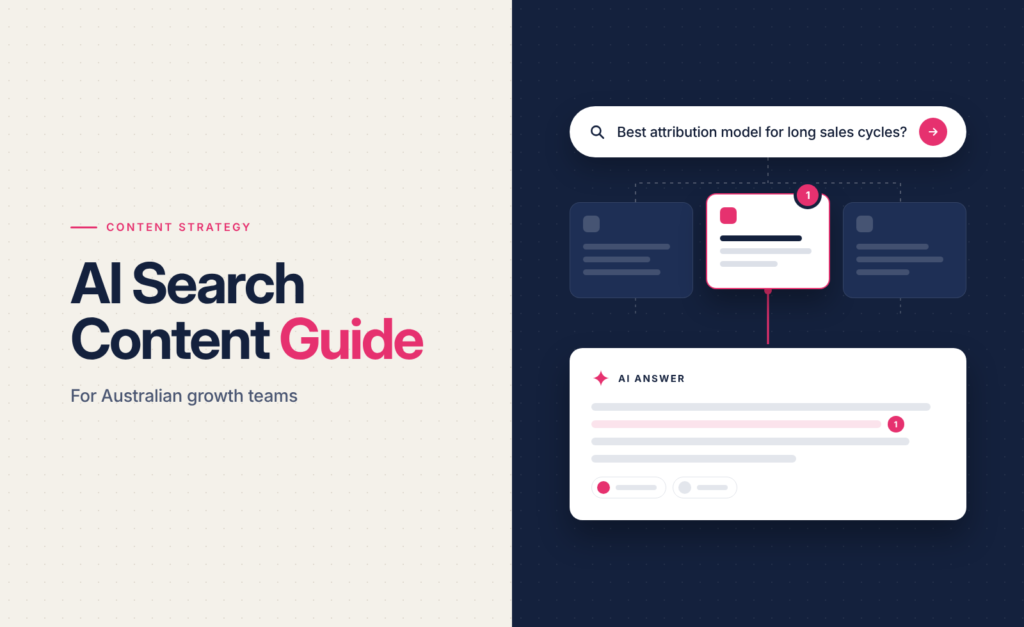
A buyer asks an AI assistant which platform suits a 200-SKU retailer, how to compare solar finance options, or what causes a sudden drop in conversion rate. The answer may shape the shortlist before that buyer ever opens a traditional search result. This AI search content guide explains how to build content that is useful in that moment – without sacrificing the search, conversion and brand fundamentals that still move revenue.
AI search is not a replacement for SEO. It is an additional retrieval and recommendation layer. Google AI Overviews, AI Mode experiences, ChatGPT-style web search and other answer engines can interpret questions, retrieve sources, synthesise findings and cite pages. Their interfaces vary, their visibility changes quickly, and no business can guarantee inclusion. What remains controllable is the quality, clarity and credibility of the information on your site.
Key takeaways
- Build pages around decision-making questions, not keywords in isolation.
- Give important claims a clear source, a date and enough context to be quoted accurately.
- Make commercial distinctions explicit: who a product, process or approach is for, where it is not suitable, and what changes the answer.
- Treat AI visibility as an assist to qualified demand, then measure its downstream impact rather than chasing screenshots.
What AI search changes – and what it does not
Traditional organic search often rewards a page that closely matches a query and earns a click. AI search can answer part of the query within the interface, pulling together multiple sources before a user chooses whether to investigate further. That raises the bar for generic explainer content. A page that merely repeats a definition has little reason to be selected when a system can generate the same definition in seconds.
The opportunity sits in content with information gain: first-hand expertise, original analysis, tested processes, local operating context and specific trade-offs. For an Australian eCommerce business, that could mean a detailed explanation of how shipping thresholds affect margin after GST, rather than another generic article on free shipping.
The fundamentals have not changed. Search systems still need to discover, crawl and understand pages. They still look for signals of usefulness and trust. Google’s published Search Essentials and its Search Quality Rater Guidelines consistently reinforce the same direction: helpful content, clear purpose, evidence of experience and transparent authorship matter. AI interfaces increase the value of those fundamentals because answers are assembled from content that is easy to interpret and support.
The AI search content guide: build for retrieval and decisions
A practical AI search strategy starts before writing. The goal is not to make every page sound like an answer engine. It is to make the page the strongest available source for a defined decision.
1. Map the question behind the query
Keyword research identifies demand, but AI prompts are usually longer and more conditional. A user may ask, “What is the best attribution model for a retailer with long consideration cycles and paid social spend?” That contains a category, a context, a constraint and an intended outcome.
Capture those dimensions in your content brief. Define the audience, problem, variables, recommendation criteria and next question. Then create a page that handles the core question directly while explaining the conditions that alter the answer.
A useful prompt-to-page formula is:
Decision quality = direct answer + evidence + conditions + practical next step
This prevents two common failures. The first is vague thought leadership that sounds credible but cannot help someone choose. The second is an overconfident recommendation that ignores the commercial context.
2. Answer early, then earn the detail
Lead with a concise, defensible answer in the opening section. If the answer is “it depends”, state what it depends on. For example, an article comparing server-side tracking options should immediately identify the deciding factors: consent design, technical resources, data governance and reporting requirements.
After that, use short sections to explain the reasoning. Clear heading hierarchy, descriptive labels and focused paragraphs help people scan, but they also help systems isolate relevant passages. Avoid burying the answer beneath 500 words of scene-setting.
This does not mean stripping out nuance. It means organising nuance. A strong page can say that a tactic works for high-repeat-purchase brands but creates poor economics for low-margin, one-off purchases. Specific limitations are a credibility asset, not a weakness.
3. Make evidence inspectable
AI-generated answers can amplify weak claims, which makes source discipline more valuable. Where you use a statistic, cite the organisation that published it, note the report date and explain what was measured. Do not turn a global benchmark into an Australian market fact without checking the sample and methodology.
For original insight, show your working. A CRO article might explain that a finding comes from a specific test pattern across mobile product pages, rather than claiming a universal uplift. A research-led content asset can include methodology, definitions, exclusions and a date of last review.
Evidence should be close to the claim it supports. Broad source lists at the bottom of a page are useful, but they do not fix ambiguous prose. The reader and the retrieval system should be able to understand precisely what a source supports.
4. Create content only your business can publish
AI can produce competent summaries at scale. It cannot automatically reproduce your customer research, product data, test learnings or category judgement. Those are the assets that make content cite-worthy.
For growth teams, the strongest formats are often decision frameworks, annotated benchmarks, practical comparisons and post-test analyses. A retailer could publish a guide to interpreting its own cohort retention patterns. A B2B business could document the evaluation criteria buyers should use when comparing implementation approaches. Neither needs inflated claims to be useful.
This is where SEO, analytics, CRO and content strategy intersect. The page should answer the question, but it should also demonstrate the depth of thinking a buyer needs for a higher-stakes decision.
5. Strengthen the technical foundation
Good writing will not compensate for a page that cannot be reliably accessed or understood. Ensure important content is indexable, appears in clean HTML, uses accurate titles and headings, and is not hidden behind avoidable scripts or gated interactions. Keep canonicalisation, internal site architecture and duplicate-page control disciplined.
Structured data can clarify eligible page types and entities where it accurately reflects visible content. It is not a shortcut to an AI citation. Markup that overstates reviews, authorship or FAQs creates risk without creating durable visibility.
Technical SEO remains the service pillar underneath AI search readiness. The objective is straightforward: make the site a dependable source that search systems can retrieve, interpret and trust.
Measure commercial value, not mention count
Being cited in an AI answer can look impressive and still produce no meaningful demand. Equally, a page may influence a buyer’s research without sending a neatly labelled referral visit. Measurement therefore needs more than a tally of appearances.
Track traditional organic performance alongside referral patterns from identifiable AI platforms, branded search growth, assisted conversions, lead quality and sales-team feedback. In analytics, annotate when major content is published and when search interfaces materially change. Compare performance by topic cluster rather than judging a single article after a few weeks.
For pages close to revenue, monitor whether AI-oriented improvements affect the metrics that matter: engaged sessions, product exploration, qualified enquiries, conversion rate and revenue contribution. If a page gains impressions but attracts the wrong audience, tighten the audience definition and decision criteria rather than producing more of the same.
Mistakes that weaken AI search visibility
The first is producing thin pages for every possible prompt variation. This creates duplication, fragments authority and leaves little substance worth retrieving. Build fewer, stronger pages that resolve a family of related questions.
The second is treating AI search as a loophole around trust. Hidden text, fabricated expert quotes, vague claims of experience and automated content published without review are not sustainable strategies. They also create brand risk when buyers scrutinise the source.
The third is optimising for a single platform. Google, ChatGPT and emerging answer tools may surface information differently. A strategy built around useful, well-structured and evidence-led content is more durable than a tactic built around one interface’s current behaviour.
A practical 90-day starting point
Start by auditing the pages already closest to customer decisions: comparison pages, implementation guides, category explainers, research pieces and high-intent product education. Select three topics where your business has credible evidence or lived expertise, then rebuild those pages around the decision-quality formula.
Next, interview sales, support and product teams. Their recurring questions reveal the uncertainty that standard keyword tools often miss. Turn the best questions into pages with direct answers, caveats, examples and clear ownership for future updates.
Finally, establish a review cycle. AI search rewards current, reliable information in fast-moving categories, but freshness does not mean changing dates for appearance’s sake. Update when product details, regulations, market conditions, data or buyer behaviour genuinely change.
The businesses that earn attention in AI search will not be the ones producing the most pages. They will be the ones that make complex decisions easier, with evidence strong enough to stand behind when a buyer asks the next question.