


A product-page headline written in seconds is not a growth strategy. Neither is an AI-generated ad variant, a chatbot or a dashboard that predicts churn. AI marketing creates commercial value only when it improves a decision that changes revenue, margin, retention or the efficiency of customer acquisition.
That distinction matters. Many teams are producing more marketing output with AI, then discovering that volume has simply made review cycles, brand risk and measurement harder. The better approach is strategy-first: use AI content strategy where there is a clear decision, usable data, a measurable outcome and a human owner accountable for the result.
Key takeaways
- AI is most useful when it improves a high-volume, repeatable marketing decision rather than replacing strategy or judgement.
- The strongest early use cases tend to sit in audience analysis, creative testing, lifecycle personalisation and operational reporting.
- Better output is not proof of better performance. Incremental revenue, contribution margin and customer retention remain the tests that matter.
- Privacy, brand safety and review processes must be designed before customer-facing AI is scaled.
What AI marketing actually means
AI marketing is the use of machine learning, generative models and automated decision systems to analyse customer signals, create or adapt content, predict likely outcomes and improve marketing actions. It can support search, paid media, CRM, eCommerce, content production, analytics and customer service.
The useful definition is narrower than the vendor pitch: AI should help a team make a better decision at speed. That might mean identifying which customers are most likely to buy again, generating structured creative variations for a controlled test, or detecting a sudden fall in conversion rate before it becomes an expensive month.
It is not automatically intelligent because it is automated. A recommendation engine trained on poor product data will make poor recommendations faster. A language model given unclear positioning will produce polished, generic copy. That’s where AI-generated content strategy matters, not to replace your brand voice, but to amplify weak strategy faster. AI magnifies the quality of the system around it.
Where AI has the clearest commercial case
The best opportunities usually share three features: the task occurs often, the team has enough reliable input data, and the result can be evaluated against a business metric. For most Australian businesses, that points to a small number of practical applications.
| Use case | What AI can improve | What still needs human judgement |
|---|---|---|
| Customer segmentation | Finding behavioural patterns across purchase, site and CRM data | Deciding which segments are strategically valuable |
| Creative production | Producing on-brand starting points, variants and asset adaptations | Positioning, claims, taste and final approval |
| Paid media optimisation | Detecting patterns and adjusting towards defined conversion signals | Budget strategy, offer design and incrementality checks |
| Lifecycle marketing | Timing and tailoring messages based on observed behaviour | Contact rules, consent and customer experience |
| Analytics | Summarising performance shifts and surfacing anomalies | Validating causes before reallocating budget |
Consider an eCommerce retailer with thousands of SKUs. AI can classify product attributes, surface gaps in product information and help create consistent first drafts of category copy. That can reduce manual workload. The revenue opportunity arrives only if the business then tests whether clearer product information improves organic visibility, add-to-cart rate or return rates. Clean product feeds are the foundation; AI can only optimise what already exists.
The same principle applies to paid media. Platform automation can allocate spend more efficiently within its own system, but it cannot determine whether the business should prioritise new-customer growth, profit, stock clearance or market share. Those are commercial choices, not algorithmic ones.
A four-part AI marketing framework
1. Start with the decision, not the tool
Frame the opportunity in one sentence: “We need to improve [decision] to move [metric] for [audience] within [constraint].”
For example: “We need to identify customers likely to lapse so we can improve repeat purchase rate without increasing email frequency.” This is materially better than asking a team to “use AI in CRM”. It sets the business outcome, identifies the relevant audience and introduces a customer-experience constraint.
Avoid projects that begin with a tool demo and no baseline. They often become expensive content factories with no credible way to prove value.
2. Audit the inputs before automating the output
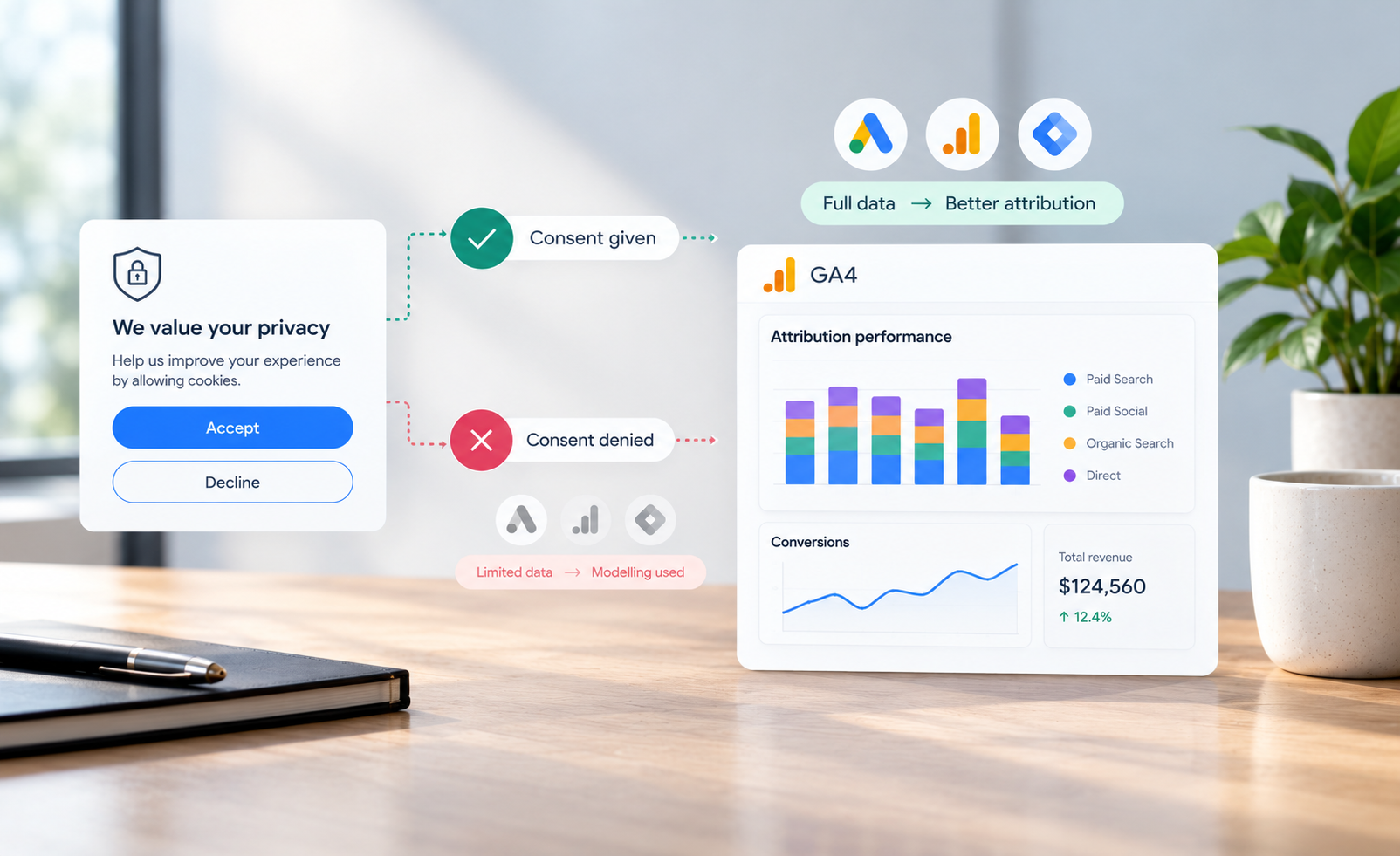
AI models learn from, retrieve from or are prompted with existing information. Check whether product feeds are current, whether CRM fields are meaningful, whether conversion events are correctly configured and whether consent status is reliable.
For generative work, build a source pack that includes approved brand language, product facts, offer conditions, audience insight, prohibited claims and examples of strong existing work. This gives the model useful guardrails and gives reviewers a standard to assess against.
Data cleanliness is not glamorous, but it is often the work that determines whether AI becomes a useful capability or another layer of noise.
3. Keep the experiment narrow enough to learn
Choose one audience, one channel and one commercial metric. Establish a baseline, then compare AI-assisted activity against a suitable control wherever possible.
A simple test might compare a human-written lifecycle email series with an AI-assisted series that uses the same offer, send volume and customer eligibility rules. Measure not just opens and clicks, but conversion, unsubscribe rate, repeat purchase and margin. An uplift in clicks that reduces customer quality is not a win.
For larger spend decisions, use holdout groups, geographic tests or other incrementality testing methods. Attribution reports can be useful directional evidence, but they commonly over-credit channels that sit near the final conversion.
A practical formula is:
Incremental profit = incremental revenue × gross margin – media cost – production cost – technology cost
If the result is not positive, faster production is irrelevant.
4. Build governance into the workflow
Customer-facing output requires accountability. Someone must own final approval, factual accuracy, legal and privacy checks, and the process for correcting an error. This is especially important for financial claims, health-related messaging, promotions, pricing, regulated products and personalised communications.
Australian teams should assess AI activity against the Privacy Act 1988 and Australian Privacy Principles, the Spam Act 2003, and Australian Consumer Law requirements around misleading or deceptive conduct. Personal information should not be copied into public AI tools without a clear, approved basis for doing so.
Governance should be proportionate. A first draft of an internal report needs lighter controls than an AI-generated product recommendation sent to a high-value customer segment. The point is not to slow experimentation. It is to ensure experimentation does not create avoidable reputational, legal or customer-trust costs.
The measurement mistake that undermines most AI projects
The common mistake is measuring activity instead of business impact. Teams report content produced, hours saved, campaigns launched, or dashboard queries completed. Those metrics can show operational efficiency, but they do not establish whether AI improved marketing performance.
Track what matters on two levels. First, process metrics: turnaround time, error rate, production cost and analyst capacity. Second, business metrics: conversion rate, customer acquisition cost, revenue per visitor, repeat purchase rate, contribution margin and retention. Build a dashboard that surfaces both so the decision is transparent.
If AI saves a team 20 hours a month, that capacity may be valuable. But the business still needs to decide where those hours are reinvested. More content is not necessarily the answer. Better testing, customer research or conversion-rate optimisation may produce a stronger return.
Evidence should beat enthusiasm
AI marketing changes quickly, which makes disciplined source selection essential. For governance principles, the NIST AI Risk Management Framework remains a useful reference point. For Australian privacy obligations, rely on guidance from the Office of the Australian Information Commissioner. For advertising claims, review Australian Competition and Consumer Commission guidance alongside internal legal advice where the risk is material.
Vendor case studies can be useful for generating hypotheses, but they are not independent proof that a tool will produce the same outcome in another category, market or data environment. Ask what was measured, what the control was, how long the test ran and whether the reported result was incremental. Stay current with how AI is reshaping marketing strategy to avoid yesterday’s assumptions.
The businesses that gain an advantage will not be the ones with the longest list of AI tools. They will be the ones that turn customer data, creative judgement and rigorous measurement into faster, better decisions. Start with one decision that matters, test it properly, and let the result determine what scales next.