
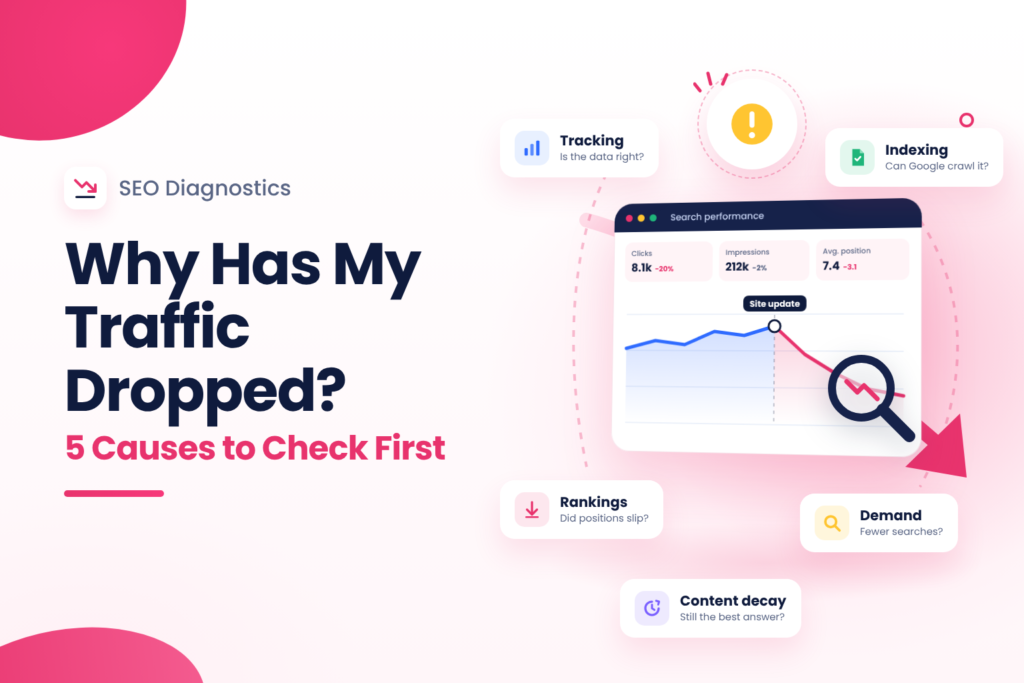
A 20% organic traffic drop can be a technical fault, a ranking loss, a change in search demand or simply a reporting problem. Treating every decline as an SEO failure is how teams waste weeks rewriting pages that were never the issue. The fastest path to a useful answer is to separate organic traffic decline causes from the commercial impact they may, or may not, create.
For founders and marketing leaders, the priority is not restoring a dashboard line at any cost. It is protecting qualified visibility, revenue and future demand. That requires a diagnosis based on evidence, not a hurried list of SEO fixes.
Key takeaways
Start by validating the data and isolating the affected pages, queries, devices and countries. Then determine whether Google can still crawl and index the site, whether rankings have shifted, and whether search demand has changed. Finally, assess conversions and revenue alongside sessions. A decline in low-intent blog traffic and a decline in high-value category-page traffic demand very different responses.
Diagnose organic traffic decline causes in the right order
Search Console and GA4 answer different questions. Search Console shows Google Search impressions, clicks, average position and indexed pages. GA4 shows sessions, engagement and conversion behaviour after the click. Use both before deciding what changed.
A practical diagnostic sequence looks like this:
| Question | Primary evidence | What it can reveal |
|---|---|---|
| Is the decline real? | GA4 channel grouping, consent settings, tracking releases | Attribution or measurement errors |
| Did search visibility fall? | Search Console clicks, impressions and queries | Ranking, demand or SERP-layout changes |
| Can Google access key pages? | Search Console indexing reports, URL inspection, server logs | Crawl, rendering, canonical or noindex faults |
| Is the commercial effect material? | Revenue, leads, conversion rate and assisted conversions | Whether to prioritise recovery immediately |
Compare equivalent periods wherever possible. Week-on-week comparisons can be useful for a sudden release issue, but they are unreliable for seasonal businesses. An Australian retailer selling heaters, school supplies or EOFY products needs year-on-year context before calling normal demand movement a problem.
1. Measurement and attribution changed
Before investigating Google, rule out a broken measurement layer. A GA4 tag removed during a redesign, altered consent configuration, cross-domain tracking failure, or an incorrect channel grouping can make organic sessions appear to disappear.
Check whether Search Console clicks fell by a similar proportion. If Search Console is stable while GA4 organic sessions collapse, the likely issue sits in analytics rather than rankings. Also check total sessions, direct traffic and paid landing-page data. A sudden fall across every channel often points to tagging, cookie consent or site availability.
This distinction matters commercially. Repairing analytics is urgent, but it does not require content production or a broad technical SEO project.
2. Indexing, crawling or migration errors
A sharp decline in impressions across many pages can signal that Google has stopped indexing important URLs correctly. Common triggers include a misplaced noindex directive, robots.txt block, incorrect canonical tags, redirect chains, a faulty XML sitemap or changes to JavaScript rendering.
Site migrations are especially high risk. A new platform, domain consolidation or faceted-navigation update can create thousands of duplicate, blocked or redirected URLs in a single release. Check the date traffic changed against your deployment log. If the dates align, investigate the release before blaming an algorithm update.
Google’s Search Central documentation consistently advises site owners to use URL Inspection and indexing reports to test representative URLs. Test more than the homepage. Include revenue-driving product, category, service and editorial pages, because technical faults are often template-specific.
A fall in indexed pages is not automatically bad. Google may remove duplicate or low-value URLs without harming priority pages. The real issue is whether pages that should rank and convert are excluded or replaced by weaker canonical versions.
3. Rankings fell because the result became less competitive
When impressions remain broadly stable but clicks decline, look at average position, query-level rankings and search-result changes. A page moving from position three to eight can materially reduce clicks, particularly for high-volume, non-branded searches.
Ranking declines tend to come from one of three places: competitors improved their content or authority, your page no longer matches the intent behind the query, or Google has changed what it considers the best result format.
For example, a category page may lose visibility if shoppers now expect richer comparison content, stock information and clearer delivery details. An informational article may fall if newer expert sources offer stronger evidence, original research or a more direct answer. The solution is not always to make the page longer. It is to improve its usefulness for the job the searcher is trying to complete.
Review the live search results, not just ranking software. Look for product listings, map packs, video results, AI-generated answer features, forums or expanded brand results taking space above the traditional blue links. Your ranking may be steady while click-through rate falls because the page is less visible on the screen.
4. Search demand declined
Organic traffic is the product of visibility and demand:
Organic clicks = search impressions × click-through rate
If impressions decline while average position is stable, fewer people may be searching for the terms you rank for. That can be driven by seasonality, economic conditions, product cycles, news events or a shift in consumer language.
This is where query segmentation earns its place. Separate branded from non-branded terms, then group non-branded queries by topic and intent. If branded traffic falls while non-branded visibility is stable, the issue may be reduced awareness or fewer returning customers rather than SEO. If one product topic falls while adjacent categories grow, the opportunity may be to adjust merchandising, content and paid-media investment rather than chase a disappearing keyword.
Demand changes are not failures. They are planning signals. Businesses built to move revenue respond by reallocating effort towards categories and queries where intent is growing.
5. Content quality or intent has weakened over time
Pages decay. Product ranges change, statistics age, screenshots become inaccurate and competitor pages improve. Content can still be indexed and technically sound while losing its ability to satisfy users.
Start with pages that have lost clicks, impressions or rankings over a meaningful period. Review whether the page answers the query early, demonstrates first-hand expertise where relevant, covers the decision criteria customers genuinely use and supports the next commercial step. For eCommerce, that may mean better specifications, comparison guidance, availability information and internal category logic. For lead generation, it may mean clearer proof, more relevant use cases and stronger qualification.
Avoid treating content refreshes as a word-count exercise. Consolidating overlapping articles can be smarter than updating both. Likewise, removing thin pages may improve crawl efficiency, but only when those pages add no unique search or customer value.
How to prioritise the recovery work
Not every traffic loss deserves the same response. Score affected page groups using three factors: commercial value, size of decline and confidence in the diagnosis.
A high-revenue category page with a clear indexing fault should be fixed first. A low-converting article that lost a small amount of traffic after a seasonal peak may be monitored instead. This is the difference between activity and strategy.
Set a short investigation window, document what changed, and avoid releasing multiple major fixes at once. If you alter templates, redirects, content and internal linking together, you will struggle to learn which action produced the result. SEO recovery is an experiment programme, not a panic response.
When a traffic decline is not the problem
Traffic is a leading indicator, not the business outcome. A reduction in broad informational visits can coincide with a higher conversion rate, more qualified enquiries and stronger revenue. Conversely, stable traffic can conceal a serious decline in category-page visibility or organic sales.
Track organic revenue, lead quality, conversion rate and the proportion of traffic landing on high-intent pages. Where attribution is imperfect, include assisted conversions and CRM outcomes rather than relying on last-click reporting alone. This gives decision-makers a clearer view of measurable success than sessions in isolation.
The most useful response to an organic decline is rarely a universal checklist. It is a disciplined decision: verify the data, identify the specific failure mode, estimate commercial exposure and make the smallest high-confidence change that addresses it. That approach protects both search performance and the budget behind it.