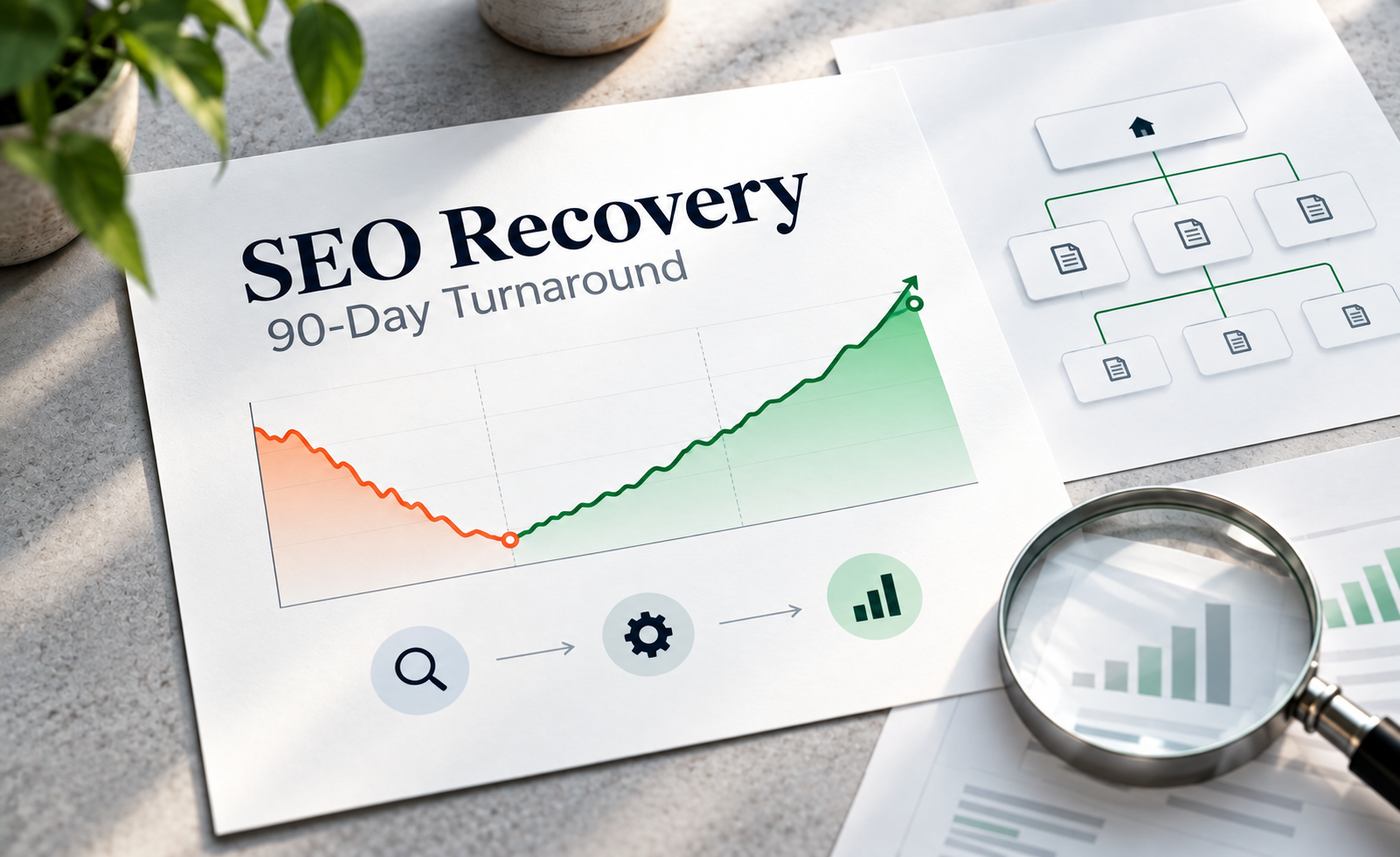

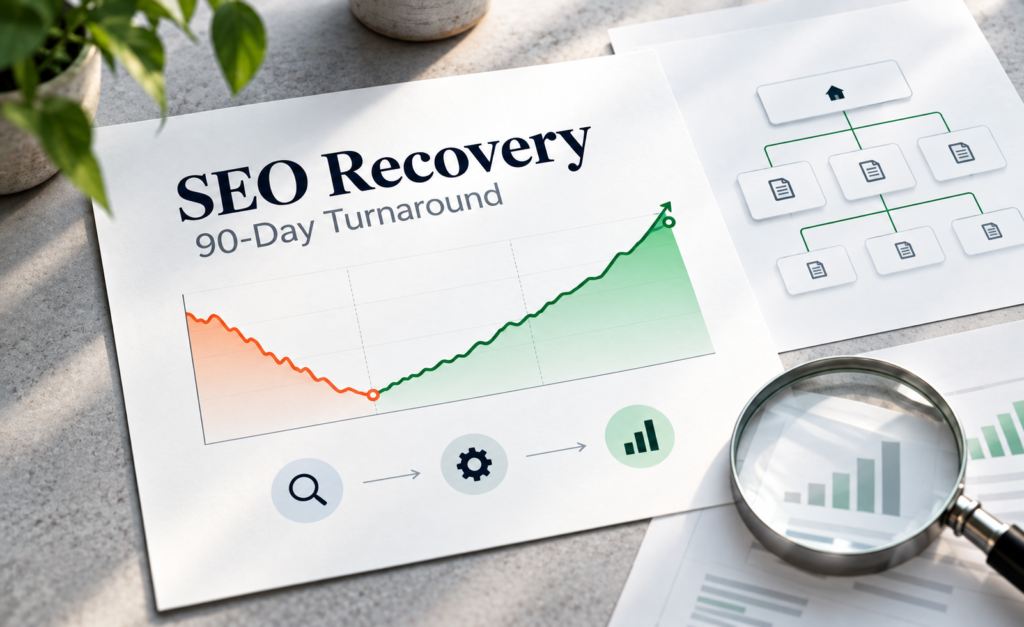
A 38% decline in organic revenue is not an SEO problem until you know what changed, where the loss sits and whether search demand itself moved. For one Australian eCommerce retailer, that distinction shaped the entire recovery. This SEO recovery case study outlines a practical 90-day approach to diagnosing a material search decline, prioritising fixes by commercial impact and rebuilding qualified organic traffic without chasing vanity rankings.
The business sold high-consideration home products, with organic search accounting for a meaningful share of first-time customer acquisition. The business sold high-consideration home products, with organic search accounting for a meaningful share of first-time customer acquisition. This is the type of environment where an SEO agency for eCommerce needs to look beyond rankings and connect technical issues, category visibility and commercial performance.
Revenue fell over eight weeks, yet total impressions were relatively stable. The original assumption was an algorithm update. The data told a more useful story: technical changes, weakened category-page relevance and declining conversion efficiency were compounding one another.
This is a composite case based on common recovery patterns, with figures adjusted to protect commercial confidentiality. The framework is designed for operators who need to protect revenue while making deliberate, evidence-based SEO decisions.
Key takeaways
- Treat an SEO decline as a business diagnosis, not a ranking emergency.
- Segment losses by page type, query intent, device and revenue before changing anything.
- Fix indexation and internal-linking failures before rewriting large volumes of content.
- Measure recovery through qualified traffic, revenue and conversion rate, not keyword positions alone.
The starting point: traffic was down, but the cause was mixed
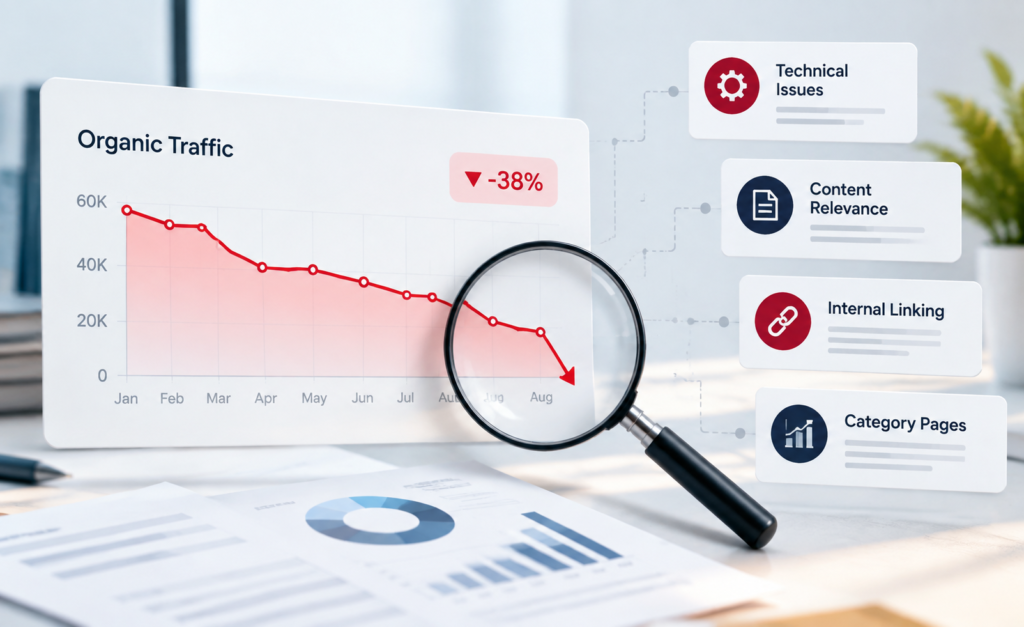
The retailer had launched a new site template shortly before the decline. At the same time, several category pages had been consolidated, product copy had been shortened and a promotional campaign had changed the internal linking pattern across the site.
A top-line dashboard showed a 31% fall in organic sessions and a 38% fall in organic revenue over the comparison period. Those figures were alarming, but not actionable. The first task was to separate correlation from cause.
The team compared Google Search Console data, web analytics, crawl data and merchant performance by week. They also marked known release dates: the template deployment, redirects, content changes and seasonal sale period. This prevented a familiar mistake: attributing every visibility movement to Google when the site itself had changed materially.
What the segmentation revealed
The decline was concentrated in non-brand category and subcategory pages. Product-detail pages had held relatively steady, while editorial content had gained impressions but generated little revenue. Mobile organic conversion rate had also fallen, even where rankings were stable.
That led to three working hypotheses:
- Important category pages were receiving less internal authority after the template change.
- Consolidated pages no longer matched the breadth of customer queries they had previously served.
- The new mobile template had introduced friction in the path from landing page to product selection.
None of these hypotheses required guesswork. Each could be tested against the site’s data.
The SEO recovery case study: the 90-day plan
The recovery plan was sequenced around revenue risk. It did not begin with a wholesale content rewrite, a backlink campaign or a long list of low-impact technical tickets. Those activities can have a place, but only after the pages driving commercial losses are accessible, indexable and useful.
Days 1-14: stop further loss and establish the baseline
The first fortnight focused on technical validation and measurement hygiene. A crawl found that 14 high-value category URLs were technically indexable but had been pushed several clicks deeper into the site architecture. Their former navigation links had been replaced by promotional modules that rotated frequently.
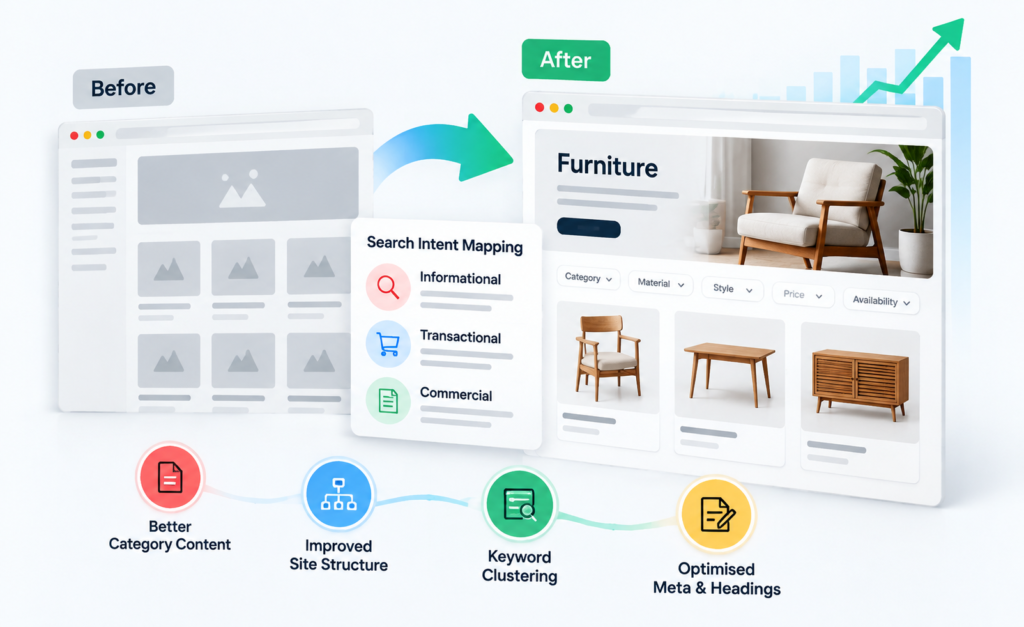
Several redirected URLs were also pointing to broad parent categories rather than their closest equivalent. This diluted relevance for users and search engines, particularly for long-tail category searches. Redirects were updated where a clear destination existed. Where a consolidated page had to serve multiple former categories, the page structure was expanded to reflect distinct product needs rather than merely combining headings.
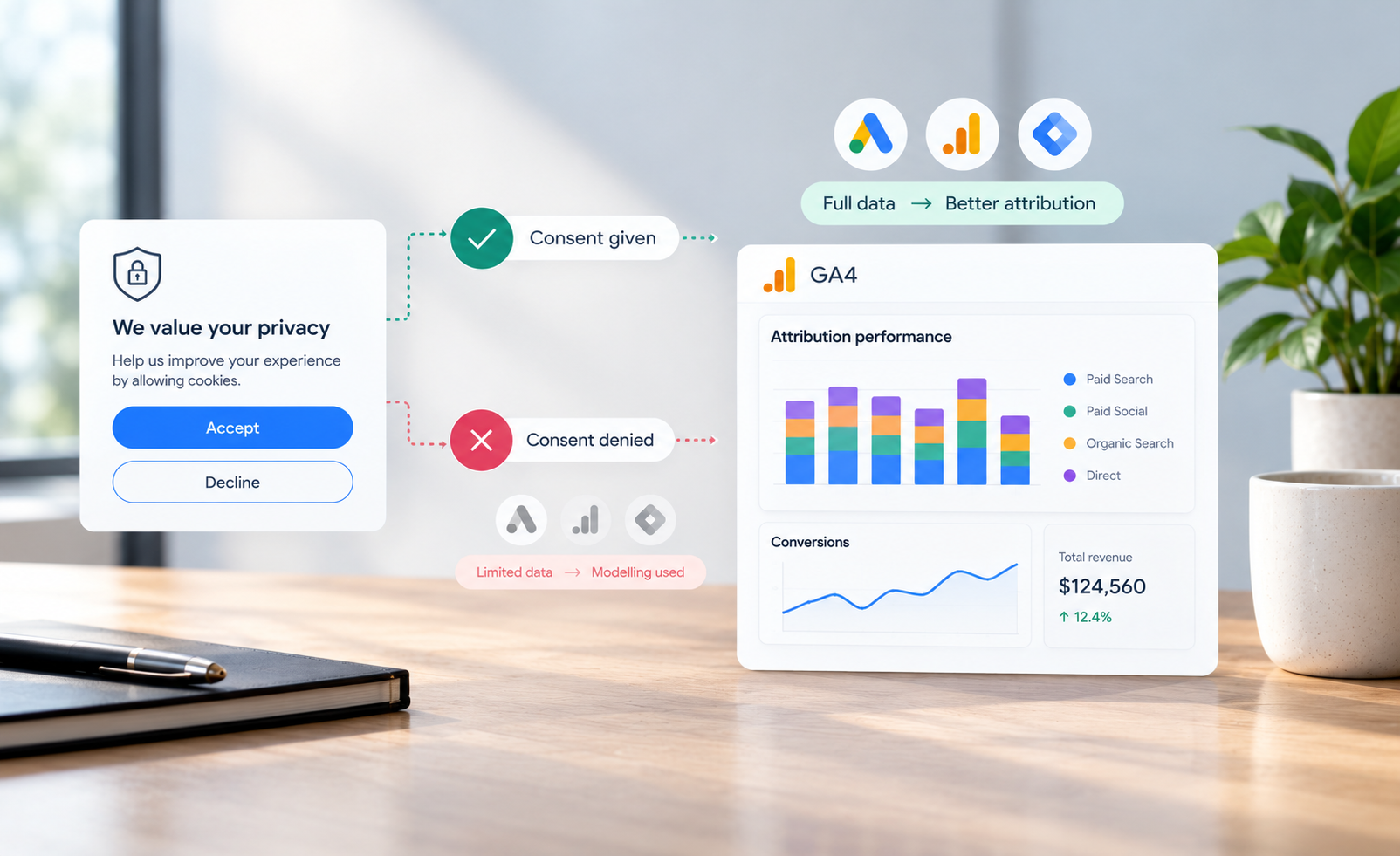
The analytics review found an additional issue: a consent-management configuration change had reduced recorded transactions for some users. The team reviewed GA4 event tracking to separate the measurement problem from the underlying SEO decline.
This did not explain the organic decline in Search Console, but it did exaggerate the revenue drop in the reporting platform. Fixing the measurement gap mattered because leaders needed a reliable baseline before judging recovery.
At this stage, the team created a recovery scorecard with four measures: non-brand clicks to commercial landing pages, organic revenue, mobile conversion rate and the share of priority URLs receiving internal links from relevant hub pages. Rankings were monitored, but they were not the primary success metric.
Days 15-45: rebuild relevance where demand and revenue met
The next phase focused on the 22 category and subcategory pages responsible for the largest revenue decline. Keyword research was not treated as a spreadsheet exercise. The team reviewed the actual search results for priority terms and grouped queries by what the searcher appeared to need: product type, room, material, size, problem or comparison.
Several pages had become too generic after consolidation. A page once focused on a specific product use case now contained a short paragraph and a broad product grid. It ranked for fewer specific searches because it offered less specific help.
The revised pages used clearer category introductions, practical selection guidance, scannable subcategories and product filters aligned to customer language. This was not content for content’s sake. Each addition answered a pre-purchase question that helped visitors narrow their choice.
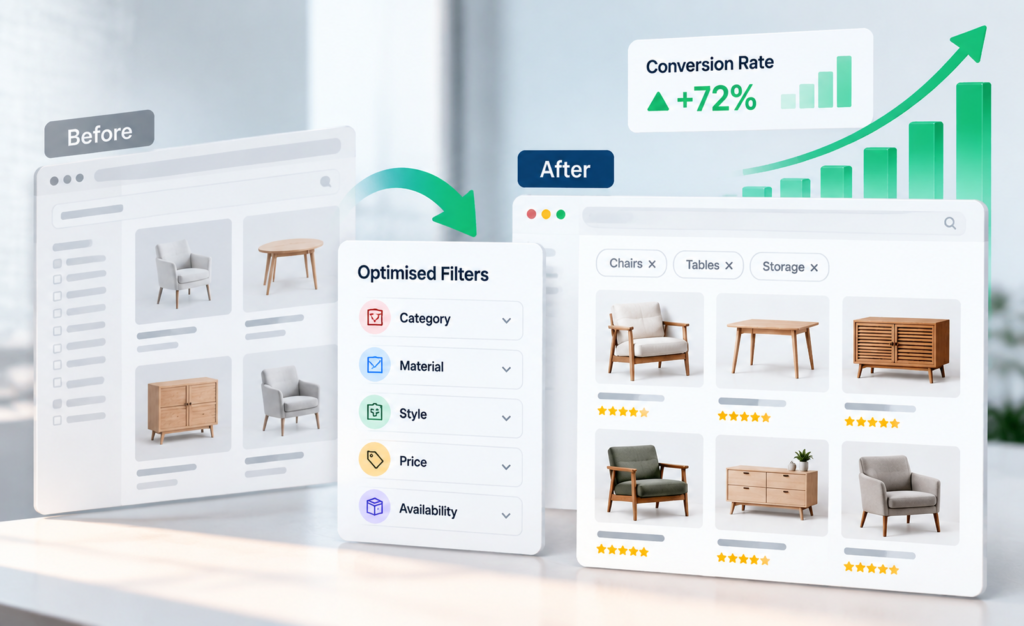
Internal linking was rebuilt around commercial logic. Editorial guides linked to relevant categories where they genuinely supported the reader’s next step. High-authority hub pages restored prominent links to priority categories. Breadcrumbs and related-category modules were checked to ensure they reflected a consistent hierarchy.
A critical trade-off emerged here. Expanding every category page would have consumed months and produced uneven quality. The team concentrated first on pages with proven historic revenue, clear demand and an identifiable relevance gap. Lower-value pages were queued for later testing.
Days 46-90: improve conversion and confirm the recovery
By week six, impressions and clicks for several priority categories were improving, but revenue had not recovered at the same pace. The reason was mobile.
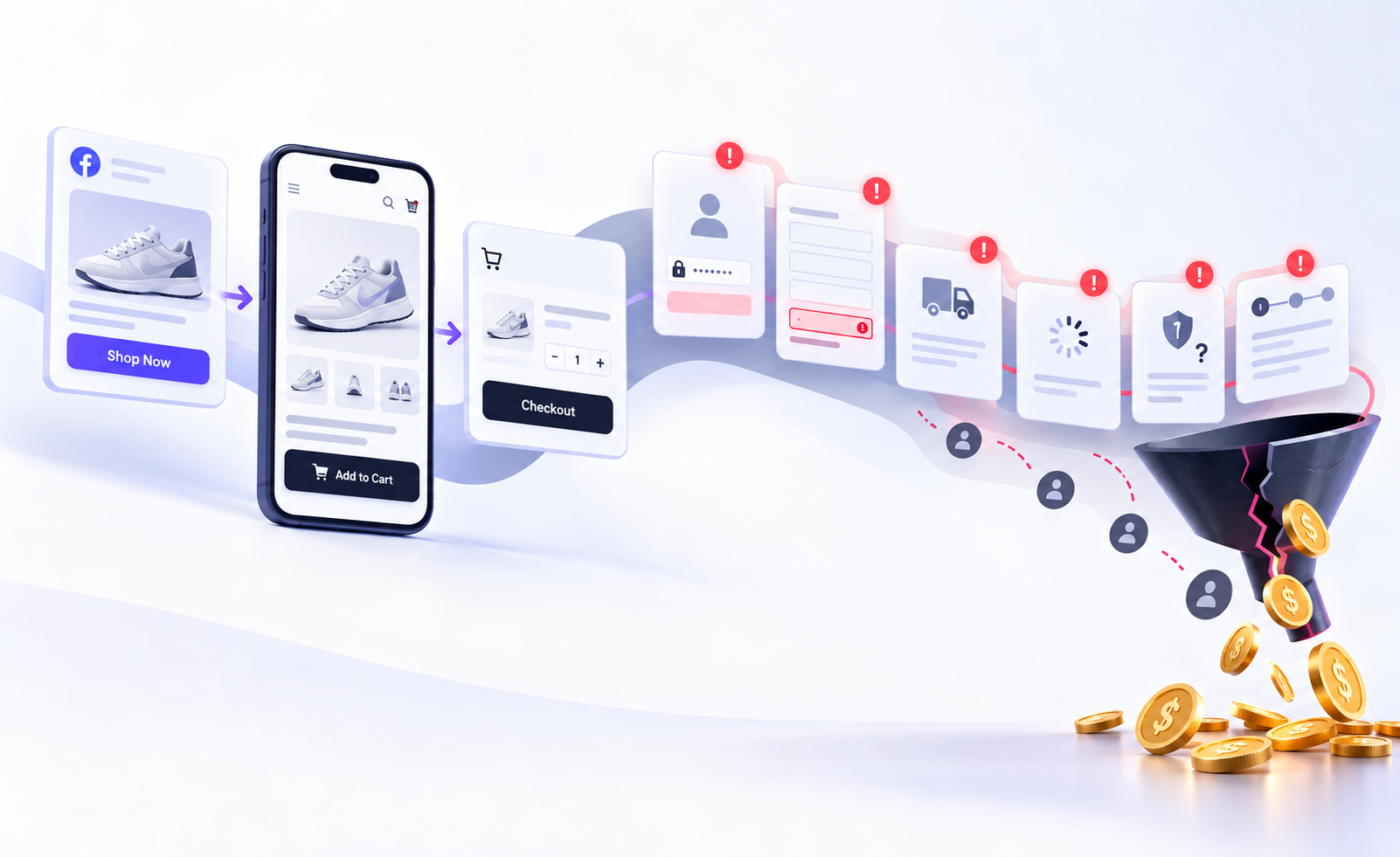
Session recordings and funnel data showed that customers were struggling to compare product variations on smaller screens. Filter controls were difficult to use, delivery information appeared late in the journey and product cards lacked enough detail for high-consideration shoppers.
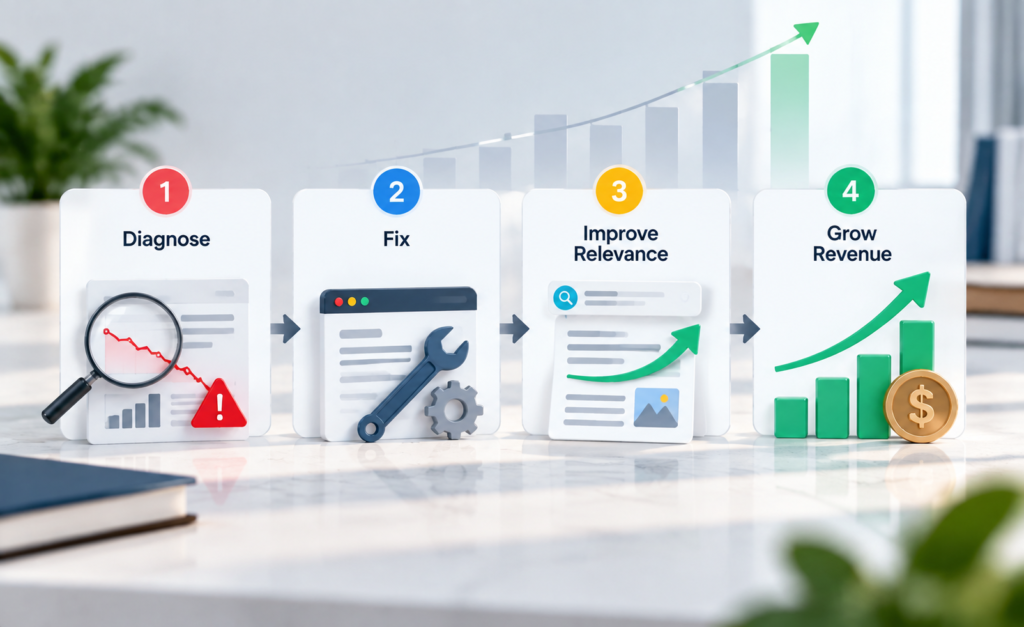
The conversion rate optimisation work was deliberately modest: clearer filter labels, persistent access to key product attributes, earlier delivery messaging and improved product-card information. These changes were prioritised because they reduced decision friction without requiring a full redesign.
By day 90, non-brand clicks to the priority category set were up 24% from the post-decline low. Organic revenue from those pages increased 29%, while mobile conversion rate improved by 11%. Total organic traffic had not fully returned to its previous peak, but commercially valuable traffic was recovering faster than informational traffic.
That is the point many recovery reports miss. A return to historic sessions is not automatically a win if the traffic mix is weaker. Measurable success comes from restored demand capture and improved efficiency, not a flattering chart.
What made the recovery work
The strongest decision was refusing to treat the decline as one issue. Search performance is a system: crawlability, indexation, information architecture, page relevance, user experience, demand shifts and measurement all affect the outcome.
The second was prioritisation. A site with thousands of URLs can generate hundreds of recommendations. Most will not move revenue. The useful question is: which fix has the clearest path to improving qualified acquisition or conversion on pages that matter commercially? That principle should sit inside the broader digital marketing strategy rather than being treated as a separate SEO exercise.
The third was patience with evidence. Search engines need time to recrawl and reassess material changes. A business should not reverse sound work after a few days of noise. Equally, patience is not passivity. If pages remain unindexed, redirects fail or conversion collapses, those are operational problems that need immediate attention.
A practical recovery framework for Australian teams
Start by defining the loss in commercial terms. Compare organic revenue, leads or margin contribution before looking at sessions. Then segment the decline by brand versus non-brand queries, landing-page type, device, location and product category. For businesses assessing external support, the same diagnostic approach should shape how they evaluate an SEO agency in Australia.
Next, map changes against the timeline. Platform migrations, template releases, navigation changes, stock availability, pricing shifts, tracking updates and seasonality can all affect performance. Google Search Console is essential for distinguishing a visibility problem from an analytics problem, while crawl data exposes whether priority pages are being discovered and linked properly.
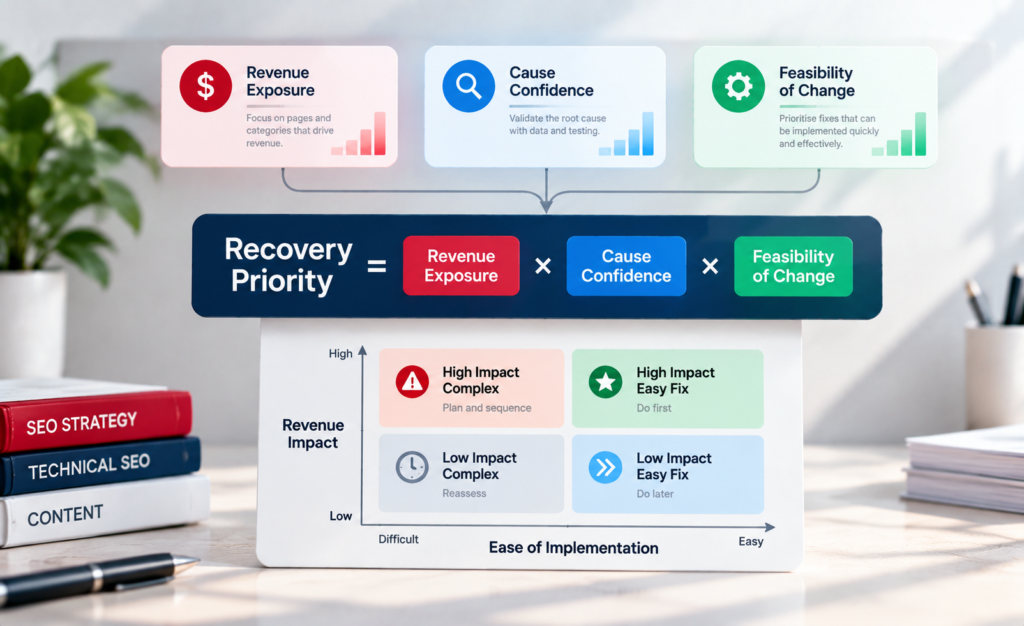
Then prioritise fixes using a simple formula:
Recovery priority = revenue exposure × confidence in cause × feasibility of change
A technically urgent issue affecting a high-revenue category should outrank a speculative content opportunity on a low-value blog post. This sounds obvious, but it is where many recovery plans lose momentum.
Finally, report the recovery in cohorts. Track the affected page set separately from the entire website. That makes it easier to see whether the intervention worked, whether demand has shifted or whether another issue is masking progress.
The hard truth about SEO recoveries
Not every decline should be “recovered”. Some traffic disappears because demand changes, competitors improve, products go out of stock or search results become more crowded with shopping features, video and AI-generated summaries. The objective is not to recreate a historical graph at any cost. It is to build a search programme that captures the most valuable available demand and turns that demand into revenue.
For founders and marketing leaders, the practical lesson is simple: do not ask for more SEO activity. Ask for a defensible diagnosis, a prioritised plan and a measurement model that ties work to commercial outcomes. When those three elements are in place, an SEO recovery becomes less like damage control and more like building a stronger acquisition system.